Home >
Community >
Determine reaction rate constant from the reaction time?
Upvote
28
Downvote
+ Kinetics
Posted by
LaToya Boggans
Determine reaction rate constant from the reaction time?
Assuming the reaction is a one step reaction, and does not have any elementary reactions, this could potentially work. However, if there are elementary reactions, this would change the rate law, and it would not be Rate = k[KIO3][NaHSO3].
You would also need to know the reaction order for both the potassium iodate and the sodium bisulfate, as well as the coefficients for both in the original reactions, yes you would be able to do this.
Knowing the coefficients, you could figure out the rate using rate -dA/adT. You could plug this rate into the rate law, Rate = k[KIO3]^m[NaHSO3]^n. However, you would need to know the reaction orders for KIO3 and NaHSO3, to plug in for m and n, and these can only be determined experimentally. If you know these, however, this equation would work for you.
Assuming the reaction is a one step reaction, and does not have any elementary reactions, this could potentially work. However, if there are elementary reactions, this would change the rate law, and it would not be Rate = k[KIO3][NaHSO3]. You would also need to know the reaction order for both the potassium iodate and the sodium bisulfate, as well as the coefficients for both in the original reactions, yes you would be able to do this. Knowing the coefficients, you could figure out the rate using rate -dA/adT. You could plug this rate into the rate law, Rate = k[KIO3]^m[NaHSO3]^n. However, you would need to know the reaction orders for KIO3 and NaHSO3, to plug in for m and n, and these can only be determined experimentally. If you know these, however, this equation would work for you.
Thank you very much. I have finished collecting data for the reaction and will analyze it this weekend to try and determine the reaction orders for KIO3 and NAHSO3.More


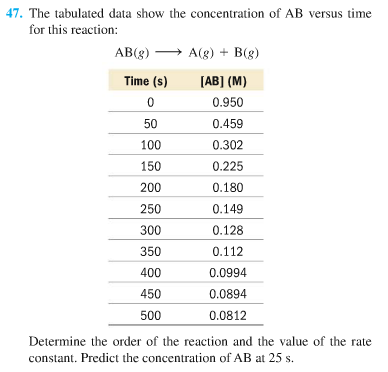
Assuming the reaction is a one step reaction, and does not have any elementary reactions, this could potentially work. However, if there are elementary reactions, this would change the rate law, and it would not be Rate = k[KIO3][NaHSO3]. You would also need to know the reaction order for both the potassium iodate and the sodium bisulfate, as well as the coefficients for both in the original reactions, yes you would be able to do this. Knowing the coefficients, you could figure out the rate using rate -dA/adT. You could plug this rate into the rate law, Rate = k[KIO3]^m[NaHSO3]^n. However, you would need to know the reaction orders for KIO3 and NaHSO3, to plug in for m and n, and these can only be determined experimentally. If you know these, however, this equation would work for you.
Assuming the reaction is a one step reaction, and does not have any elementary reactions, this could potentially work. However, if there are elementary reactions, this would change the rate law, and it would not be Rate = k[KIO3][NaHSO3]. You would also need to know the reaction order for both the potassium iodate and the sodium bisulfate, as well as the coefficients for both in the original reactions, yes you would be able to do this. Knowing the coefficients, you could figure out the rate using rate -dA/adT. You could plug this rate into the rate law, Rate = k[KIO3]^m[NaHSO3]^n. However, you would need to know the reaction orders for KIO3 and NaHSO3, to plug in for m and n, and these can only be determined experimentally. If you know these, however, this equation would work for you.
More
VOTE
VOTE