26
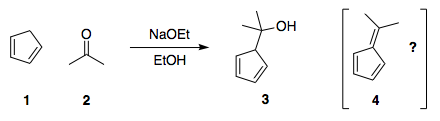
When cyclopentadiene 1 and acetone 2 are reacted with sodium ethoxide in ethanol, what product is obtained? I was told that the correct product 3 is formed by nucleophilic addition of cyclopentadienyl anion to the carbonyl group.
However, when I thought about it more, I wondered why an E1cB reaction to form the dimethyl fulvene 4 isn't possible in this case. I believe it should be possible because the aromaticity of the cyclopentadienyl carbanion allows the rate-determining deprotonation of 3 to proceed under strongly basic conditions.
On the other hand, there would be more ring strain in the more unsaturated compound 4.
How do I decide if E1cB is possible or not here?
2026-10-29