Home >
Community >
Photochemical rearrangement of 4,4‐diphenylcyclohexa‐2,5‐dien‐1‐one
Upvote
17
Downvote
+ Rearrangements
+ Chemistry
Posted by
Mark Barton
Photochemical rearrangement of 4,4‐diphenylcyclohexa‐2,5‐dien‐1‐one
The above answer is totally Correct but for your information, if light was not there then there would have been a RETRO PINACOLE-PINNACOLON REARRANGEMENT.
The above answer is totally Correct but for your information, if light was not there then there would have been a RETRO PINACOLE-PINNACOLON REARRANGEMENT.
The formation of structure 6 (your D) occurs as follows. Photolysis of dienone 1 affords excited state 2 that forms cyclopropane 3. In turn, 3 is capable of breaking a different cyclopropane bond to form 5-membered ring 4. Structure 5 is a resonance structure of 4. Structure 5 closes to the [3.1.0] product 6 (your D). I don't know how you formed A (12 here) but further photolysis of 6 can form 12 via a bridged phenyl migration as shown in structure 9. A similar migration in structure 2 leads to your B. Of course, structure C has only five carbons and was added to the choices as a trap. See reference 1 for an example of a dienone phenol rearrangement.
The formation of structure 6 (your D) occurs as follows. Photolysis of dienone 1 affords excited state 2 that forms cyclopropane 3. In turn, 3 is capable of breaking a different cyclopropane bond to form 5-membered ring 4. Structure 5 is a resonance structure of 4. Structure 5 closes to the [3.1.0] product 6 (your D). I don't know how you formed A (12 here) but further photolysis of 6 can form 12 via a bridged phenyl migration as shown in structure 9. A similar migration in structure 2 leads to your B. Of course, structure C has only five carbons and was added to the choices as a trap. See reference 1 for an example of a dienone phenol rearrangement.



The above answer is totally Correct but for your information, if light was not there then there would have been a RETRO PINACOLE-PINNACOLON REARRANGEMENT.
The above answer is totally Correct but for your information, if light was not there then there would have been a RETRO PINACOLE-PINNACOLON REARRANGEMENT.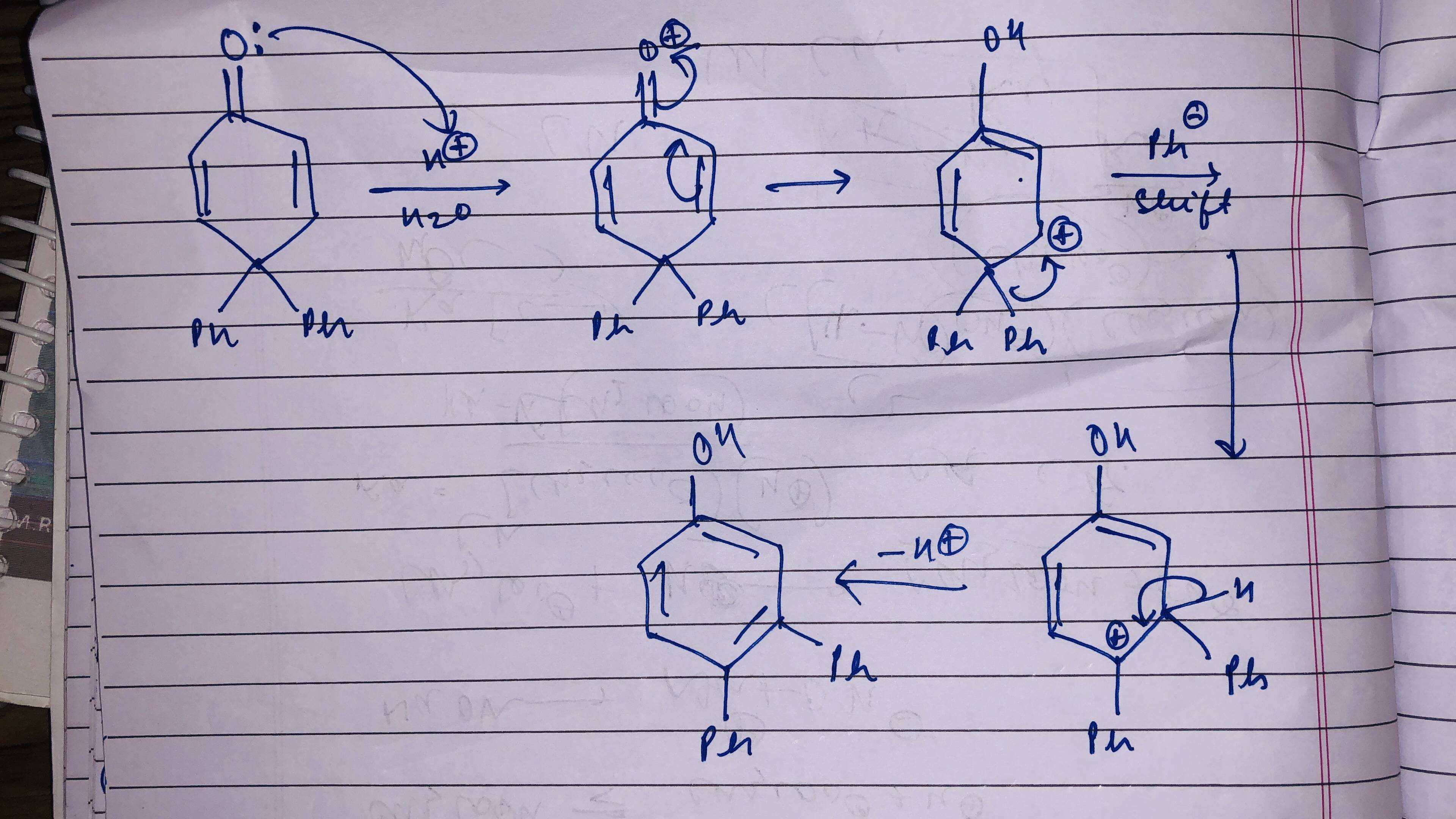
More
VOTE
The formation of structure 6 (your D) occurs as follows. Photolysis of dienone 1 affords excited state 2 that forms cyclopropane 3. In turn, 3 is capable of breaking a different cyclopropane bond to form 5-membered ring 4. Structure 5 is a resonance structure of 4. Structure 5 closes to the [3.1.0] product 6 (your D). I don't know how you formed A (12 here) but further photolysis of 6 can form 12 via a bridged phenyl migration as shown in structure 9. A similar migration in structure 2 leads to your B. Of course, structure C has only five carbons and was added to the choices as a trap. See reference 1 for an example of a dienone phenol rearrangement.

1) A. G. Schultz and S. A. Hardinger, J. Org. Chem., 1991, 56, 1105.
The formation of structure 6 (your D) occurs as follows. Photolysis of dienone 1 affords excited state 2 that forms cyclopropane 3. In turn, 3 is capable of breaking a different cyclopropane bond to form 5-membered ring 4. Structure 5 is a resonance structure of 4. Structure 5 closes to the [3.1.0] product 6 (your D). I don't know how you formed A (12 here) but further photolysis of 6 can form 12 via a bridged phenyl migration as shown in structure 9. A similar migration in structure 2 leads to your B. Of course, structure C has only five carbons and was added to the choices as a trap. See reference 1 for an example of a dienone phenol rearrangement.

1) A. G. Schultz and S. A. Hardinger, J. Org. Chem., 1991, 56, 1105.
More
VOTE