Home >
Community >
What is the hybridisation of trifluoromethyl free radical?
Upvote
25
Downvote
+ Radicals
+ Hybridization
Posted by
Leslie Coduti
What is the hybridisation of trifluoromethyl free radical?
Hyperconjugation between the orbital that contains the lone pair and the $\ce{C-F}$ antibonding orbital contributes to the pyramidalization of $\ce{CF3^·}$ radical:
In the planar geometry the orbitals are perpendicular and no overlap occurs.
References
Carey, F. A.; Sundberg, R. J. Advanced Organic Chemistry, Part A: Structure and Mechanisms, 5th edition.; Springer: New York, 2008. ISBN 978-0-387-68346-1.
Hyperconjugation between the orbital that contains the lone pair and the $\ce{C-F}$ antibonding orbital contributes to the pyramidalization of $\ce{CF3^·}$ radical:
In the planar geometry the orbitals are perpendicular and no overlap occurs.
References
Carey, F. A.; Sundberg, R. J. Advanced Organic Chemistry, Part A: Structure and Mechanisms, 5th edition.; Springer: New York, 2008. ISBN 978-0-387-68346-1.
This is a very popular, albeit very organic chemistry, view on that matter. The explanation in terms of Bents rule might be much easier. Also that hand-wavy argument repulses more cannot be proven, and is likely as wrong as spd hybridisation in hypercoordinate molecules. The second part is actually quite nice thoughMore


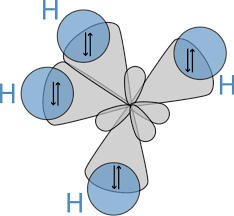


Hyperconjugation between the orbital that contains the lone pair and the $\ce{C-F}$ antibonding orbital contributes to the pyramidalization of $\ce{CF3^·}$ radical:
In the planar geometry the orbitals are perpendicular and no overlap occurs.
References
Hyperconjugation between the orbital that contains the lone pair and the $\ce{C-F}$ antibonding orbital contributes to the pyramidalization of $\ce{CF3^·}$ radical:
In the planar geometry the orbitals are perpendicular and no overlap occurs.
References
More
VOTE
VOTE