Home >
Community >
What test can be used to differ amide and amine?
Upvote
21
Downvote
+ Amines
Posted by
Marcio Da Silva
What test can be used to differ amide and amine?
Easiest way is to use TLC(thin layer chromatography) plate and stain with ninhydrin. Ninhydrin colors primary and secondary amines and amides only with vigorous heating when amide bond breaks.
Easiest way is to use TLC(thin layer chromatography) plate and stain with ninhydrin. Ninhydrin colors primary and secondary amines and amides only with vigorous heating when amide bond breaks.
While the conjugate acid of an amine has a pKa of about 9.5, the conjugate acid of an amide has a pKa around −0.5. Therefore, amides don't have as clearly noticeable acid-base properties in water.
Therefore, if you are dealing trying to distinguish a water-soluble amide from a water-soluble amine, and neither molecule has other functional groups, you could simply dissolve them in water and then measure the pH. If it's alkaline, it's an amine. If the pH doesn't change much, it's an amide.
While the conjugate acid of an amine has a pKa of about 9.5, the conjugate acid of an amide has a pKa around −0.5. Therefore, amides don't have as clearly noticeable acid-base properties in water.
Therefore, if you are dealing trying to distinguish a water-soluble amide from a water-soluble amine, and neither molecule has other functional groups, you could simply dissolve them in water and then measure the pH. If it's alkaline, it's an amine. If the pH doesn't change much, it's an amide.
I do not know how to distinguish chemically between an amide and an amine based on the reaction with $\ce{NaOH}$ but I can tell you a different way to distinguish between the two kinds of compounds.
An amide on acidic hydrolysis will yield the corresponding carboxylic acid (i.e. with the same number of carbons) as follows. $$\ce{RCONH2->[\ce{H3O+}][\Delta] RCOOH}$$
The carboxylic acid produced can be tested for using the sodium hydrogencarbonate test, in which adding a pinch of $\ce{NaHCO3}$ produces a brisk effervescence due to the evolution of carbon dioxide gas.
$$\ce{RCOOH + NaHCO3->RCOONa + H2O + CO2 ^}$$
So basically, out of the two given compounds, the one that gives you a brisk effervescence when you first hydrolyse it in an acidic medium and then follow it with a pinch of $\ce{NaHCO3}$, is the amide, and the other is the amine.
I do not know how to distinguish chemically between an amide and an amine based on the reaction with $\ce{NaOH}$ but I can tell you a different way to distinguish between the two kinds of compounds.
An amide on acidic hydrolysis will yield the corresponding carboxylic acid (i.e. with the same number of carbons) as follows. $$\ce{RCONH2->[\ce{H3O+}][\Delta] RCOOH}$$
The carboxylic acid produced can be tested for using the sodium hydrogencarbonate test, in which adding a pinch of $\ce{NaHCO3}$ produces a brisk effervescence due to the evolution of carbon dioxide gas.
$$\ce{RCOOH + NaHCO3->RCOONa + H2O + CO2 ^}$$
So basically, out of the two given compounds, the one that gives you a brisk effervescence when you first hydrolyse it in an acidic medium and then follow it with a pinch of $\ce{NaHCO3}$, is the amide, and the other is the amine.


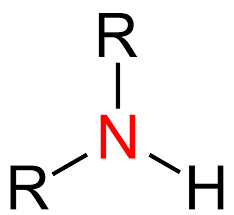


Easiest way is to use TLC(thin layer chromatography) plate and stain with ninhydrin. Ninhydrin colors primary and secondary amines and amides only with vigorous heating when amide bond breaks.
Easiest way is to use TLC(thin layer chromatography) plate and stain with ninhydrin. Ninhydrin colors primary and secondary amines and amides only with vigorous heating when amide bond breaks.
More
VOTE
From Wikipedia:
Therefore, if you are dealing trying to distinguish a water-soluble amide from a water-soluble amine, and neither molecule has other functional groups, you could simply dissolve them in water and then measure the pH. If it's alkaline, it's an amine. If the pH doesn't change much, it's an amide.
From Wikipedia:
Therefore, if you are dealing trying to distinguish a water-soluble amide from a water-soluble amine, and neither molecule has other functional groups, you could simply dissolve them in water and then measure the pH. If it's alkaline, it's an amine. If the pH doesn't change much, it's an amide.
More
VOTE
I do not know how to distinguish chemically between an amide and an amine based on the reaction with $\ce{NaOH}$ but I can tell you a different way to distinguish between the two kinds of compounds.
An amide on acidic hydrolysis will yield the corresponding carboxylic acid (i.e. with the same number of carbons) as follows. $$\ce{RCONH2->[\ce{H3O+}][\Delta] RCOOH}$$
The carboxylic acid produced can be tested for using the sodium hydrogencarbonate test, in which adding a pinch of $\ce{NaHCO3}$ produces a brisk effervescence due to the evolution of carbon dioxide gas.
$$\ce{RCOOH + NaHCO3->RCOONa + H2O + CO2 ^}$$
So basically, out of the two given compounds, the one that gives you a brisk effervescence when you first hydrolyse it in an acidic medium and then follow it with a pinch of $\ce{NaHCO3}$, is the amide, and the other is the amine.
I do not know how to distinguish chemically between an amide and an amine based on the reaction with $\ce{NaOH}$ but I can tell you a different way to distinguish between the two kinds of compounds.
An amide on acidic hydrolysis will yield the corresponding carboxylic acid (i.e. with the same number of carbons) as follows. $$\ce{RCONH2->[\ce{H3O+}][\Delta] RCOOH}$$
The carboxylic acid produced can be tested for using the sodium hydrogencarbonate test, in which adding a pinch of $\ce{NaHCO3}$ produces a brisk effervescence due to the evolution of carbon dioxide gas.
$$\ce{RCOOH + NaHCO3->RCOONa + H2O + CO2 ^}$$
So basically, out of the two given compounds, the one that gives you a brisk effervescence when you first hydrolyse it in an acidic medium and then follow it with a pinch of $\ce{NaHCO3}$, is the amide, and the other is the amine.
More
VOTE
VOTE
VOTE
VOTE
VOTE