Home >
Community >
Why are there peaks in electronegativities in d-block elements?
Upvote
28
Downvote
+ Electronegativity
Posted by
Adrian Wiechoczek
Why are there peaks in electronegativities in d-block elements?
The peaks in electronegativity for elements may be named as groups as next:
V Cr Mn has a peak and then Mn drops down. Iron is the key as shown next.
Zr Nb Mo has a peak and then a a plateau. Zirconium is the key as shown next.
My research is displayed :
Periodic Table of Elements : Shape of Each Nucleus affecting electronegativity
http://pyramidalcube.blogspot.com/2017/08/periodic-table-of-shapes-of-nuclei.html
The shape of the nucleus affects the properties of the element. Notice how
Manganese is the last in a series from the carbon core cube-2, then iron starts the cube-3 shape. That transition across the Table causes the abrupt change in electronegativity.
Alan Folmsbee
The peaks in electronegativity for elements may be named as groups as next:
V Cr Mn has a peak and then Mn drops down. Iron is the key as shown next.Zr Nb Mo has a peak and then a a plateau. Zirconium is the key as shown next.My research is displayed : Periodic Table of Elements : Shape of Each Nucleus affecting electronegativity
http://pyramidalcube.blogspot.com/2017/08/periodic-table-of-shapes-of-nuclei.htmlThe shape of the nucleus affects the properties of the element. Notice howManganese is the last in a series from the carbon core cube-2, then iron starts the cube-3 shape. That transition across the Table causes the abrupt change in electronegativity.Alan Folmsbee
and also Barium has a shape like in the Table More
Upvote
VOTE
Downvote
more replies
You should know that closeness to filling a shell and atomic size are the reasons for the overall electronegativity trend. This also applies to the subshells, how close is an element to filling, or half-filling, a subshell? How large is the atom?
The atomic size trend for the d subshell is opposite to that of the overall trend. In period 4 the 3d subshell is deep in the core orbitals and the electron density is high, whereas in the lower periods the d orbital is more diffuse and can more easily accommodate more electrons, leading to a better energy payoff for completing the subshell. For the elements that take s electrons to fill the d subshell, this energy payoff is even greater from then filling the s subshell as they are very diffuse.
You should know that closeness to filling a shell and atomic size are the reasons for the overall electronegativity trend. This also applies to the subshells, how close is an element to filling, or half-filling, a subshell? How large is the atom?
The atomic size trend for the d subshell is opposite to that of the overall trend. In period 4 the 3d subshell is deep in the core orbitals and the electron density is high, whereas in the lower periods the d orbital is more diffuse and can more easily accommodate more electrons, leading to a better energy payoff for completing the subshell. For the elements that take s electrons to fill the d subshell, this energy payoff is even greater from then filling the s subshell as they are very diffuse.



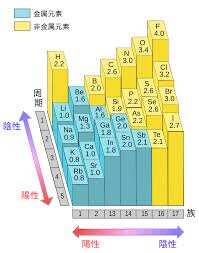

The peaks in electronegativity for elements may be named as groups as next:
V Cr Mn has a peak and then Mn drops down. Iron is the key as shown next. Zr Nb Mo has a peak and then a a plateau. Zirconium is the key as shown next. My research is displayed : Periodic Table of Elements : Shape of Each Nucleus affecting electronegativity
The peaks in electronegativity for elements may be named as groups as next:
V Cr Mn has a peak and then Mn drops down. Iron is the key as shown next.Zr Nb Mo has a peak and then a a plateau. Zirconium is the key as shown next.My research is displayed : Periodic Table of Elements : Shape of Each Nucleus affecting electronegativity
More
VOTE
VOTE
VOTE
VOTE
VOTE
VOTE
You should know that closeness to filling a shell and atomic size are the reasons for the overall electronegativity trend. This also applies to the subshells, how close is an element to filling, or half-filling, a subshell? How large is the atom?
The atomic size trend for the d subshell is opposite to that of the overall trend. In period 4 the 3d subshell is deep in the core orbitals and the electron density is high, whereas in the lower periods the d orbital is more diffuse and can more easily accommodate more electrons, leading to a better energy payoff for completing the subshell. For the elements that take s electrons to fill the d subshell, this energy payoff is even greater from then filling the s subshell as they are very diffuse.
You should know that closeness to filling a shell and atomic size are the reasons for the overall electronegativity trend. This also applies to the subshells, how close is an element to filling, or half-filling, a subshell? How large is the atom?
The atomic size trend for the d subshell is opposite to that of the overall trend. In period 4 the 3d subshell is deep in the core orbitals and the electron density is high, whereas in the lower periods the d orbital is more diffuse and can more easily accommodate more electrons, leading to a better energy payoff for completing the subshell. For the elements that take s electrons to fill the d subshell, this energy payoff is even greater from then filling the s subshell as they are very diffuse.
More
VOTE