Home >
Community >
Why does fluorine stabilise a carbocation? [duplicate]
Upvote
22
Downvote
+ Resonance
+ Carbocation
Posted by
K.L.
Why does fluorine stabilise a carbocation? [duplicate]
Most of the times the question that comes in the examinations is that why CH2F+ is more stable than CH2Br+ or CH2I+.
The reason behind it is that the p orbital of fluorine overlaps more effectively than that of Br or I with the carbon atom and therefore disperses the charge on it.
refer to K L Chugh for the details.
Most of the times the question that comes in the examinations is that why CH2F+ is more stable than CH2Br+ or CH2I+.The reason behind it is that the p orbital of fluorine overlaps more effectively than that of Br or I with the carbon atom and therefore disperses the charge on it.refer to K L Chugh for the details.
Fluorine belongs to the same period as carbon. Carbocation is electron deficient which has its two $\mathrm{2p}$ orbitals vacant. One electron of carbon in $\mathrm{2p}$ orbital goes into the formation of $\ce{C-F}$ σ bond. $\ce{F}$ has $\mathrm{2p}$ orbital containing a lone pair which can be donated to the $\mathrm{2p}$ vacant orbitals of carbocation. Same size $\mathrm{2p}$ orbitals of carbon and fluorine overlap effectively to form a π bond.
Fluorine belongs to the same period as carbon. Carbocation is electron deficient which has its two $\mathrm{2p}$ orbitals vacant. One electron of carbon in $\mathrm{2p}$ orbital goes into the formation of $\ce{C-F}$ σ bond. $\ce{F}$ has $\mathrm{2p}$ orbital containing a lone pair which can be donated to the $\mathrm{2p}$ vacant orbitals of carbocation. Same size $\mathrm{2p}$ orbitals of carbon and fluorine overlap effectively to form a π bond.
Carbocations are stabilized by neighboring atoms with lone pairs. The key stabilizing influence is that the neighboring atom can donate a pair of electrons to the electron-poor carbocation. In this way halogenes, nitrogen or oxygen can actually be an electron-donor group and stabilize the carbocation.
Carbocations are stabilized by neighboring atoms with lone pairs. The key stabilizing influence is that the neighboring atom can donate a pair of electrons to the electron-poor carbocation. In this way halogenes, nitrogen or oxygen can actually be an electron-donor group and stabilize the carbocation.
This is stated in the question. The actual question is about why the inductive effect does not dominate the mesomeric effect in carbocations, whereas it usually does for fluorine.More




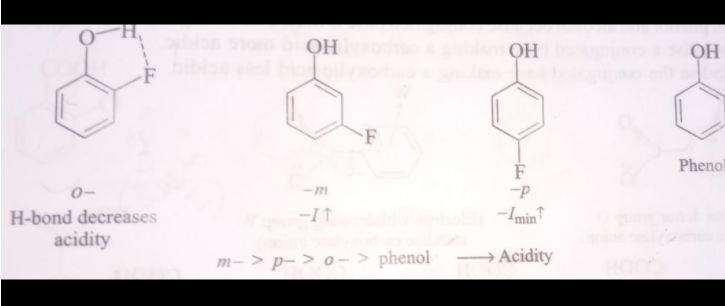


Most of the times the question that comes in the examinations is that why CH2F+ is more stable than CH2Br+ or CH2I+. The reason behind it is that the p orbital of fluorine overlaps more effectively than that of Br or I with the carbon atom and therefore disperses the charge on it. refer to K L Chugh for the details.
Most of the times the question that comes in the examinations is that why CH2F+ is more stable than CH2Br+ or CH2I+.The reason behind it is that the p orbital of fluorine overlaps more effectively than that of Br or I with the carbon atom and therefore disperses the charge on it.refer to K L Chugh for the details.
More
VOTE
Fluorine belongs to the same period as carbon. Carbocation is electron deficient which has its two $\mathrm{2p}$ orbitals vacant. One electron of carbon in $\mathrm{2p}$ orbital goes into the formation of $\ce{C-F}$ σ bond. $\ce{F}$ has $\mathrm{2p}$ orbital containing a lone pair which can be donated to the $\mathrm{2p}$ vacant orbitals of carbocation. Same size $\mathrm{2p}$ orbitals of carbon and fluorine overlap effectively to form a π bond.
Fluorine belongs to the same period as carbon. Carbocation is electron deficient which has its two $\mathrm{2p}$ orbitals vacant. One electron of carbon in $\mathrm{2p}$ orbital goes into the formation of $\ce{C-F}$ σ bond. $\ce{F}$ has $\mathrm{2p}$ orbital containing a lone pair which can be donated to the $\mathrm{2p}$ vacant orbitals of carbocation. Same size $\mathrm{2p}$ orbitals of carbon and fluorine overlap effectively to form a π bond.
More
VOTE
Carbocations are stabilized by neighboring atoms with lone pairs. The key stabilizing influence is that the neighboring atom can donate a pair of electrons to the electron-poor carbocation. In this way halogenes, nitrogen or oxygen can actually be an electron-donor group and stabilize the carbocation.
Carbocations are stabilized by neighboring atoms with lone pairs. The key stabilizing influence is that the neighboring atom can donate a pair of electrons to the electron-poor carbocation. In this way halogenes, nitrogen or oxygen can actually be an electron-donor group and stabilize the carbocation.
More
VOTE
VOTE