Home >
Community >
Why does the phosphorus trifluoride molecule have dipole moment?
Upvote
26
Downvote
+ Polarity
+ Dipole
Posted by
Mineta Harlow
Why does the phosphorus trifluoride molecule have dipole moment?
Fluorine is more electronegative than phosphorus.
The phosphorus is at the apex of a pyramid, the base of the pyramid being an equilateral triangle with a fluorine atom at each vertex.
The F-P-F angles are 96 degrees.
Each F-P bond contributes to the net dipole moment, as a vector from the P to the F. The net dipole moment is the vector sum of the vectors along the three P-F bonds.
If all four atoms were in a plane (a trigonal planar geometry), there would be no net dipole moment. But because the geometry is pyramidal, the vector sum is not zero and there is a net dipole moment.
In some molecules lone pairs also contribute to the net dipole moment, in this particular case the lone pair of phosphorus is in a mostly s-like orbital, so in first approximation it can be neglected.
The phosphorus is at the apex of a pyramid, the base of the pyramid being an equilateral triangle with a fluorine atom at each vertex.The F-P-F angles are 96 degrees.
Each F-P bond contributes to the net dipole moment, as a vector from the P to the F. The net dipole moment is the vector sum of the vectors along the three P-F bonds.
If all four atoms were in a plane (a trigonal planar geometry), there would be no net dipole moment. But because the geometry is pyramidal, the vector sum is not zero and there is a net dipole moment.
In some molecules lone pairs also contribute to the net dipole moment, in this particular case the lone pair of phosphorus is in a mostly s-like orbital, so in first approximation it can be neglected.



Fluorine is more electronegative than phosphorus.
The phosphorus is at the apex of a pyramid, the base of the pyramid being an equilateral triangle with a fluorine atom at each vertex. The F-P-F angles are 96 degrees.
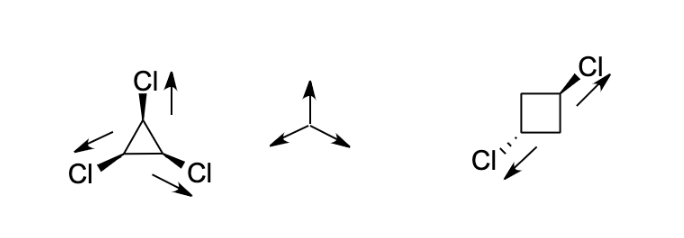
Each F-P bond contributes to the net dipole moment, as a vector from the P to the F. The net dipole moment is the vector sum of the vectors along the three P-F bonds.
If all four atoms were in a plane (a trigonal planar geometry), there would be no net dipole moment. But because the geometry is pyramidal, the vector sum is not zero and there is a net dipole moment.
In some molecules lone pairs also contribute to the net dipole moment, in this particular case the lone pair of phosphorus is in a mostly s-like orbital, so in first approximation it can be neglected.
Fluorine is more electronegative than phosphorus.
The phosphorus is at the apex of a pyramid, the base of the pyramid being an equilateral triangle with a fluorine atom at each vertex.The F-P-F angles are 96 degrees.
Each F-P bond contributes to the net dipole moment, as a vector from the P to the F. The net dipole moment is the vector sum of the vectors along the three P-F bonds.
If all four atoms were in a plane (a trigonal planar geometry), there would be no net dipole moment. But because the geometry is pyramidal, the vector sum is not zero and there is a net dipole moment.
In some molecules lone pairs also contribute to the net dipole moment, in this particular case the lone pair of phosphorus is in a mostly s-like orbital, so in first approximation it can be neglected.
More
VOTE