Home >
Community >
Why does the solubility of some salts decrease with temperature?
Upvote
26
Downvote
+ Solubility
Posted by
Laurie Keller
Why does the solubility of some salts decrease with temperature?
A saturated solution is at equilibrium (rate of dissolution is equal to rate of crystallization) with some equilibrium constant $K_1$. If you change the temperature of the system at equilibrium, you will observe a different equilibrium constant $K_2$. Whether the equilibrium constant increase or decreases is described by the Van't Hoff equation:
$$\ln \left(\frac{K_2}{K_1}\right) = \frac{-\Delta H}{R}\left(\frac{1}{T_2}-\frac{1}{T_1}\right)$$
So it depends on the sign of the enthalpy of reaction, in this case the enthalpy of dissolution.
It is well known to us that the Solubility of solute in a solution increases with the increase in the temperature because, when the temperature increases the molecules of the solvent gain more kinetic energy.
The statement about solubility is not always true, and the explanation leaves out something. A lot of things change when you increase the temperature. The solvent gains kinetic energy, the solute gains kinetic energy, and the solid gains kinetic energy. How this influences the solubility depends on the specific system, and is hard to predict.
However, there a few salts like cerium sulphate , lithium carbonate sodium carbonate monohydrate, etc. whose solubility decreases with the increase in temperature. How it is so ?
Now that we introduced the Van't Hoff equation, we know it must have to do with the enthalpy of dissolution. Usually, you expect the interactions in the solid that need to be broken to be stronger than the gains from solvating the solute. In these cases, it is apparently the opposite.
A saturated solution is at equilibrium (rate of dissolution is equal to rate of crystallization) with some equilibrium constant $K_1$. If you change the temperature of the system at equilibrium, you will observe a different equilibrium constant $K_2$. Whether the equilibrium constant increase or decreases is described by the Van't Hoff equation:$$\ln \left(\frac{K_2}{K_1}\right) = \frac{-\Delta H}{R}\left(\frac{1}{T_2}-\frac{1}{T_1}\right)$$
So it depends on the sign of the enthalpy of reaction, in this case the enthalpy of dissolution.
It is well known to us that the Solubility of solute in a solution increases with the increase in the temperature because, when the temperature increases the molecules of the solvent gain more kinetic energy.
The statement about solubility is not always true, and the explanation leaves out something. A lot of things change when you increase the temperature. The solvent gains kinetic energy, the solute gains kinetic energy, and the solid gains kinetic energy. How this influences the solubility depends on the specific system, and is hard to predict.
However, there a few salts like cerium sulphate , lithium carbonate sodium carbonate monohydrate, etc. whose solubility decreases with the increase in temperature. How it is so ?
Now that we introduced the Van't Hoff equation, we know it must have to do with the enthalpy of dissolution. Usually, you expect the interactions in the solid that need to be broken to be stronger than the gains from solvating the solute. In these cases, it is apparently the opposite.
@KarstenTheis enthalpy of dissolution for both, lithium carbonate and sodium hydroxide, is negative. But solubility of former decreases and that for later increases upon increasing of temperature.More
Note that you can use "stretchy parentheses" with More
Upvote
VOTE
Downvote
more replies
What you refer to, the decreased in a solid's solubility in a liquid with increased temperature, is frequently called retrograde or inverse solubility, and occurs when the dissolution of the solute is exothermic.
The explanation for this can be viewed as a manifestation of Le Chatelier's principle. Essentially, since evolved heat can be viewed as a product of an exothermic reaction, the addition of more heat (e.g. a higher temperature) is equivalent to adding a product to the product side of the chemical equation for dissolution, driving the equilibrium back toward the reactants, in this case toward the undissolved compound.
Take the exothermic dissolution of calcium sulfate in water for example:
In this case, the solubility decreases with increasing temperature because by increasing the temperature you are adding heat to the product side. Inversely, if you pull heat from this system, e.g. cool it, you drive the equilibrium toward the products side and solubility is increased.
What you refer to, the decreased in a solid's solubility in a liquid with increased temperature, is frequently called retrograde or inverse solubility, and occurs when the dissolution of the solute is exothermic.
The explanation for this can be viewed as a manifestation of Le Chatelier's principle. Essentially, since evolved heat can be viewed as a product of an exothermic reaction, the addition of more heat (e.g. a higher temperature) is equivalent to adding a product to the product side of the chemical equation for dissolution, driving the equilibrium back toward the reactants, in this case toward the undissolved compound.
Take the exothermic dissolution of calcium sulfate in water for example:
In this case, the solubility decreases with increasing temperature because by increasing the temperature you are adding heat to the product side. Inversely, if you pull heat from this system, e.g. cool it, you drive the equilibrium toward the products side and solubility is increased.
The solvation of species with high charge density forces water molecules in their vicinity to adopt a more strict subset of conformations, which is entropically less favourable. Both the anion and cation in $\ce{CaSO4}$ are divalent, and thus may fall in this category. Meanwhile, $\ce{NaOH}$ contains only monovalent species and thus restricts the conformation of solvating water molecules less (though I am sure that the hydroxide ion in water is special due its Grotthuss-type mobility, which likely results in a particularly diffuse solvation shell and even less restricted conformations).More
More generally, the solubility is governed by Gibbs free energy, which has both enthalpic and entropic components. In the example in this answer, the enthalpic component is dominant. The entropy continues to dominate in the NaOH counter-example though.More
Ive heard this argument many times before, but I dont know if its very good. For example, sodium hydroxide dissolves very exothermically in water, but nevertheless its solubility increases very steeply with temperature (from 418 g/L at 0 °C to 3370 g/L at 100 °C according to Wikipedia). Rather than enthalpy of dissolution, in most cases it is presumably the More
Upvote
VOTE
Downvote
more replies
As others noted, the effect of temperature is governed completely by $\Delta H$ of dissolution. The reason that dissolution can have either positive or negative $\Delta H$ is because the favorability is determined by the Gibbs free energy $\Delta G = \Delta H - T \Delta S$. If the $\Delta S$ term is negative (before multiplication by -T) and $\Delta H$ is also negative, dissolution is favorable only if $|\Delta H|>|T\Delta S|$.
It is important to note also that the magnitude of $\Delta G^\circ$ does NOT correlate with the solubility, since the change in concentration per change in $\Delta G^\circ$ is not constant. That is why $\Delta S^\circ$ does not determine the effect of temperature.
This can be seen by noting that the important value is $K$. Since $\Delta G^\circ=-RT\ln K=\Delta H^\circ - T\Delta S^\circ$, we can rearrange and find that $\ln K = -\frac{\Delta H^\circ}{R}\left(\frac{1}{T}\right)+\frac{\Delta S^\circ}{R}$, so a plot of $\ln K$ vs $\frac{1}{T}$ (which is the temperature dependence of solubility) has a slope whose sign is determined only by $\Delta H^\circ$.
As others noted, the effect of temperature is governed completely by $\Delta H$ of dissolution. The reason that dissolution can have either positive or negative $\Delta H$ is because the favorability is determined by the Gibbs free energy $\Delta G = \Delta H - T \Delta S$. If the $\Delta S$ term is negative (before multiplication by -T) and $\Delta H$ is also negative, dissolution is favorable only if $|\Delta H|>|T\Delta S|$.
It is important to note also that the magnitude of $\Delta G^\circ$ does NOT correlate with the solubility, since the change in concentration per change in $\Delta G^\circ$ is not constant. That is why $\Delta S^\circ$ does not determine the effect of temperature.
This can be seen by noting that the important value is $K$. Since $\Delta G^\circ=-RT\ln K=\Delta H^\circ - T\Delta S^\circ$, we can rearrange and find that $\ln K = -\frac{\Delta H^\circ}{R}\left(\frac{1}{T}\right)+\frac{\Delta S^\circ}{R}$, so a plot of $\ln K$ vs $\frac{1}{T}$ (which is the temperature dependence of solubility) has a slope whose sign is determined only by $\Delta H^\circ$.


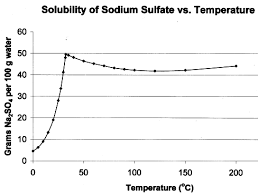
A saturated solution is at equilibrium (rate of dissolution is equal to rate of crystallization) with some equilibrium constant $K_1$. If you change the temperature of the system at equilibrium, you will observe a different equilibrium constant $K_2$. Whether the equilibrium constant increase or decreases is described by the Van't Hoff equation: $$\ln \left(\frac{K_2}{K_1}\right) = \frac{-\Delta H}{R}\left(\frac{1}{T_2}-\frac{1}{T_1}\right)$$
So it depends on the sign of the enthalpy of reaction, in this case the enthalpy of dissolution.
The statement about solubility is not always true, and the explanation leaves out something. A lot of things change when you increase the temperature. The solvent gains kinetic energy, the solute gains kinetic energy, and the solid gains kinetic energy. How this influences the solubility depends on the specific system, and is hard to predict.
Now that we introduced the Van't Hoff equation, we know it must have to do with the enthalpy of dissolution. Usually, you expect the interactions in the solid that need to be broken to be stronger than the gains from solvating the solute. In these cases, it is apparently the opposite.
A saturated solution is at equilibrium (rate of dissolution is equal to rate of crystallization) with some equilibrium constant $K_1$. If you change the temperature of the system at equilibrium, you will observe a different equilibrium constant $K_2$. Whether the equilibrium constant increase or decreases is described by the Van't Hoff equation:$$\ln \left(\frac{K_2}{K_1}\right) = \frac{-\Delta H}{R}\left(\frac{1}{T_2}-\frac{1}{T_1}\right)$$
So it depends on the sign of the enthalpy of reaction, in this case the enthalpy of dissolution.
The statement about solubility is not always true, and the explanation leaves out something. A lot of things change when you increase the temperature. The solvent gains kinetic energy, the solute gains kinetic energy, and the solid gains kinetic energy. How this influences the solubility depends on the specific system, and is hard to predict.
Now that we introduced the Van't Hoff equation, we know it must have to do with the enthalpy of dissolution. Usually, you expect the interactions in the solid that need to be broken to be stronger than the gains from solvating the solute. In these cases, it is apparently the opposite.
More
VOTE
VOTE
VOTE
VOTE
VOTE
VOTE
What you refer to, the decreased in a solid's solubility in a liquid with increased temperature, is frequently called retrograde or inverse solubility, and occurs when the dissolution of the solute is exothermic.
The explanation for this can be viewed as a manifestation of Le Chatelier's principle. Essentially, since evolved heat can be viewed as a product of an exothermic reaction, the addition of more heat (e.g. a higher temperature) is equivalent to adding a product to the product side of the chemical equation for dissolution, driving the equilibrium back toward the reactants, in this case toward the undissolved compound.
Take the exothermic dissolution of calcium sulfate in water for example:
$$\ce{CaSO4_{(s)} <--> Ca^{2+}_{(aq)} + SO4^{2-}_{(aq)} + heat}$$
In this case, the solubility decreases with increasing temperature because by increasing the temperature you are adding heat to the product side. Inversely, if you pull heat from this system, e.g. cool it, you drive the equilibrium toward the products side and solubility is increased.
What you refer to, the decreased in a solid's solubility in a liquid with increased temperature, is frequently called retrograde or inverse solubility, and occurs when the dissolution of the solute is exothermic.
The explanation for this can be viewed as a manifestation of Le Chatelier's principle. Essentially, since evolved heat can be viewed as a product of an exothermic reaction, the addition of more heat (e.g. a higher temperature) is equivalent to adding a product to the product side of the chemical equation for dissolution, driving the equilibrium back toward the reactants, in this case toward the undissolved compound.
Take the exothermic dissolution of calcium sulfate in water for example:
$$\ce{CaSO4_{(s)} <--> Ca^{2+}_{(aq)} + SO4^{2-}_{(aq)} + heat}$$
In this case, the solubility decreases with increasing temperature because by increasing the temperature you are adding heat to the product side. Inversely, if you pull heat from this system, e.g. cool it, you drive the equilibrium toward the products side and solubility is increased.
More
VOTE
VOTE
VOTE
VOTE
VOTE
VOTE
As others noted, the effect of temperature is governed completely by $\Delta H$ of dissolution. The reason that dissolution can have either positive or negative $\Delta H$ is because the favorability is determined by the Gibbs free energy $\Delta G = \Delta H - T \Delta S$. If the $\Delta S$ term is negative (before multiplication by -T) and $\Delta H$ is also negative, dissolution is favorable only if $|\Delta H|>|T\Delta S|$.
It is important to note also that the magnitude of $\Delta G^\circ$ does NOT correlate with the solubility, since the change in concentration per change in $\Delta G^\circ$ is not constant. That is why $\Delta S^\circ$ does not determine the effect of temperature.
This can be seen by noting that the important value is $K$. Since $\Delta G^\circ=-RT\ln K=\Delta H^\circ - T\Delta S^\circ$, we can rearrange and find that $\ln K = -\frac{\Delta H^\circ}{R}\left(\frac{1}{T}\right)+\frac{\Delta S^\circ}{R}$, so a plot of $\ln K$ vs $\frac{1}{T}$ (which is the temperature dependence of solubility) has a slope whose sign is determined only by $\Delta H^\circ$.
As others noted, the effect of temperature is governed completely by $\Delta H$ of dissolution. The reason that dissolution can have either positive or negative $\Delta H$ is because the favorability is determined by the Gibbs free energy $\Delta G = \Delta H - T \Delta S$. If the $\Delta S$ term is negative (before multiplication by -T) and $\Delta H$ is also negative, dissolution is favorable only if $|\Delta H|>|T\Delta S|$.
It is important to note also that the magnitude of $\Delta G^\circ$ does NOT correlate with the solubility, since the change in concentration per change in $\Delta G^\circ$ is not constant. That is why $\Delta S^\circ$ does not determine the effect of temperature.
This can be seen by noting that the important value is $K$. Since $\Delta G^\circ=-RT\ln K=\Delta H^\circ - T\Delta S^\circ$, we can rearrange and find that $\ln K = -\frac{\Delta H^\circ}{R}\left(\frac{1}{T}\right)+\frac{\Delta S^\circ}{R}$, so a plot of $\ln K$ vs $\frac{1}{T}$ (which is the temperature dependence of solubility) has a slope whose sign is determined only by $\Delta H^\circ$.
More
VOTE
VOTE