Home >
Community >
Why is the Gibbs free energy for phase changes zero at constant temperature and pressure?
Upvote
20
Downvote
+ Energy
+ Thermodynamics
Posted by
Neil Farbstein
Why is the Gibbs free energy for phase changes zero at constant temperature and pressure?
Here is a simpler answer. $\Delta G$ is zero for a phase change at the normal phase change temperature. For instance, for the melting of ice,
$\Delta G<0$ if at $T>\pu{0 ^\circ C}$ (spontaneous)
$\Delta G=0$ if at $T=\pu{0^\circ C}$
$\Delta G>0$ if at $T<\pu{0^\circ C}$ (not spontaneous)
At $\pu{0^\circ C}$ there is no preference for $\ce{H2O}$ being ice vs. water, so $\Delta G=0$.
For melting ice, $\Delta H=\pu{+6 kJ/mol}$ and $\Delta S=\pu{+0.022 kJ/(mol K)}$. Using $\Delta G=\Delta H-T\Delta S$, you can plug in temperatures in Kelvin (eg. $263, 273, \pu{283 K}$) and see the $\Delta G$ variations (eg. $+0.2, 0.0, \pu{-0.2 kJ/mol}$).
Freezing always releases heat ($\Delta H = \pu{-6kJ/mol}$ for freezing water); it just sometimes isn't spontaneous. If spontaneous, this lost $\pu{6 kJ/mol}$ of heat is being sucked out of the system by the sub-zero surroundings.
Here is a simpler answer. $\Delta G$ is zero for a phase change at the normal phase change temperature. For instance, for the melting of ice,
$\Delta G<0$ if at $T>\pu{0 ^\circ C}$ (spontaneous)
$\Delta G=0$ if at $T=\pu{0^\circ C}$
$\Delta G>0$ if at $T<\pu{0^\circ C}$ (not spontaneous)
At $\pu{0^\circ C}$ there is no preference for $\ce{H2O}$ being ice vs. water, so $\Delta G=0$.
For melting ice, $\Delta H=\pu{+6 kJ/mol}$ and $\Delta S=\pu{+0.022 kJ/(mol K)}$. Using $\Delta G=\Delta H-T\Delta S$, you can plug in temperatures in Kelvin (eg. $263, 273, \pu{283 K}$) and see the $\Delta G$ variations (eg. $+0.2, 0.0, \pu{-0.2 kJ/mol}$).
Freezing always releases heat ($\Delta H = \pu{-6kJ/mol}$ for freezing water); it just sometimes isn't spontaneous. If spontaneous, this lost $\pu{6 kJ/mol}$ of heat is being sucked out of the system by the sub-zero surroundings.
So why is Gibbs free energy zero for phase changes at constant temperature and pressure?
It isn't necessarily.
For example if you supercool liquid water to -10 degrees C, let the water freeze and do this in a way that the final state is solid water at -10 degrees C, the change in Gibbs free energy will be negative. This is a spontaneous process.
So why is Gibbs free energy zero for phase changes at constant temperature and pressure?
It isn't necessarily.
For example if you supercool liquid water to -10 degrees C, let the water freeze and do this in a way that the final state is solid water at -10 degrees C, the change in Gibbs free energy will be negative. This is a spontaneous process.
The initial and final thermodynamic equilibrium states of your system are as follows:
State 1: $\pu{1kg}$ liquid water at $\pu{0 ^\circ C}$ and $\pu{1 atm}$
State 2: $\pu{1 kg}$ water ice at $\pu{0 ^\circ C}$ and $\pu{1 atm}$
You want to find the change in enthalpy, entropy, and Gibbs free energy between these two states.
Now, we know that, to get the change in entropy between two thermodynamic equilibrium states of a closed system, we need to identify a reversible path between these states and then calculate the integral of $\mathrm dq/T$ for that path. For the present situation, this can be accomplished by putting the system into contact with a constant temperature reservoir at a temperature only slightly lower than $\pu{0 ^\circ C}$. As the liquid water freezes, its molecules lock into place (losing potential energy) and this results in a release of heat to the reservoir. So the temperature of the system never deviates significantly from $\pu{0 ^\circ C}$. Since the process is at constant pressure, the change in enthalpy is equal to the heat transferred from the surroundings to the system:$$\Delta H = q$$where both $q$ and $\Delta H$ are negative for this process. Since the process is also at constant temperature, the change in entropy, which is given by the integral of $\mathrm dq/T$, is:$$\Delta S=\frac{q}{T}=\frac{\Delta H}{T}$$Thus, for this change from State 1 to State 2, $\Delta S$ is also negative. If we now use the change in enthalpy and the change in entropy to calculate the change in free energy between the two thermodynamic equilibrium states, we obtain:
$$\Delta G = \Delta H-T\Delta S=\Delta H-T\frac{\Delta H}{T}=0$$
The initial and final thermodynamic equilibrium states of your system are as follows:
State 1: $\pu{1kg}$ liquid water at $\pu{0 ^\circ C}$ and $\pu{1 atm}$
State 2: $\pu{1 kg}$ water ice at $\pu{0 ^\circ C}$ and $\pu{1 atm}$
You want to find the change in enthalpy, entropy, and Gibbs free energy between these two states.
Now, we know that, to get the change in entropy between two thermodynamic equilibrium states of a closed system, we need to identify a reversible path between these states and then calculate the integral of $\mathrm dq/T$ for that path. For the present situation, this can be accomplished by putting the system into contact with a constant temperature reservoir at a temperature only slightly lower than $\pu{0 ^\circ C}$. As the liquid water freezes, its molecules lock into place (losing potential energy) and this results in a release of heat to the reservoir. So the temperature of the system never deviates significantly from $\pu{0 ^\circ C}$. Since the process is at constant pressure, the change in enthalpy is equal to the heat transferred from the surroundings to the system:$$\Delta H = q$$where both $q$ and $\Delta H$ are negative for this process. Since the process is also at constant temperature, the change in entropy, which is given by the integral of $\mathrm dq/T$, is:$$\Delta S=\frac{q}{T}=\frac{\Delta H}{T}$$Thus, for this change from State 1 to State 2, $\Delta S$ is also negative. If we now use the change in enthalpy and the change in entropy to calculate the change in free energy between the two thermodynamic equilibrium states, we obtain:$$\Delta G = \Delta H-T\Delta S=\Delta H-T\frac{\Delta H}{T}=0$$
Great, thanks. You said that the temperature of the reservoir is slightly lower than t= 0c thus it is a reversible process right?. But some of the sources on the internet says that $\Delta G = 0$ because we have an equilibrium between the 2 phases. In this case, how the liquid is reforming? Is it due to &\Delta H& of freezing? If yes, so the system is unchanged, how theres a change in the entropy of the system?More
We showed that $\Delta G=0$ whenever we have phase equilibrium. The liquid is not reforming. We are removing heat until all the liquid has changed to ice. Look back at the initial and final states that we identified. Whenever you are trying to determine changes in thermodynamic functions, it is important to precisely identify the initial and final states that you are considering. The system is not unchanged. Only the free energy is unchanged. The entropy and enthalpy both change between the initial and final equilibrium states.More



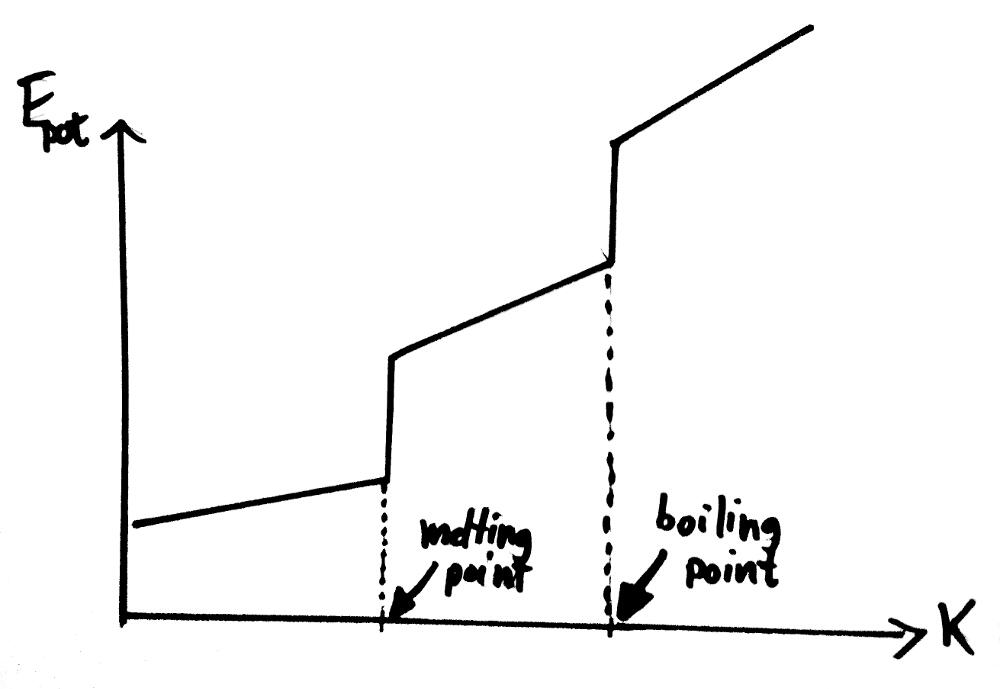

Here is a simpler answer. $\Delta G$ is zero for a phase change at the normal phase change temperature. For instance, for the melting of ice,
At $\pu{0^\circ C}$ there is no preference for $\ce{H2O}$ being ice vs. water, so $\Delta G=0$.
For melting ice, $\Delta H=\pu{+6 kJ/mol}$ and $\Delta S=\pu{+0.022 kJ/(mol K)}$. Using $\Delta G=\Delta H-T\Delta S$, you can plug in temperatures in Kelvin (eg. $263, 273, \pu{283 K}$) and see the $\Delta G$ variations (eg. $+0.2, 0.0, \pu{-0.2 kJ/mol}$).
Freezing always releases heat ($\Delta H = \pu{-6kJ/mol}$ for freezing water); it just sometimes isn't spontaneous. If spontaneous, this lost $\pu{6 kJ/mol}$ of heat is being sucked out of the system by the sub-zero surroundings.
Here is a simpler answer. $\Delta G$ is zero for a phase change at the normal phase change temperature. For instance, for the melting of ice,
At $\pu{0^\circ C}$ there is no preference for $\ce{H2O}$ being ice vs. water, so $\Delta G=0$.
For melting ice, $\Delta H=\pu{+6 kJ/mol}$ and $\Delta S=\pu{+0.022 kJ/(mol K)}$. Using $\Delta G=\Delta H-T\Delta S$, you can plug in temperatures in Kelvin (eg. $263, 273, \pu{283 K}$) and see the $\Delta G$ variations (eg. $+0.2, 0.0, \pu{-0.2 kJ/mol}$).
Freezing always releases heat ($\Delta H = \pu{-6kJ/mol}$ for freezing water); it just sometimes isn't spontaneous. If spontaneous, this lost $\pu{6 kJ/mol}$ of heat is being sucked out of the system by the sub-zero surroundings.
More
VOTE
It isn't necessarily.
For example if you supercool liquid water to -10 degrees C, let the water freeze and do this in a way that the final state is solid water at -10 degrees C, the change in Gibbs free energy will be negative. This is a spontaneous process.
See W. R. Salzman's Gibbs Free Energy and Temperature: The Gibbs-Helmholtz Equation for further explanation.
It isn't necessarily.
For example if you supercool liquid water to -10 degrees C, let the water freeze and do this in a way that the final state is solid water at -10 degrees C, the change in Gibbs free energy will be negative. This is a spontaneous process.
See W. R. Salzman's Gibbs Free Energy and Temperature: The Gibbs-Helmholtz Equation for further explanation.
More
VOTE
The initial and final thermodynamic equilibrium states of your system are as follows:
State 1: $\pu{1kg}$ liquid water at $\pu{0 ^\circ C}$ and $\pu{1 atm}$
State 2: $\pu{1 kg}$ water ice at $\pu{0 ^\circ C}$ and $\pu{1 atm}$
You want to find the change in enthalpy, entropy, and Gibbs free energy between these two states.
Now, we know that, to get the change in entropy between two thermodynamic equilibrium states of a closed system, we need to identify a reversible path between these states and then calculate the integral of $\mathrm dq/T$ for that path. For the present situation, this can be accomplished by putting the system into contact with a constant temperature reservoir at a temperature only slightly lower than $\pu{0 ^\circ C}$. As the liquid water freezes, its molecules lock into place (losing potential energy) and this results in a release of heat to the reservoir. So the temperature of the system never deviates significantly from $\pu{0 ^\circ C}$. Since the process is at constant pressure, the change in enthalpy is equal to the heat transferred from the surroundings to the system:$$\Delta H = q$$where both $q$ and $\Delta H$ are negative for this process. Since the process is also at constant temperature, the change in entropy, which is given by the integral of $\mathrm dq/T$, is:$$\Delta S=\frac{q}{T}=\frac{\Delta H}{T}$$Thus, for this change from State 1 to State 2, $\Delta S$ is also negative. If we now use the change in enthalpy and the change in entropy to calculate the change in free energy between the two thermodynamic equilibrium states, we obtain: $$\Delta G = \Delta H-T\Delta S=\Delta H-T\frac{\Delta H}{T}=0$$
The initial and final thermodynamic equilibrium states of your system are as follows:
State 1: $\pu{1kg}$ liquid water at $\pu{0 ^\circ C}$ and $\pu{1 atm}$
State 2: $\pu{1 kg}$ water ice at $\pu{0 ^\circ C}$ and $\pu{1 atm}$
You want to find the change in enthalpy, entropy, and Gibbs free energy between these two states.
Now, we know that, to get the change in entropy between two thermodynamic equilibrium states of a closed system, we need to identify a reversible path between these states and then calculate the integral of $\mathrm dq/T$ for that path. For the present situation, this can be accomplished by putting the system into contact with a constant temperature reservoir at a temperature only slightly lower than $\pu{0 ^\circ C}$. As the liquid water freezes, its molecules lock into place (losing potential energy) and this results in a release of heat to the reservoir. So the temperature of the system never deviates significantly from $\pu{0 ^\circ C}$. Since the process is at constant pressure, the change in enthalpy is equal to the heat transferred from the surroundings to the system:$$\Delta H = q$$where both $q$ and $\Delta H$ are negative for this process. Since the process is also at constant temperature, the change in entropy, which is given by the integral of $\mathrm dq/T$, is:$$\Delta S=\frac{q}{T}=\frac{\Delta H}{T}$$Thus, for this change from State 1 to State 2, $\Delta S$ is also negative. If we now use the change in enthalpy and the change in entropy to calculate the change in free energy between the two thermodynamic equilibrium states, we obtain:$$\Delta G = \Delta H-T\Delta S=\Delta H-T\frac{\Delta H}{T}=0$$
More
VOTE
VOTE
VOTE
VOTE
VOTE
VOTE