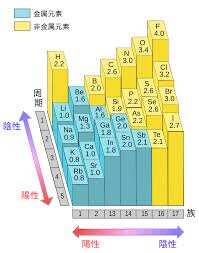
Electro negativity decides how the bond A-B is polarized- electron cloud is more attracted towards more electronegative atom. It's assumed that polarization beyond a certain limit, leads to ionic bond. The electronegativity difference serves as a measure of percentage at which a bond is ionic.Roughly speaking, electro negativity difference of 1.7 is equivalent to 50 ℅ ionic character;.(calculated ionic character in your question ) Thus, ionic character of a given compound is 50% ×∆ (E.N)/1.7
Electro negativity decides how the bond A-B is polarized- electron cloud is more attracted towards more electronegative atom. It's assumed that polarization beyond a certain limit, leads to ionic bond. The electronegativity difference serves as a measure of percentage at which a bond is ionic.Roughly speaking, electro negativity difference of 1.7 is equivalent to 50 ℅ ionic character;.(calculated ionic character in your question ) Thus, ionic character of a given compound is 50% ×∆ (E.N)/1.7
Linus Pauling proposed an empirical relationship which relates the percent ionic character in a bond to the electronegativity difference $\Delta \chi$.
Percent ionic character $= (1-e^{-(\Delta \chi/2)^2} )\times 100$
But I'd like to correct the definition of percent ionic character in your question using dipole moment $\mu$ (not Observed value of ionic character):
Percent ionic character = $\Large\frac{\mu_{\text{observed}}} {\mu_{\text{calculated} }}$ $\times 100 \%$
Where $\mu_{\text{calculated}}$ is calculated assuming a 100% ionic bond.
Linus Pauling proposed an empirical relationship which relates the percent ionic character in a bond to the electronegativity difference $\Delta \chi$.
Percent ionic character $= (1-e^{-(\Delta \chi/2)^2} )\times 100$
But I'd like to correct the definition of percent ionic character in your question using dipole moment $\mu$ (not Observed value of ionic character):
Percent ionic character = $\Large\frac{\mu_{\text{observed}}} {\mu_{\text{calculated} }}$ $\times 100 \%$
Where $\mu_{\text{calculated}}$ is calculated assuming a 100% ionic bond.
I agree on most of Yomen Atassi's answer, however I would like to "correct/clarify" the formula of the percent ionic character. The following is the one cited by him, which is the one also reported in several sites in the internet:
Percent ionic character = (1 − e^(−(Δχ/2)2))×100
However applying this equation to real cases results in incoherent percentages (negative values larger than 100).
Checking the source of Pauling's equation (Pauling L. The nature of the chemical bond. 3rd ed. 1960. Pag. 98), I realized that the mathematical expression is different. This is the one cited in the book:
Percent ionic character = (1 − e^(−1/4(Δχ^2)))×100
The last expression provides consistent values which are in agreement with values reported by Pauling and other authors.
If you want to apply Pauling's equation for the calculation of "percent of ionic character" (using electronegativity differences, Δχ), consider to use the later equation.
I agree on most of Yomen Atassi's answer, however I would like to "correct/clarify" the formula of the percent ionic character. The following is the one cited by him, which is the one also reported in several sites in the internet:
Percent ionic character = (1 − e^(−(Δχ/2)2))×100
However applying this equation to real cases results in incoherent percentages (negative values larger than 100).Checking the source of Pauling's equation (Pauling L. The nature of the chemical bond. 3rd ed. 1960. Pag. 98), I realized that the mathematical expression is different. This is the one cited in the book:
Percent ionic character = (1 − e^(−1/4(Δχ^2)))×100
The last expression provides consistent values which are in agreement with values reported by Pauling and other authors. If you want to apply Pauling's equation for the calculation of "percent of ionic character" (using electronegativity differences, Δχ), consider to use the later equation.
The expressions are in fact the same. You or the references mistyped the first formula, the second 2 is meant to be an exponent and should be preceded by ^.More





$$\text{% of ionic character} = 16\times ∆\mathrm{EN} + 3.5\times (∆\mathrm{EN})^2$$
where $∆\mathrm{EN}$ is electronegativity difference. For example, in $\ce{H-F}$ $∆\mathrm{EN} = 2$:
$$ \begin{align} \text{% of ionic character} &= 16\times 2 + 3.5\times 2^2 \\ &= 32 + 14 \\ &= 46~(\%) \end{align} $$
$$\text{% of ionic character} = 16\times ∆\mathrm{EN} + 3.5\times (∆\mathrm{EN})^2$$
where $∆\mathrm{EN}$ is electronegativity difference. For example, in $\ce{H-F}$ $∆\mathrm{EN} = 2$:
$$\begin{align}\text{% of ionic character} &= 16\times 2 + 3.5\times 2^2 \\ &= 32 + 14 \\ &= 46~(\%)\end{align}$$
More
VOTE
VOTE
VOTE
Electro negativity decides how the bond A-B is polarized- electron cloud is more attracted towards more electronegative atom. It's assumed that polarization beyond a certain limit, leads to ionic bond. The electronegativity difference serves as a measure of percentage at which a bond is ionic.Roughly speaking, electro negativity difference of 1.7 is equivalent to 50 ℅ ionic character;.(calculated ionic character in your question ) Thus, ionic character of a given compound is 50% ×∆ (E.N)/1.7
Electro negativity decides how the bond A-B is polarized- electron cloud is more attracted towards more electronegative atom. It's assumed that polarization beyond a certain limit, leads to ionic bond. The electronegativity difference serves as a measure of percentage at which a bond is ionic.Roughly speaking, electro negativity difference of 1.7 is equivalent to 50 ℅ ionic character;.(calculated ionic character in your question ) Thus, ionic character of a given compound is 50% ×∆ (E.N)/1.7
More
VOTE
Linus Pauling proposed an empirical relationship which relates the percent ionic character in a bond to the electronegativity difference $\Delta \chi$.
Percent ionic character $= (1-e^{-(\Delta \chi/2)^2} )\times 100$
But I'd like to correct the definition of percent ionic character in your question using dipole moment $\mu$ (not Observed value of ionic character):
Percent ionic character = $\Large\frac{\mu_{\text{observed}}} {\mu_{\text{calculated} }}$ $\times 100 \%$
Where $\mu_{\text{calculated}}$ is calculated assuming a 100% ionic bond.
For more details please see this page.
Linus Pauling proposed an empirical relationship which relates the percent ionic character in a bond to the electronegativity difference $\Delta \chi$.
Percent ionic character $= (1-e^{-(\Delta \chi/2)^2} )\times 100$
But I'd like to correct the definition of percent ionic character in your question using dipole moment $\mu$ (not Observed value of ionic character):
Percent ionic character = $\Large\frac{\mu_{\text{observed}}} {\mu_{\text{calculated} }}$ $\times 100 \%$
Where $\mu_{\text{calculated}}$ is calculated assuming a 100% ionic bond.
For more details please see this page.
More
VOTE
I agree on most of Yomen Atassi's answer, however I would like to "correct/clarify" the formula of the percent ionic character. The following is the one cited by him, which is the one also reported in several sites in the internet:
Percent ionic character = (1 − e^(−(Δχ/2)2))×100
However applying this equation to real cases results in incoherent percentages (negative values larger than 100). Checking the source of Pauling's equation (Pauling L. The nature of the chemical bond. 3rd ed. 1960. Pag. 98), I realized that the mathematical expression is different. This is the one cited in the book:
Percent ionic character = (1 − e^(−1/4(Δχ^2)))×100
The last expression provides consistent values which are in agreement with values reported by Pauling and other authors.
If you want to apply Pauling's equation for the calculation of "percent of ionic character" (using electronegativity differences, Δχ), consider to use the later equation.
I agree on most of Yomen Atassi's answer, however I would like to "correct/clarify" the formula of the percent ionic character. The following is the one cited by him, which is the one also reported in several sites in the internet:
Percent ionic character = (1 − e^(−(Δχ/2)2))×100
However applying this equation to real cases results in incoherent percentages (negative values larger than 100).Checking the source of Pauling's equation (Pauling L. The nature of the chemical bond. 3rd ed. 1960. Pag. 98), I realized that the mathematical expression is different. This is the one cited in the book:
Percent ionic character = (1 − e^(−1/4(Δχ^2)))×100
The last expression provides consistent values which are in agreement with values reported by Pauling and other authors.
If you want to apply Pauling's equation for the calculation of "percent of ionic character" (using electronegativity differences, Δχ), consider to use the later equation.
More
VOTE
VOTE