Home >
Community >
Why is CH4 a gas at room temperature but CH3Cl a liquid?
Upvote
27
Downvote
+ Bond
+ Phase
Posted by
Ken Helmick
Why is CH4 a gas at room temperature but CH3Cl a liquid?
Yes, I think that is the right answer expected for this question.
Three factors to consider.
(1) Most importantly there four intermolecular forces which effect BP
Ionic bonds > Ion-dipole interactions > H bonding > dipole-dipole interactions > Van der Waals dispersion forces.
(2) Increasing the number of carbon atoms (e.g. n-alkanes) increases the BP
(3) Branching on carbon chain lowers the BP.
The answer being given though is a bit of hand-waving that oversimplifies the situation. Dipole moment alone can't explain the overall trends. Van der Waals dispersion forces must be considered also.
For instance with increasing substitution $\ce{CH2Cl2}$, and $\ce{CHCl3}$ both have lower dipole moments than $\ce{CH3Cl}$ but higher BP's. $\ce{CCl4}$ has no dipole moment like methane, but has the highest BP of all.
The trend for molecular weight looks good, but the deuterated form of methane, $\ce{CD4}$, has the same (or at least nearly the same) boiling point as $\ce{CH4}$.
Yes, I think that is the right answer expected for this question.
Three factors to consider.
(1) Most importantly there four intermolecular forces which effect BP
Ionic bonds > Ion-dipole interactions > H bonding > dipole-dipole interactions > Van der Waals dispersion forces.
(2) Increasing the number of carbon atoms (e.g. n-alkanes) increases the BP
(3) Branching on carbon chain lowers the BP.
The answer being given though is a bit of hand-waving that oversimplifies the situation. Dipole moment alone can't explain the overall trends. Van der Waals dispersion forces must be considered also.
For instance with increasing substitution $\ce{CH2Cl2}$, and $\ce{CHCl3}$ both have lower dipole moments than $\ce{CH3Cl}$ but higher BP's. $\ce{CCl4}$ has no dipole moment like methane, but has the highest BP of all.
The trend for molecular weight looks good, but the deuterated form of methane, $\ce{CD4}$, has the same (or at least nearly the same) boiling point as $\ce{CH4}$.
The answer to predict boiling points of the four substances would indeed be expected to be given as:
$\ce{CH3Cl}$ is a dipole. The dipole-dipole interactions are much stronger than the van der Waals interactions present in methane, so it’s boiling point is much higher.
When comparing $\ce{CH4}$ to $\ce{CCl4}$, the latter has a much higher boiling point due to its larger number of electrons meaning stronger van der Waals forces.
That said, the teacher that gave you the above information should be removed from chemistry classes immediately. Here’s why:
$\ce{CH3Cl}$ is not chloroform but methyl chloride or chloromethane. It is a gas at room temperature with a boiling point $\vartheta_\mathrm{b} = - 23.8~\mathrm{^\circ C}$.
Chloroform, which is indeed a liquid at room temperature ($\vartheta_\mathrm{b} = 61.2~\mathrm{^\circ C}$) is $\ce{CHCl3}$ or trichloromethane. You need to substitute three hydrogens with chlorine atoms to create chloroform.
The answer to predict boiling points of the four substances would indeed be expected to be given as:
$\ce{CH3Cl}$ is a dipole. The dipole-dipole interactions are much stronger than the van der Waals interactions present in methane, so it’s boiling point is much higher.
When comparing $\ce{CH4}$ to $\ce{CCl4}$, the latter has a much higher boiling point due to its larger number of electrons meaning stronger van der Waals forces.
That said, the teacher that gave you the above information should be removed from chemistry classes immediately. Here’s why:
$\ce{CH3Cl}$ is not chloroform but methyl chloride or chloromethane. It is a gas at room temperature with a boiling point $\vartheta_\mathrm{b} = - 23.8~\mathrm{^\circ C}$.
Chloroform, which is indeed a liquid at room temperature ($\vartheta_\mathrm{b} = 61.2~\mathrm{^\circ C}$) is $\ce{CHCl3}$ or trichloromethane. You need to substitute three hydrogens with chlorine atoms to create chloroform.




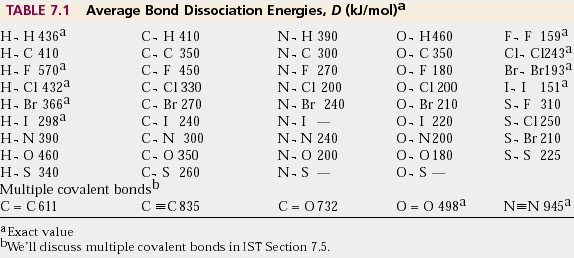

Yes, I think that is the right answer expected for this question.
Three factors to consider.
(1) Most importantly there four intermolecular forces which effect BP
Ionic bonds > Ion-dipole interactions > H bonding > dipole-dipole interactions > Van der Waals dispersion forces.
(2) Increasing the number of carbon atoms (e.g. n-alkanes) increases the BP
(3) Branching on carbon chain lowers the BP.
The answer being given though is a bit of hand-waving that oversimplifies the situation. Dipole moment alone can't explain the overall trends. Van der Waals dispersion forces must be considered also.
For instance with increasing substitution $\ce{CH2Cl2}$, and $\ce{CHCl3}$ both have lower dipole moments than $\ce{CH3Cl}$ but higher BP's. $\ce{CCl4}$ has no dipole moment like methane, but has the highest BP of all.
Also look at the halomethanes as a series. $\ce{CH3F}$ has a smaller dipole moment than $\ce{CH3Cl}$ because the bond length is shorter.
The trend for molecular weight looks good, but the deuterated form of methane, $\ce{CD4}$, has the same (or at least nearly the same) boiling point as $\ce{CH4}$.
Yes, I think that is the right answer expected for this question.
Three factors to consider.
(1) Most importantly there four intermolecular forces which effect BP
Ionic bonds > Ion-dipole interactions > H bonding > dipole-dipole interactions > Van der Waals dispersion forces.
(2) Increasing the number of carbon atoms (e.g. n-alkanes) increases the BP
(3) Branching on carbon chain lowers the BP.
The answer being given though is a bit of hand-waving that oversimplifies the situation. Dipole moment alone can't explain the overall trends. Van der Waals dispersion forces must be considered also.
For instance with increasing substitution $\ce{CH2Cl2}$, and $\ce{CHCl3}$ both have lower dipole moments than $\ce{CH3Cl}$ but higher BP's. $\ce{CCl4}$ has no dipole moment like methane, but has the highest BP of all.
Also look at the halomethanes as a series. $\ce{CH3F}$ has a smaller dipole moment than $\ce{CH3Cl}$ because the bond length is shorter.
The trend for molecular weight looks good, but the deuterated form of methane, $\ce{CD4}$, has the same (or at least nearly the same) boiling point as $\ce{CH4}$.
More
VOTE
The answer to predict boiling points of the four substances would indeed be expected to be given as:
That said, the teacher that gave you the above information should be removed from chemistry classes immediately. Here’s why:
$\ce{CH3Cl}$ is not chloroform but methyl chloride or chloromethane. It is a gas at room temperature with a boiling point $\vartheta_\mathrm{b} = - 23.8~\mathrm{^\circ C}$.
Chloroform, which is indeed a liquid at room temperature ($\vartheta_\mathrm{b} = 61.2~\mathrm{^\circ C}$) is $\ce{CHCl3}$ or trichloromethane. You need to substitute three hydrogens with chlorine atoms to create chloroform.
The answer to predict boiling points of the four substances would indeed be expected to be given as:
That said, the teacher that gave you the above information should be removed from chemistry classes immediately. Here’s why:
$\ce{CH3Cl}$ is not chloroform but methyl chloride or chloromethane. It is a gas at room temperature with a boiling point $\vartheta_\mathrm{b} = - 23.8~\mathrm{^\circ C}$.
Chloroform, which is indeed a liquid at room temperature ($\vartheta_\mathrm{b} = 61.2~\mathrm{^\circ C}$) is $\ce{CHCl3}$ or trichloromethane. You need to substitute three hydrogens with chlorine atoms to create chloroform.
More
VOTE