Home >
Community >
Why there is no change in water level when salt is added?
Upvote
22
Downvote
+ Solutions
+ Water
Posted by
Lisa Ford
Why there is no change in water level when salt is added?
Actually, sodium chloride added to water will decrease the volume of the solution, up to around 2% for a saturated solution. Even when fully saturated, that's not a big change, so you may not have been able to observe it without something with a narrow neck like a volumetric flask. If you start with a large volume and carefully mark the level, you should be able to see it.
Todd's answer explains why this happens with water, but it should also be noted that deviations from the ideal can happen in both directions (increasing or decreasing the volume) and changes in volume also occur when mixing two miscible liquids together, sometimes in a rather complex way. A good example is a binary mixture of acetone and chloroform (there's a good figure for this in the Engel and Reid physical chemistry textbook, but I can't find a decent one online). Starting from a pure acetone mixture, as we add chloroform, the volume is more than the sum of the two component volumes, but once we get above 20% chloroform or so, the volume drops below the sum of the two pure component volumes. Why this happens is a bit complicated, but it has to do with different competing factors affecting how compact the local structure around the molecules is.
Actually, sodium chloride added to water will decrease the volume of the solution, up to around 2% for a saturated solution. Even when fully saturated, that's not a big change, so you may not have been able to observe it without something with a narrow neck like a volumetric flask. If you start with a large volume and carefully mark the level, you should be able to see it.
Todd's answer explains why this happens with water, but it should also be noted that deviations from the ideal can happen in both directions (increasing or decreasing the volume) and changes in volume also occur when mixing two miscible liquids together, sometimes in a rather complex way. A good example is a binary mixture of acetone and chloroform (there's a good figure for this in the Engel and Reid physical chemistry textbook, but I can't find a decent one online). Starting from a pure acetone mixture, as we add chloroform, the volume is more than the sum of the two component volumes, but once we get above 20% chloroform or so, the volume drops below the sum of the two pure component volumes. Why this happens is a bit complicated, but it has to do with different competing factors affecting how compact the local structure around the molecules is.
This is an example of electrostriction - see, for example, this paper for a full explanation.
In short, the solvent molecules become more ordered in the vicinity of dissolved (charged) ions and less ordered as we go further away from the dissolved (charged) ions. The increase of solvent density near the ions is offset by the decrease of bulk density in the solvent as distance from the ions increases. This results in an overall net reduction in the observed volume of the solution.
From the Discussion section of the manuscript:
The interaction of the electrostatic field of an
ion with water tends to align the dipolar water
molecules in the direction of the field. In this way
the field tends to disrupt hydrogen bonded
structures in liquid water, and to compress the
water molecules surrounding an ion. These
electrostatic effect give rise to a shrinkage of the
water.
Dog daycare/dog experts/cat expertsFollowFollowing
This is an example of electrostriction - see, for example, this paper for a full explanation.
In short, the solvent molecules become more ordered in the vicinity of dissolved (charged) ions and less ordered as we go further away from the dissolved (charged) ions. The increase of solvent density near the ions is offset by the decrease of bulk density in the solvent as distance from the ions increases. This results in an overall net reduction in the observed volume of the solution.
From the Discussion section of the manuscript:
The interaction of the electrostatic field of an ion with water tends to align the dipolar water molecules in the direction of the field. In this way the field tends to disrupt hydrogen bonded structures in liquid water, and to compress the water molecules surrounding an ion. These electrostatic effect give rise to a shrinkage of the water.
@ibuprofen - For molarity, you are concerned with the volume of the solution after you have added the solvent to the solute. Therefore, the volume change is implicitly included as you correctly note (weigh the solute, add solvent to desired volume - done).More
when measuring concentration in molarity, do we only take the volume of the solvent before adding the solute? do we not care about any volume change which might occur upon adding the solute?More
Is it ever possible that dissolving a solute in a solvent will cause the level of the solvent to fall? @ToddMinehardtMore
Upvote
VOTE
Downvote
When sodium chloride dissolves in water to make a saturated solution there is a 2.5 per cent reduction in volume. One would never notice that in a beaker. Even in an ordinary flask it would be barely perceptible. However, if a volumetric flask is available from the chemistry laboratory, the volume change will be noticeable in the narrow neck. It is essential to remove all air bubbles from the salt that is to be dissolved. Therefore, it must be thoroughly wetted at the start of the demonstration.
The solubility of salt does not change much with temperature, so there is little profit in using hot water.
The salt should be in small crystals and not in rocks or very fine powder.
When sodium chloride dissolves in water to make a saturated solution there is a 2.5 per cent reduction in volume. One would never notice that in a beaker. Even in an ordinary flask it would be barely perceptible. However, if a volumetric flask is available from the chemistry laboratory, the volume change will be noticeable in the narrow neck. It is essential to remove all air bubbles from the salt that is to be dissolved. Therefore, it must be thoroughly wetted at the start of the demonstration.
The solubility of salt does not change much with temperature, so there is little profit in using hot water.
The salt should be in small crystals and not in rocks or very fine powder.



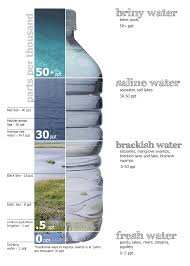
Actually, sodium chloride added to water will decrease the volume of the solution, up to around 2% for a saturated solution. Even when fully saturated, that's not a big change, so you may not have been able to observe it without something with a narrow neck like a volumetric flask. If you start with a large volume and carefully mark the level, you should be able to see it.
Todd's answer explains why this happens with water, but it should also be noted that deviations from the ideal can happen in both directions (increasing or decreasing the volume) and changes in volume also occur when mixing two miscible liquids together, sometimes in a rather complex way. A good example is a binary mixture of acetone and chloroform (there's a good figure for this in the Engel and Reid physical chemistry textbook, but I can't find a decent one online). Starting from a pure acetone mixture, as we add chloroform, the volume is more than the sum of the two component volumes, but once we get above 20% chloroform or so, the volume drops below the sum of the two pure component volumes. Why this happens is a bit complicated, but it has to do with different competing factors affecting how compact the local structure around the molecules is.
Actually, sodium chloride added to water will decrease the volume of the solution, up to around 2% for a saturated solution. Even when fully saturated, that's not a big change, so you may not have been able to observe it without something with a narrow neck like a volumetric flask. If you start with a large volume and carefully mark the level, you should be able to see it.
Todd's answer explains why this happens with water, but it should also be noted that deviations from the ideal can happen in both directions (increasing or decreasing the volume) and changes in volume also occur when mixing two miscible liquids together, sometimes in a rather complex way. A good example is a binary mixture of acetone and chloroform (there's a good figure for this in the Engel and Reid physical chemistry textbook, but I can't find a decent one online). Starting from a pure acetone mixture, as we add chloroform, the volume is more than the sum of the two component volumes, but once we get above 20% chloroform or so, the volume drops below the sum of the two pure component volumes. Why this happens is a bit complicated, but it has to do with different competing factors affecting how compact the local structure around the molecules is.
More
VOTE
This is an example of electrostriction - see, for example, this paper for a full explanation.
In short, the solvent molecules become more ordered in the vicinity of dissolved (charged) ions and less ordered as we go further away from the dissolved (charged) ions. The increase of solvent density near the ions is offset by the decrease of bulk density in the solvent as distance from the ions increases. This results in an overall net reduction in the observed volume of the solution.
From the Discussion section of the manuscript:
This is an example of electrostriction - see, for example, this paper for a full explanation.
In short, the solvent molecules become more ordered in the vicinity of dissolved (charged) ions and less ordered as we go further away from the dissolved (charged) ions. The increase of solvent density near the ions is offset by the decrease of bulk density in the solvent as distance from the ions increases. This results in an overall net reduction in the observed volume of the solution.
From the Discussion section of the manuscript:
More
VOTE
VOTE
VOTE
VOTE
VOTE
When sodium chloride dissolves in water to make a saturated solution there is a 2.5 per cent reduction in volume. One would never notice that in a beaker. Even in an ordinary flask it would be barely perceptible. However, if a volumetric flask is available from the chemistry laboratory, the volume change will be noticeable in the narrow neck. It is essential to remove all air bubbles from the salt that is to be dissolved. Therefore, it must be thoroughly wetted at the start of the demonstration.
The solubility of salt does not change much with temperature, so there is little profit in using hot water.
The salt should be in small crystals and not in rocks or very fine powder.
When sodium chloride dissolves in water to make a saturated solution there is a 2.5 per cent reduction in volume. One would never notice that in a beaker. Even in an ordinary flask it would be barely perceptible. However, if a volumetric flask is available from the chemistry laboratory, the volume change will be noticeable in the narrow neck. It is essential to remove all air bubbles from the salt that is to be dissolved. Therefore, it must be thoroughly wetted at the start of the demonstration.
The solubility of salt does not change much with temperature, so there is little profit in using hot water.
The salt should be in small crystals and not in rocks or very fine powder.
More
VOTE