Home >
Community >
Ethane and ethene: which is easier to burn? Which one burns hotter? Why?
Upvote
27
Downvote
+ Enthalpy
+ Bond
+ Hydrogen
Posted by
Mustang Mark
Ethane and ethene: which is easier to burn? Which one burns hotter? Why?
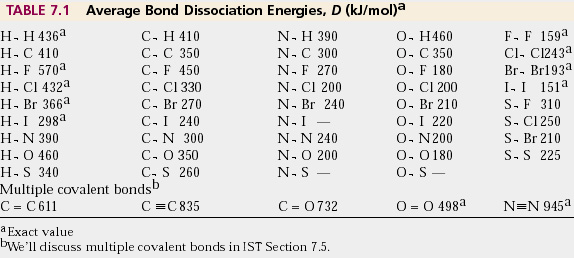
Ethane will release more heat per mole but ethene should produce a higher temperature. The extra heat released by ethane goes into heating up more water which has a high heat capacity.
As for which has lower activation energy, ethyne is dangerous to store because it can explode so I am assuming ethene is faster to react because of some trend. I also worked with someone who was researching possible fuels for a ramjet and his group chose ethene because it was the best compromise between safety and speed of combustion. I do not know why the trend ethane>ethene>ethyne for reaction rates is as it is though.
Ethane will release more heat per mole but ethene should produce a higher temperature. The extra heat released by ethane goes into heating up more water which has a high heat capacity.
As for which has lower activation energy, ethyne is dangerous to store because it can explode so I am assuming ethene is faster to react because of some trend. I also worked with someone who was researching possible fuels for a ramjet and his group chose ethene because it was the best compromise between safety and speed of combustion. I do not know why the trend ethane>ethene>ethyne for reaction rates is as it is though.
Ethene produce a high temperature. Ethane release more heat per mol. The extra heat released by ethane goes into heating up more water which has a high heat temperature.
Ethene produce a high temperature. Ethane release more heat per mol. The extra heat released by ethane goes into heating up more water which has a high heat temperature.
Why and how do enthalpy and $E_\mathrm a$ change when two single bonds and two H atoms are replaced with a double bond?
Olefins are less stable than their corresponding alkane analogues. For example, when ethene is hydrogenated to ethane roughly 33 kcal/mol of heat is given off because ethene has a higher energy content than ethane.
Why is this, why is a molecule with a double bond higher in energy than a molecule without a double bond?
There are two equivalent ways to describe the orbitals in ethene. One is the "double bond" description where a pi and sigma bond exist together side by side. We know that a pi bond is not as strong as a sigma bond due to poorer overlap with the pi bond compared to the the sigma bond. It only takes something on the order of 60 kcal/mol to break a pi bond and produce cis-trans isomerization about the double bond, whereas it takes something like 90 kcal/mol to break a carbon-carbon single bond. This poorer overlap with the pi bond causes ethene to be higher in energy than ethane. Alternatively one can view ethene as a two-membered ring, no pi bond, just 2 sigma bonds between the 2 carbons forming a two-membered ring. It is easy to see that such a ring system would contain a significant amount of strain.
Whether you use the pi bond or two-membered ring approach to describe olefinic double bonds, both lead to the conclusion that olefins are destabilized (higher in energy content) due to poor overlap or ring strain (which in itself is really a reflection of poor overlap). Because of this destabilization, alkenes will generally have lower activation energies and more heat will be given off when they react compared to alkanes.
Example:
Let's consider the bromination of ethene and ethane
$$\begin{align}
\ce{C2H4 + Br2 &-> BrH2C-CH2Br}\\
\ce{C2H6 + Br2 &-> 2 CH3Br}
\end{align}$$
The heats of formation of ethene, bromine and 1,2-dibromoethane are 52.5, 0 and -37.8 kJ/mol respectively; the reaction is exothermic by 90.3 kJ/mol. On the other hand, in the case of ethane, the heats of formation are -84.7, 0 and (2x) -37.4 kJ/mol; this reaction is endothermic by 10.3 kJ/mol. The olefinic reaction is significantly favored for the reasons discussed above.
Why and how do enthalpy and $E_\mathrm a$ change when two single bonds and two H atoms are replaced with a double bond?
Olefins are less stable than their corresponding alkane analogues. For example, when ethene is hydrogenated to ethane roughly 33 kcal/mol of heat is given off because ethene has a higher energy content than ethane.
Why is this, why is a molecule with a double bond higher in energy than a molecule without a double bond?
There are two equivalent ways to describe the orbitals in ethene. One is the "double bond" description where a pi and sigma bond exist together side by side. We know that a pi bond is not as strong as a sigma bond due to poorer overlap with the pi bond compared to the the sigma bond. It only takes something on the order of 60 kcal/mol to break a pi bond and produce cis-trans isomerization about the double bond, whereas it takes something like 90 kcal/mol to break a carbon-carbon single bond. This poorer overlap with the pi bond causes ethene to be higher in energy than ethane. Alternatively one can view ethene as a two-membered ring, no pi bond, just 2 sigma bonds between the 2 carbons forming a two-membered ring. It is easy to see that such a ring system would contain a significant amount of strain.
Whether you use the pi bond or two-membered ring approach to describe olefinic double bonds, both lead to the conclusion that olefins are destabilized (higher in energy content) due to poor overlap or ring strain (which in itself is really a reflection of poor overlap). Because of this destabilization, alkenes will generally have lower activation energies and more heat will be given off when they react compared to alkanes.
Example:Let's consider the bromination of ethene and ethane$$\begin{align}\ce{C2H4 + Br2 &-> BrH2C-CH2Br}\\\ce{C2H6 + Br2 &-> 2 CH3Br}\end{align}$$
The heats of formation of ethene, bromine and 1,2-dibromoethane are 52.5, 0 and -37.8 kJ/mol respectively; the reaction is exothermic by 90.3 kJ/mol. On the other hand, in the case of ethane, the heats of formation are -84.7, 0 and (2x) -37.4 kJ/mol; this reaction is endothermic by 10.3 kJ/mol. The olefinic reaction is significantly favored for the reasons discussed above.





Ethane will release more heat per mole but ethene should produce a higher temperature. The extra heat released by ethane goes into heating up more water which has a high heat capacity.
As for which has lower activation energy, ethyne is dangerous to store because it can explode so I am assuming ethene is faster to react because of some trend. I also worked with someone who was researching possible fuels for a ramjet and his group chose ethene because it was the best compromise between safety and speed of combustion. I do not know why the trend ethane>ethene>ethyne for reaction rates is as it is though.
Ethane will release more heat per mole but ethene should produce a higher temperature. The extra heat released by ethane goes into heating up more water which has a high heat capacity.
As for which has lower activation energy, ethyne is dangerous to store because it can explode so I am assuming ethene is faster to react because of some trend. I also worked with someone who was researching possible fuels for a ramjet and his group chose ethene because it was the best compromise between safety and speed of combustion. I do not know why the trend ethane>ethene>ethyne for reaction rates is as it is though.
More
VOTE
Ethene produce a high temperature. Ethane release more heat per mol. The extra heat released by ethane goes into heating up more water which has a high heat temperature.
Ethene produce a high temperature. Ethane release more heat per mol. The extra heat released by ethane goes into heating up more water which has a high heat temperature.
More
VOTE
VOTE
Olefins are less stable than their corresponding alkane analogues. For example, when ethene is hydrogenated to ethane roughly 33 kcal/mol of heat is given off because ethene has a higher energy content than ethane.
Why is this, why is a molecule with a double bond higher in energy than a molecule without a double bond?
There are two equivalent ways to describe the orbitals in ethene. One is the "double bond" description where a pi and sigma bond exist together side by side. We know that a pi bond is not as strong as a sigma bond due to poorer overlap with the pi bond compared to the the sigma bond. It only takes something on the order of 60 kcal/mol to break a pi bond and produce cis-trans isomerization about the double bond, whereas it takes something like 90 kcal/mol to break a carbon-carbon single bond. This poorer overlap with the pi bond causes ethene to be higher in energy than ethane. Alternatively one can view ethene as a two-membered ring, no pi bond, just 2 sigma bonds between the 2 carbons forming a two-membered ring. It is easy to see that such a ring system would contain a significant amount of strain.
Whether you use the pi bond or two-membered ring approach to describe olefinic double bonds, both lead to the conclusion that olefins are destabilized (higher in energy content) due to poor overlap or ring strain (which in itself is really a reflection of poor overlap). Because of this destabilization, alkenes will generally have lower activation energies and more heat will be given off when they react compared to alkanes.
Example: Let's consider the bromination of ethene and ethane $$\begin{align} \ce{C2H4 + Br2 &-> BrH2C-CH2Br}\\ \ce{C2H6 + Br2 &-> 2 CH3Br} \end{align}$$
The heats of formation of ethene, bromine and 1,2-dibromoethane are 52.5, 0 and -37.8 kJ/mol respectively; the reaction is exothermic by 90.3 kJ/mol. On the other hand, in the case of ethane, the heats of formation are -84.7, 0 and (2x) -37.4 kJ/mol; this reaction is endothermic by 10.3 kJ/mol. The olefinic reaction is significantly favored for the reasons discussed above.
Olefins are less stable than their corresponding alkane analogues. For example, when ethene is hydrogenated to ethane roughly 33 kcal/mol of heat is given off because ethene has a higher energy content than ethane.
Why is this, why is a molecule with a double bond higher in energy than a molecule without a double bond?
There are two equivalent ways to describe the orbitals in ethene. One is the "double bond" description where a pi and sigma bond exist together side by side. We know that a pi bond is not as strong as a sigma bond due to poorer overlap with the pi bond compared to the the sigma bond. It only takes something on the order of 60 kcal/mol to break a pi bond and produce cis-trans isomerization about the double bond, whereas it takes something like 90 kcal/mol to break a carbon-carbon single bond. This poorer overlap with the pi bond causes ethene to be higher in energy than ethane. Alternatively one can view ethene as a two-membered ring, no pi bond, just 2 sigma bonds between the 2 carbons forming a two-membered ring. It is easy to see that such a ring system would contain a significant amount of strain.
Whether you use the pi bond or two-membered ring approach to describe olefinic double bonds, both lead to the conclusion that olefins are destabilized (higher in energy content) due to poor overlap or ring strain (which in itself is really a reflection of poor overlap). Because of this destabilization, alkenes will generally have lower activation energies and more heat will be given off when they react compared to alkanes.
Example:Let's consider the bromination of ethene and ethane$$\begin{align}\ce{C2H4 + Br2 &-> BrH2C-CH2Br}\\\ce{C2H6 + Br2 &-> 2 CH3Br}\end{align}$$
The heats of formation of ethene, bromine and 1,2-dibromoethane are 52.5, 0 and -37.8 kJ/mol respectively; the reaction is exothermic by 90.3 kJ/mol. On the other hand, in the case of ethane, the heats of formation are -84.7, 0 and (2x) -37.4 kJ/mol; this reaction is endothermic by 10.3 kJ/mol. The olefinic reaction is significantly favored for the reasons discussed above.
More
VOTE