Which kind of aryl are you interested in? The following paper could be interesting for you. DOI: 10.1039/B400878B; Chem. Commun., 2004, 888-889. -Using NaN3, CuI, L-proline, and a base in DMSO you can get in many cases good yields (you can find the details on the concentrations in the paper). -You can only use your iodide. Bromide possibly will not work using the above method. -Note that the presence of proline can really affect the yield of your reaction. I wish you find this method useful. Good Luck!
Which kind of aryl are you interested in? The following paper could be interesting for you. DOI: 10.1039/B400878B; Chem. Commun., 2004, 888-889. -Using NaN3, CuI, L-proline, and a base in DMSO you can get in many cases good yields (you can find the details on the concentrations in the paper). -You can only use your iodide. Bromide possibly will not work using the above method. -Note that the presence of proline can really affect the yield of your reaction. I wish you find this method useful. Good Luck!
Thanks Raffaello Papadakis and Mahesh But for your valuable answers. Actually i am following the same article but i was using DMSO which did not work. Now i will try with mix solvent (EtOH/H2O) instead of DMSO.
Thanks Raffaello Papadakis and Mahesh But for your valuable answers. Actually i am following the same article but i was using DMSO which did not work. Now i will try with mix solvent (EtOH/H2O) instead of DMSO.
Sayed, You can do it using sodium azide under Cu2O/tetraethylammonium prolinate catalysis in EtOH/EG. See ---Tetrahedron Letters, In Press, Corrected Proof, Available online 4 November 2014 Good Luck
Sayed, You can do it using sodium azide under Cu2O/tetraethylammonium prolinate catalysis in EtOH/EG. See ---Tetrahedron Letters, In Press, Corrected Proof, Available online 4 November 2014 Good Luck


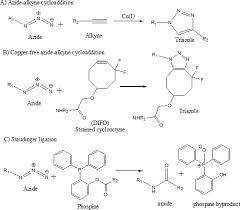
You can reacting sodium azide with aryl bromide in presence of Cu-bronze catalyst.
You can reacting sodium azide with aryl bromide in presence of Cu-bronze catalyst.
More
VOTE
Thanks sir Adel Amer and Madhukar Baburao Deshmukh for your valuable suggestions.
Thanks sir Adel Amer and Madhukar Baburao Deshmukh for your valuable suggestions.
More
VOTE
i am trying with aromatic bromide but the reaction is not going on. Can you give me any suggestion?
i am trying with aromatic bromide but the reaction is not going on. Can you give me any suggestion?
More
VOTE
Which kind of aryl are you interested in? The following paper could be interesting for you.
DOI: 10.1039/B400878B; Chem. Commun., 2004, 888-889.
-Using NaN3, CuI, L-proline, and a base in DMSO you can get in many cases good yields (you can find the details on the concentrations in the paper).
-You can only use your iodide. Bromide possibly will not work using the above method.
-Note that the presence of proline can really affect the yield of your reaction.
I wish you find this method useful.
Good Luck!
Which kind of aryl are you interested in? The following paper could be interesting for you.
DOI: 10.1039/B400878B; Chem. Commun., 2004, 888-889.
-Using NaN3, CuI, L-proline, and a base in DMSO you can get in many cases good yields (you can find the details on the concentrations in the paper).
-You can only use your iodide. Bromide possibly will not work using the above method.
-Note that the presence of proline can really affect the yield of your reaction.
I wish you find this method useful.
Good Luck!
More
VOTE
Thanks Raffaello Papadakis and Mahesh But for your valuable answers. Actually i am following the same article but i was using DMSO which did not work. Now i will try with mix solvent (EtOH/H2O) instead of DMSO.
Thanks Raffaello Papadakis and Mahesh But for your valuable answers. Actually i am following the same article but i was using DMSO which did not work. Now i will try with mix solvent (EtOH/H2O) instead of DMSO.
More
VOTE
Sayed,
You can do it using sodium azide under Cu2O/tetraethylammonium prolinate
catalysis in EtOH/EG. See
---Tetrahedron Letters, In Press, Corrected Proof, Available online 4 November 2014
Good Luck
Sayed,
You can do it using sodium azide under Cu2O/tetraethylammonium prolinate
catalysis in EtOH/EG. See
---Tetrahedron Letters, In Press, Corrected Proof, Available online 4 November 2014
Good Luck
More
VOTE
You can convert by using NaN3 NaOH, EtOH, reflux 10 hrs.
You can get the article from this link http://pubs.rsc.org/en/content/articlehtml/2004/CC/B400878B
You can convert by using NaN3 NaOH, EtOH, reflux 10 hrs.
You can get the article from this link http://pubs.rsc.org/en/content/articlehtml/2004/CC/B400878B
More
VOTE
Aryl-bromide with electron withdrawing group at p-position w.r.t. Br in benzene with NaN3 may give Aryl azide.
Aryl-bromide with electron withdrawing group at p-position w.r.t. Br in benzene with NaN3 may give Aryl azide.
More
VOTE
I already synthesized from Aryl Iodide. Aryl bromide did not work in my case. Your valued suggestion is highly appreciated. Thanks a lot.
I already synthesized from Aryl Iodide. Aryl bromide did not work in my case. Your valued suggestion is highly appreciated. Thanks a lot.
More
VOTE
give me your email Id. I will send you some papers related to your query.
give me your email Id. I will send you some papers related to your query.
More
VOTE