Home >
Community >
Why does rotating a double bond break the bond?
Upvote
27
Downvote
+ Bond
Posted by
Michael Schneider
Why does rotating a double bond break the bond?
Consider a carbon-carbon ($\ce{C=C}$) bond.
A double bond consists of a $\sigma$ bond and a $\pi$ bond. A $\pi$ bond is formed by sideways overlapping of unhybridized p-orbitals of two carbon atoms, above and below the plane of carbon atoms.
If now one of the carbon atoms of the double bond is rotated with respect to the other, the p-orbitals will no longer overlap, and the $\pi$ bond should break. But the breaking of the $\pi$ bond requires 251 kJ/mol of energy, which is not provided by the collision of the molecules at room temperature. Consequently the rotation about a carbon-carbon double bond is not free, but it is strongly hindered or restricted.
In carbon-carbon single bond ($\ce{C-C}$) only 12.55 kJ/mol of energy is required (this data is for ethane molecule). At room temperature, the collision of molecules supply sufficient kinetic energy to overcome this energy barrier.
A double bond consists of a $\sigma$ bond and a $\pi$ bond. A $\pi$ bond is formed by sideways overlapping of unhybridized p-orbitals of two carbon atoms, above and below the plane of carbon atoms.
If now one of the carbon atoms of the double bond is rotated with respect to the other, the p-orbitals will no longer overlap, and the $\pi$ bond should break. But the breaking of the $\pi$ bond requires 251 kJ/mol of energy, which is not provided by the collision of the molecules at room temperature. Consequently the rotation about a carbon-carbon double bond is not free, but it is strongly hindered or restricted.
In carbon-carbon single bond ($\ce{C-C}$) only 12.55 kJ/mol of energy is required (this data is for ethane molecule). At room temperature, the collision of molecules supply sufficient kinetic energy to overcome this energy barrier.
@Vishnu JK So the conformers cant interconvert. But what about conjugated dienes where an interconversion is possible? The overlap is lost during rotation but is regained in the final state (either cis or trans).More
The π bond breaking energy is just 20 times the one of ( C−C ) bond: 251 kJ/mol/12.55 kJ/mol = 20More
Upvote
VOTE
Downvote
Besides the thermodynamic barrier with respect to double bond rotation, we could also look at it from a symmetry perspective.
Rotating a double bond, without breaking the $\pi$ bond first, requires that you rotate the left or right orbitals that participate in the $\sigma$ and $\pi$ bonds (but not both atoms' orbitals, because that would be rotating the molecule, not the bond).
Suppose that we are looking at a $2p_x-2p_x$ $\pi$ overlap for a $\text{C}=\text{C}$ bond. If we rotate the $2p_x$ orbital $90^o$ about the internuclear ($z$) axis, we can transform the $2p_x$ orbital into a $2p_y$ orbital. Ethene, for example, is a molecule of $D_{2h}$ symmetry, and contains a $\text{C}=\text{C}$ bond.
According to this D2h character table, in ethene, the $2p_x$ orbital transforms under the $B_{3u}$ IRREP, but the $2p_y$ orbital transforms under the $B_{2u}$ IRREP.
Two orbitals transforming under different IRREPs cannot overlap, so the $\pi$ bond can no longer be made if one of the orbitals is rotated.
Beyond that, if you rotate one of the $2p_x$ orbitals about the internuclear axis by some small angle (instead of specifically $90^o$), you would change the orientation of the x-axis for only that orbital, and they would technically not be the same orbital anymore because each would be following a different x- (and y-)axis convention.
Besides the thermodynamic barrier with respect to double bond rotation, we could also look at it from a symmetry perspective.
Rotating a double bond, without breaking the $\pi$ bond first, requires that you rotate the left or right orbitals that participate in the $\sigma$ and $\pi$ bonds (but not both atoms' orbitals, because that would be rotating the molecule, not the bond).
Suppose that we are looking at a $2p_x-2p_x$ $\pi$ overlap for a $\text{C}=\text{C}$ bond. If we rotate the $2p_x$ orbital $90^o$ about the internuclear ($z$) axis, we can transform the $2p_x$ orbital into a $2p_y$ orbital. Ethene, for example, is a molecule of $D_{2h}$ symmetry, and contains a $\text{C}=\text{C}$ bond.
According to this D2h character table, in ethene, the $2p_x$ orbital transforms under the $B_{3u}$ IRREP, but the $2p_y$ orbital transforms under the $B_{2u}$ IRREP.
Two orbitals transforming under different IRREPs cannot overlap, so the $\pi$ bond can no longer be made if one of the orbitals is rotated.
Beyond that, if you rotate one of the $2p_x$ orbitals about the internuclear axis by some small angle (instead of specifically $90^o$), you would change the orientation of the x-axis for only that orbital, and they would technically not be the same orbital anymore because each would be following a different x- (and y-)axis convention.
Yes, technically they are interconvertible any any temperature but both the rate constants will become bigger as the temperature increases, as per Arrhenius for example.More
What you say about symmetry is true, but in essence the lack of rotation is about the stability of the double bond vs. thermal energy available. The double bonds strength is far greater than this and so is stable wrt rotation. The bond has to have two similarly oriented p orbitals as these otherwise do not overlap, i.e. we say that px, py , pz etc are orthogonal to one another.More
It is quite easy to break a double bond with a photon of the appropriate energy. This promotes an electron into an antibonding LUMO from which rotation is far easier as $\pi$ electron overlap is reduced.More




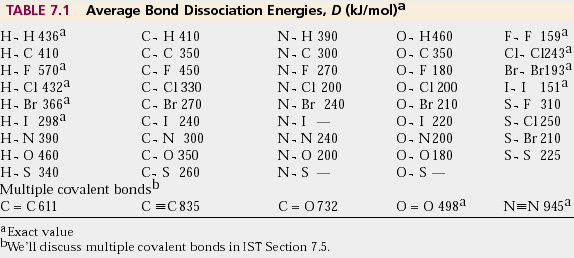


Consider a carbon-carbon ($\ce{C=C}$) bond.
A double bond consists of a $\sigma$ bond and a $\pi$ bond. A $\pi$ bond is formed by sideways overlapping of unhybridized p-orbitals of two carbon atoms, above and below the plane of carbon atoms.
If now one of the carbon atoms of the double bond is rotated with respect to the other, the p-orbitals will no longer overlap, and the $\pi$ bond should break. But the breaking of the $\pi$ bond requires 251 kJ/mol of energy, which is not provided by the collision of the molecules at room temperature. Consequently the rotation about a carbon-carbon double bond is not free, but it is strongly hindered or restricted.
In carbon-carbon single bond ($\ce{C-C}$) only 12.55 kJ/mol of energy is required (this data is for ethane molecule). At room temperature, the collision of molecules supply sufficient kinetic energy to overcome this energy barrier.
Consider a carbon-carbon ($\ce{C=C}$) bond.
A double bond consists of a $\sigma$ bond and a $\pi$ bond. A $\pi$ bond is formed by sideways overlapping of unhybridized p-orbitals of two carbon atoms, above and below the plane of carbon atoms.
If now one of the carbon atoms of the double bond is rotated with respect to the other, the p-orbitals will no longer overlap, and the $\pi$ bond should break. But the breaking of the $\pi$ bond requires 251 kJ/mol of energy, which is not provided by the collision of the molecules at room temperature. Consequently the rotation about a carbon-carbon double bond is not free, but it is strongly hindered or restricted.
In carbon-carbon single bond ($\ce{C-C}$) only 12.55 kJ/mol of energy is required (this data is for ethane molecule). At room temperature, the collision of molecules supply sufficient kinetic energy to overcome this energy barrier.
More
VOTE
VOTE
VOTE
VOTE
Besides the thermodynamic barrier with respect to double bond rotation, we could also look at it from a symmetry perspective.
Rotating a double bond, without breaking the $\pi$ bond first, requires that you rotate the left or right orbitals that participate in the $\sigma$ and $\pi$ bonds (but not both atoms' orbitals, because that would be rotating the molecule, not the bond).
Suppose that we are looking at a $2p_x-2p_x$ $\pi$ overlap for a $\text{C}=\text{C}$ bond. If we rotate the $2p_x$ orbital $90^o$ about the internuclear ($z$) axis, we can transform the $2p_x$ orbital into a $2p_y$ orbital. Ethene, for example, is a molecule of $D_{2h}$ symmetry, and contains a $\text{C}=\text{C}$ bond.
According to this D2h character table, in ethene, the $2p_x$ orbital transforms under the $B_{3u}$ IRREP, but the $2p_y$ orbital transforms under the $B_{2u}$ IRREP.
Two orbitals transforming under different IRREPs cannot overlap, so the $\pi$ bond can no longer be made if one of the orbitals is rotated.
Beyond that, if you rotate one of the $2p_x$ orbitals about the internuclear axis by some small angle (instead of specifically $90^o$), you would change the orientation of the x-axis for only that orbital, and they would technically not be the same orbital anymore because each would be following a different x- (and y-)axis convention.
Besides the thermodynamic barrier with respect to double bond rotation, we could also look at it from a symmetry perspective.
Rotating a double bond, without breaking the $\pi$ bond first, requires that you rotate the left or right orbitals that participate in the $\sigma$ and $\pi$ bonds (but not both atoms' orbitals, because that would be rotating the molecule, not the bond).
Suppose that we are looking at a $2p_x-2p_x$ $\pi$ overlap for a $\text{C}=\text{C}$ bond. If we rotate the $2p_x$ orbital $90^o$ about the internuclear ($z$) axis, we can transform the $2p_x$ orbital into a $2p_y$ orbital. Ethene, for example, is a molecule of $D_{2h}$ symmetry, and contains a $\text{C}=\text{C}$ bond.
According to this D2h character table, in ethene, the $2p_x$ orbital transforms under the $B_{3u}$ IRREP, but the $2p_y$ orbital transforms under the $B_{2u}$ IRREP.
Two orbitals transforming under different IRREPs cannot overlap, so the $\pi$ bond can no longer be made if one of the orbitals is rotated.
Beyond that, if you rotate one of the $2p_x$ orbitals about the internuclear axis by some small angle (instead of specifically $90^o$), you would change the orientation of the x-axis for only that orbital, and they would technically not be the same orbital anymore because each would be following a different x- (and y-)axis convention.
More
VOTE
VOTE
VOTE
VOTE
VOTE