Water oxidation catalysis (WOC) is the acceleration (catalysis) of the conversion of water into oxygen and protons:
2 H2O → 4 H+ + 4 e− + O2 Many catalysts are effective, both homogeneous catalysts and heterogeneous catalysts. The oxygen evolving complex in photosynthesis is the premier example. There is no interest in generating oxygen by water oxidation since oxygen is readily obtained from air. Instead, interest in water oxidation is motivated by its relevance to water splitting, which would provide "solar hydrogen," i.e. water oxidation would generate the electrons and protons for the production of hydrogen. An ideal WOC would operate rapidly at low overpotential, exhibit high stability and be of low cost, derived from nontoxic components.
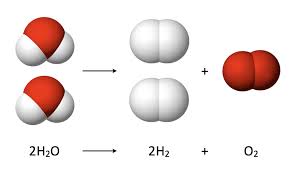
Water splitting is the chemical reaction in which water is broken down into oxygen and hydrogen:
2 H2O → 2 H2 + O2 Efficient and economical photochemical water splitting would be a technological breakthrough that could underpin a hydrogen economy. No industrially practical version of water splitting with pure water has been demonstrated, but the two component reactions (H2 production and O2 production) are well known. The water splitting of seawater and other salt water is used industrially to make chlorine, however, and the waste hydrogen collected comprises about five percent of the world's supply. A version of water splitting occurs in photosynthesis, but hydrogen is not produced. The reverse of water splitting is the basis of the hydrogen fuel cell.
Water oxidation catalysis (WOC) is the acceleration (catalysis) of the conversion of water into oxygen and protons:
2 H2O → 4 H+ + 4 e− + O2 Many catalysts are effective, both homogeneous catalysts and heterogeneous catalysts. The oxygen evolving complex in photosynthesis is the premier example. There is no interest in generating oxygen by water oxidation since oxygen is readily obtained from air. Instead, interest in water oxidation is motivated by its relevance to water splitting, which would provide "solar hydrogen," i.e. water oxidation would generate the electrons and protons for the production of hydrogen. An ideal WOC would operate rapidly at low overpotential, exhibit high stability and be of low cost, derived from nontoxic components.
Water splitting is the chemical reaction in which water is broken down into oxygen and hydrogen:
2 H2O → 2 H2 + O2 Efficient and economical photochemical water splitting would be a technological breakthrough that could underpin a hydrogen economy. No industrially practical version of water splitting with pure water has been demonstrated, but the two component reactions (H2 production and O2 production) are well known. The water splitting of seawater and other salt water is used industrially to make chlorine, however, and the waste hydrogen collected comprises about five percent of the world's supply. A version of water splitting occurs in photosynthesis, but hydrogen is not produced. The reverse of water splitting is the basis of the hydrogen fuel cell.
Your question was an ambiguous issue for me too. Here is what I’ve found now and would like to share it with you.
The water oxidation is almost a process which happen in natural systems like photosynthesis also by some bacteria. Since, oxygen is abundant in air, achieving and improving artificial water oxidation by its own is not the final target of interest for us. On the other hand, hydrogen production by splitting water using solar energy (photoelectrochemical (PEC) water splitting) toward exploiting sustainable energies has become a great topic of research. To fulfil this, first and challenging step is oxidation water (the following equation) as the half reaction of water splitting. 2 H2O → 4 H+ + 4 e− + O2 Generating molecular hydrogen (not ions) which can be save in gas form is the rest of water splitting process. Consequently, water oxidation can be considered as an initial and sub-reaction of water splitting in hydrogen economy. Yet, it should be mentioned that not always water oxidation yields in hydrogen production, but also can be employed for providing electrons for other reduction-reactions.
Your question was an ambiguous issue for me too. Here is what I’ve found now and would like to share it with you.
The water oxidation is almost a process which happen in natural systems like photosynthesis also by some bacteria. Since, oxygen is abundant in air, achieving and improving artificial water oxidation by its own is not the final target of interest for us. On the other hand, hydrogen production by splitting water using solar energy (photoelectrochemical (PEC) water splitting) toward exploiting sustainable energies has become a great topic of research. To fulfil this, first and challenging step is oxidation water (the following equation) as the half reaction of water splitting. 2 H2O → 4 H+ + 4 e− + O2 Generating molecular hydrogen (not ions) which can be save in gas form is the rest of water splitting process. Consequently, water oxidation can be considered as an initial and sub-reaction of water splitting in hydrogen economy. Yet, it should be mentioned that not always water oxidation yields in hydrogen production, but also can be employed for providing electrons for other reduction-reactions.
Water oxidation catalysis (WOC) is the acceleration (catalysis) of the conversion of water into oxygen and protons:
2 H2O → 4 H+ + 4 e− + O2 Many catalysts are effective, both homogeneous catalysts and heterogeneous catalysts. The oxygen evolving complex in photosynthesis is the premier example. There is no interest in generating oxygen by water oxidation since oxygen is readily obtained from air. Instead, interest in water oxidation is motivated by its relevance to water splitting, which would provide "solar hydrogen," i.e. water oxidation would generate the electrons and protons for the production of hydrogen. An ideal WOC would operate rapidly at low overpotential, exhibit high stability and be of low cost, derived from nontoxic components.
Water splitting is the chemical reaction in which water is broken down into oxygen and hydrogen:
2 H2O → 2 H2 + O2 Efficient and economical photochemical water splitting would be a technological breakthrough that could underpin a hydrogen economy. No industrially practical version of water splitting with pure water has been demonstrated, but the two component reactions (H2 production and O2 production) are well known. The water splitting of seawater and other salt water is used industrially to make chlorine, however, and the waste hydrogen collected comprises about five percent of the world's supply. A version of water splitting occurs in photosynthesis, but hydrogen is not produced. The reverse of water splitting is the basis of the hydrogen fuel cell.
Water oxidation catalysis (WOC) is the acceleration (catalysis) of the conversion of water into oxygen and protons:
2 H2O → 4 H+ + 4 e− + O2 Many catalysts are effective, both homogeneous catalysts and heterogeneous catalysts. The oxygen evolving complex in photosynthesis is the premier example. There is no interest in generating oxygen by water oxidation since oxygen is readily obtained from air. Instead, interest in water oxidation is motivated by its relevance to water splitting, which would provide "solar hydrogen," i.e. water oxidation would generate the electrons and protons for the production of hydrogen. An ideal WOC would operate rapidly at low overpotential, exhibit high stability and be of low cost, derived from nontoxic components.
Water splitting is the chemical reaction in which water is broken down into oxygen and hydrogen:
2 H2O → 2 H2 + O2 Efficient and economical photochemical water splitting would be a technological breakthrough that could underpin a hydrogen economy. No industrially practical version of water splitting with pure water has been demonstrated, but the two component reactions (H2 production and O2 production) are well known. The water splitting of seawater and other salt water is used industrially to make chlorine, however, and the waste hydrogen collected comprises about five percent of the world's supply. A version of water splitting occurs in photosynthesis, but hydrogen is not produced. The reverse of water splitting is the basis of the hydrogen fuel cell.
if water is both oxidized and reduced in the same time in different compartments that"s overall water splitting reaction Water oxidation and water reduction are half reactions of water splitting, in electrolysis they proceed in two compartments, anodic and cathodic, separated by membrane
if water is both oxidized and reduced in the same time in different compartments that"s overall water splitting reaction Water oxidation and water reduction are half reactions of water splitting, in electrolysis they proceed in two compartments, anodic and cathodic, separated by membrane
Sorry, I was trying to be funny. Yurii already provided very usefull information. For future reference just think about the following: is it thermodynamically possible to transform A into B without increasing entropy? "Water splitting" would be exactly this. As Yurii already mentioned, you can think of water oxidation as the first step of water splitting (a two step process which starts with oxidation followed by reduction).
Sorry, I was trying to be funny. Yurii already provided very usefull information. For future reference just think about the following: is it thermodynamically possible to transform A into B without increasing entropy? "Water splitting" would be exactly this. As Yurii already mentioned, you can think of water oxidation as the first step of water splitting (a two step process which starts with oxidation followed by reduction).
Mário Silva your opinion " I believe the most important difference to be that oxidation occurs, while splitting might be doable but never was done. Tough, it would be great to produce H2 for fuel "is exactly correct but ,with considering the overpotantial of reduction of H+ to H2 is 0.00 V and increasing entropy in this half reaction is considerable note
Mário Silva your opinion " I believe the most important difference to be that oxidation occurs, while splitting might be doable but never was done. Tough, it would be great to produce H2 for fuel "is exactly correct but ,with considering the overpotantial of reduction of H+ to H2 is 0.00 V and increasing entropy in this half reaction is considerable note
Mohammad Kooti finally we can say that if water both oxidize and reduce in the same time thats water splitting reaction and if oxidize alone thats water oxidation reaction. thanks a lot
Mohammad Kooti finally we can say that if water both oxidize and reduce in the same time thats water splitting reaction and if oxidize alone thats water oxidation reaction. thanks a lot


Dear Somayeh Shams your answer is quietly correct and This is what I wanted to know, thanks.
Dear Somayeh Shams your answer is quietly correct and This is what I wanted to know, thanks.
More
VOTE
Water oxidation catalysis (WOC) is the acceleration (catalysis) of the conversion of water into oxygen and protons:
2 H2O → 4 H+ + 4 e− + O2
Many catalysts are effective, both homogeneous catalysts and heterogeneous catalysts. The oxygen evolving complex in photosynthesis is the premier example. There is no interest in generating oxygen by water oxidation since oxygen is readily obtained from air. Instead, interest in water oxidation is motivated by its relevance to water splitting, which would provide "solar hydrogen," i.e. water oxidation would generate the electrons and protons for the production of hydrogen. An ideal WOC would operate rapidly at low overpotential, exhibit high stability and be of low cost, derived from nontoxic components.
Water splitting is the chemical reaction in which water is broken down into oxygen and hydrogen:
2 H2O → 2 H2 + O2
Efficient and economical photochemical water splitting would be a technological breakthrough that could underpin a hydrogen economy. No industrially practical version of water splitting with pure water has been demonstrated, but the two component reactions (H2 production and O2 production) are well known. The water splitting of seawater and other salt water is used industrially to make chlorine, however, and the waste hydrogen collected comprises about five percent of the world's supply. A version of water splitting occurs in photosynthesis, but hydrogen is not produced. The reverse of water splitting is the basis of the hydrogen fuel cell.
Water oxidation catalysis (WOC) is the acceleration (catalysis) of the conversion of water into oxygen and protons:
2 H2O → 4 H+ + 4 e− + O2
Many catalysts are effective, both homogeneous catalysts and heterogeneous catalysts. The oxygen evolving complex in photosynthesis is the premier example. There is no interest in generating oxygen by water oxidation since oxygen is readily obtained from air. Instead, interest in water oxidation is motivated by its relevance to water splitting, which would provide "solar hydrogen," i.e. water oxidation would generate the electrons and protons for the production of hydrogen. An ideal WOC would operate rapidly at low overpotential, exhibit high stability and be of low cost, derived from nontoxic components.
Water splitting is the chemical reaction in which water is broken down into oxygen and hydrogen:
2 H2O → 2 H2 + O2
Efficient and economical photochemical water splitting would be a technological breakthrough that could underpin a hydrogen economy. No industrially practical version of water splitting with pure water has been demonstrated, but the two component reactions (H2 production and O2 production) are well known. The water splitting of seawater and other salt water is used industrially to make chlorine, however, and the waste hydrogen collected comprises about five percent of the world's supply. A version of water splitting occurs in photosynthesis, but hydrogen is not produced. The reverse of water splitting is the basis of the hydrogen fuel cell.
More
VOTE
Yurii V Geletii
Right
thank you
Yurii V Geletii
Right
thank you
More
VOTE
Dear Mansoor Khodabandehlo ,
Your question was an ambiguous issue for me too. Here is what I’ve found now and would like to share it with you.
The water oxidation is almost a process which happen in natural systems like photosynthesis also by some bacteria. Since, oxygen is abundant in air, achieving and improving artificial water oxidation by its own is not the final target of interest for us. On the other hand, hydrogen production by splitting water using solar energy (photoelectrochemical (PEC) water splitting) toward exploiting sustainable energies has become a great topic of research. To fulfil this, first and challenging step is oxidation water (the following equation) as the half reaction of water splitting.
2 H2O → 4 H+ + 4 e− + O2
Generating molecular hydrogen (not ions) which can be save in gas form is the rest of water splitting process.
Consequently, water oxidation can be considered as an initial and sub-reaction of water splitting in hydrogen economy.
Yet, it should be mentioned that not always water oxidation yields in hydrogen production, but also can be employed for providing electrons for other reduction-reactions.
Regards,
Dear Mansoor Khodabandehlo ,
Your question was an ambiguous issue for me too. Here is what I’ve found now and would like to share it with you.
The water oxidation is almost a process which happen in natural systems like photosynthesis also by some bacteria. Since, oxygen is abundant in air, achieving and improving artificial water oxidation by its own is not the final target of interest for us. On the other hand, hydrogen production by splitting water using solar energy (photoelectrochemical (PEC) water splitting) toward exploiting sustainable energies has become a great topic of research. To fulfil this, first and challenging step is oxidation water (the following equation) as the half reaction of water splitting.
2 H2O → 4 H+ + 4 e− + O2
Generating molecular hydrogen (not ions) which can be save in gas form is the rest of water splitting process.
Consequently, water oxidation can be considered as an initial and sub-reaction of water splitting in hydrogen economy.
Yet, it should be mentioned that not always water oxidation yields in hydrogen production, but also can be employed for providing electrons for other reduction-reactions.
Regards,
More
VOTE
Water oxidation catalysis (WOC) is the acceleration (catalysis) of the conversion of water into oxygen and protons:
2 H2O → 4 H+ + 4 e− + O2
Many catalysts are effective, both homogeneous catalysts and heterogeneous catalysts. The oxygen evolving complex in photosynthesis is the premier example. There is no interest in generating oxygen by water oxidation since oxygen is readily obtained from air. Instead, interest in water oxidation is motivated by its relevance to water splitting, which would provide "solar hydrogen," i.e. water oxidation would generate the electrons and protons for the production of hydrogen. An ideal WOC would operate rapidly at low overpotential, exhibit high stability and be of low cost, derived from nontoxic components.
Water splitting is the chemical reaction in which water is broken down into oxygen and hydrogen:
2 H2O → 2 H2 + O2
Efficient and economical photochemical water splitting would be a technological breakthrough that could underpin a hydrogen economy. No industrially practical version of water splitting with pure water has been demonstrated, but the two component reactions (H2 production and O2 production) are well known. The water splitting of seawater and other salt water is used industrially to make chlorine, however, and the waste hydrogen collected comprises about five percent of the world's supply. A version of water splitting occurs in photosynthesis, but hydrogen is not produced. The reverse of water splitting is the basis of the hydrogen fuel cell.
Water oxidation catalysis (WOC) is the acceleration (catalysis) of the conversion of water into oxygen and protons:
2 H2O → 4 H+ + 4 e− + O2
Many catalysts are effective, both homogeneous catalysts and heterogeneous catalysts. The oxygen evolving complex in photosynthesis is the premier example. There is no interest in generating oxygen by water oxidation since oxygen is readily obtained from air. Instead, interest in water oxidation is motivated by its relevance to water splitting, which would provide "solar hydrogen," i.e. water oxidation would generate the electrons and protons for the production of hydrogen. An ideal WOC would operate rapidly at low overpotential, exhibit high stability and be of low cost, derived from nontoxic components.
Water splitting is the chemical reaction in which water is broken down into oxygen and hydrogen:
2 H2O → 2 H2 + O2
Efficient and economical photochemical water splitting would be a technological breakthrough that could underpin a hydrogen economy. No industrially practical version of water splitting with pure water has been demonstrated, but the two component reactions (H2 production and O2 production) are well known. The water splitting of seawater and other salt water is used industrially to make chlorine, however, and the waste hydrogen collected comprises about five percent of the world's supply. A version of water splitting occurs in photosynthesis, but hydrogen is not produced. The reverse of water splitting is the basis of the hydrogen fuel cell.
More
VOTE
if water is both oxidized and reduced in the same time in different compartments that"s overall water splitting reaction
Water oxidation and water reduction are half reactions of water splitting, in electrolysis they proceed in two compartments, anodic and cathodic, separated by membrane
if water is both oxidized and reduced in the same time in different compartments that"s overall water splitting reaction
Water oxidation and water reduction are half reactions of water splitting, in electrolysis they proceed in two compartments, anodic and cathodic, separated by membrane
More
VOTE
The potential required to oxidize water is
E = 1.24 - 0.059*pH
to reduce water
E=0.059*pH,
to split water E 1.24 V (pH independent)
The potential required to oxidize water is
E = 1.24 - 0.059*pH
to reduce water
E=0.059*pH,
to split water E 1.24 V (pH independent)
More
VOTE
Dear Mansoor Khodabandehlo ,
Sorry, I was trying to be funny. Yurii already provided very usefull information. For future reference just think about the following: is it thermodynamically possible to transform A into B without increasing entropy? "Water splitting" would be exactly this. As Yurii already mentioned, you can think of water oxidation as the first step of water splitting (a two step process which starts with oxidation followed by reduction).
Cheers!
Dear Mansoor Khodabandehlo ,
Sorry, I was trying to be funny. Yurii already provided very usefull information. For future reference just think about the following: is it thermodynamically possible to transform A into B without increasing entropy? "Water splitting" would be exactly this. As Yurii already mentioned, you can think of water oxidation as the first step of water splitting (a two step process which starts with oxidation followed by reduction).
Cheers!
More
VOTE
Mário Silva
your opinion " I believe the most important difference to be that oxidation occurs, while splitting might be doable but never was done. Tough, it would be great to produce H2 for fuel "is exactly correct but ,with considering the overpotantial of reduction of H+ to H2 is 0.00 V and increasing entropy in this half reaction is considerable note
Mário Silva
your opinion " I believe the most important difference to be that oxidation occurs, while splitting might be doable but never was done. Tough, it would be great to produce H2 for fuel "is exactly correct but ,with considering the overpotantial of reduction of H+ to H2 is 0.00 V and increasing entropy in this half reaction is considerable note
More
VOTE
Stephen Adalikwu @
Thanks for the useful information provided. Much appreciated
Stephen Adalikwu @
Thanks for the useful information provided. Much appreciated
More
VOTE
You are welcome
You are welcome
More
VOTE
Mohammad Kooti
finally we can say that if water both oxidize and reduce in the same time thats water splitting reaction
and if oxidize alone thats water oxidation reaction.
thanks a lot
Mohammad Kooti
finally we can say that if water both oxidize and reduce in the same time thats water splitting reaction
and if oxidize alone thats water oxidation reaction.
thanks a lot
More
VOTE