Fraunhofer Researchers Produce Bio-based Chemicals using Fungi for Cosmetic good
Using Renewable Raw Materials
If you find a layer of blue-green mold covering your bread, fruit or something else from your pantry, you’ll quite rightly end up throwing it out with the garbage – fungi are after all harmful to your health. Researchers at the Fraunhofer Institute for Interfacial Engineering and Biotechnology IGB in Stuttgart, however, are particularly keen on molds, and in particular the genus Aspergillus. They’re also enthusiastic about Yeast and smut fungi. Why? “Fungi have long been indispensable for antibiotic production or in the food industry. The fungi we employ help us to synthesize a variety of chemicals in a CO2-neutral way. They’re the basis for detergents, emulsifiers, cosmetics and pharmaceuticals, pesticides, and plastics,” says Prof. Steffen Rupp, deputy director of Fraunhofer IGB and head of the Department of Molecular Biotechnology.
In contrast to petroleum, extracting chemicals from renewable raw materials doesn’t release CO2 into the atmosphere. And using fungi as production organisms has another major advantage: The pool of potential production organisms is almost inexhaustible, as is the range of renewable raw materials they can convert. As the fungi employ a host of different metabolic pathways, they produce an astonishing variety of products, which can be used in a wide range of applications.
From Malic acid to BIO-Surfactants and Polyesters
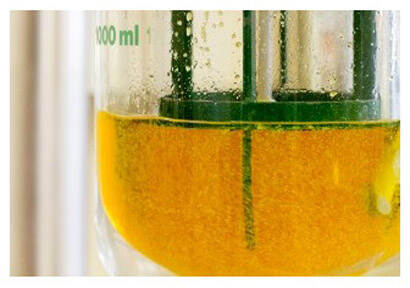
Researchers at Fraunhofer IGB produce a wide variety of chemicals using fungi. One example is malic acid. There is a continually growing market for the substance, which gives products such as jams and juices a sour taste and improves the shelf life of baked goods. It can also be used as a building block for bio-based polyesters. And, in a process similar to brewing beer, it can be produced using molds. In beer brewing, the yeast ferments the malt sugar of the barley, while in malic acid production Aspergillus fungi convert sugar or vegetable oils.
This can be done by “feeding”, for instance, a wood-based sugar solution to the fungi to get them to generate malic acid. Fermentation like this works well on a laboratory scale. The IGB researchers are currently investigating ways to scale up the process for commercialization, in particular, by improving the fermentation yield.
Using a similar process, they can also create surface-active agents that can be used to produce detergents, emulsifiers, active ingredients for cosmetics, pharmaceutics, and pesticides. That’s where the smut fungi come into play. They’re parasites that infest plants, making them look like they’ve been burned – hence their Germanic name, Brandpilze [burnt fungi]. “The process is another one we’re actively developing for industrial production. Our principal goal is to optimize the composition of the biosurfactants we produce to suit various applications in the field of detergents and emulsifiers,” explains Dr. Susanne Zibek, head of the Industrial Biotechnology Group.
Yeasts are also interesting producers. In addition to brewing beer, as previously mentioned, certain yeasts can also be used to produce molecules that are essential for synthesizing novel plastics, such as long-chain dicarboxylic acids. The researchers at Fraunhofer IGB have succeeded in working out a process to produce long-chain dicarboxylic acids from a strain of Candida.

You May Interested In


High Quality β-Nicotinamide adenine dinucleotide CAS 53-84-9 NADwith ready stock and best price
$3/UNIT FOB


2026-10-18
Trade Alert
Delivering the latest product trends and industry news straight to your inbox.
(We'll never share your email address with a third-party.)

Related News
-
From “Made in China” to “Created in China”
-
COSMOPROF WORLDWIDE BOLOGNA PRESENTS “THE INVISIBLE BEAUTY”, THE PROJECT REVEALING WHAT MAKES BEAUTY POSSIBLE
-
Skin longevity, biotech, fragrance and sensory beauty take centre stage as in-cosmetics Asia returns to Bangkok
-
Skin longevity, biotech, fragrance and sensory beauty take centre stage as in-cosmetics Asia returns to Bangkok
-
COSMOPROF WORLDWIDE BOLOGNA ANNOUNCES 2027 DATES AND UNVEILS A NEW LAYOUT FOR ITS 60TH ANNIVERSARY EDITION
-
in-cosmetics Global launches the first Nutricosmetics Ingredient Index
-
in-cosmetics Global reveals line-up for 2026 programme curated for innovation
-
IN-COSMETICS GLOBAL TO LAUNCH FIRST DEDICATED INNER BEAUTY ZONE FOR NUTRICOSMETIC INNOVATIONS IN 2026
-
COSMOPROF WORLDWIDE BOLOGNA 2026: A GLOBAL BEAUTY ECOSYSTEM IN CONTINUOUS EVOLUTION
-
French Cosmetics Exports Poised for First Drop in Over Two Decades in 2025
Recommend Reading
-
![Two Saudi Crude Supertankers Hit in Hormuz as Brent Surges to Nearly $95]()
Two Saudi Crude Supertankers Hit in Hormuz as Brent Surges to Nearly $95
-
![Chung Lien Oil’s 8,000-Ton Soybean Oil BaP Scandal: NT$165 Million Fine, 401 Product Recalls, Source Still Unknown]()
Chung Lien Oil’s 8,000-Ton Soybean Oil BaP Scandal: NT$165 Million Fine, 401 Product Recalls, Source Still Unknown
-
![India’s Latest Manufacturing Clarification Is Really a Delayed Regulatory Line in the Sand]()
India’s Latest Manufacturing Clarification Is Really a Delayed Regulatory Line in the Sand
-
![Global Ag M&A in 2025 Looked Less Like Expansion and More Like Selection]()
Global Ag M&A in 2025 Looked Less Like Expansion and More Like Selection
-
![“The 40-Year Ethylene Giant Collapses”: ExxonMobil’s Premature Shutdown Is Not Just Scotland’s Tragedy—It’s the Twilight Elegy of European Industrial Civilization]()
“The 40-Year Ethylene Giant Collapses”: ExxonMobil’s Premature Shutdown Is Not Just Scotland’s Tragedy—It’s the Twilight Elegy of European Industrial Civilization
-
![Chemical Properties of Dibenzylideneacetone]()
Chemical Properties of Dibenzylideneacetone
-
![Will 2026 Bring a Turnaround After DMF Prices Hit Bottom in 2025 in China?]()
Will 2026 Bring a Turnaround After DMF Prices Hit Bottom in 2025 in China?
-
![China’s Acetone Market in 2025 Continues to Decline, Constantly Reaching New Lows]()
China’s Acetone Market in 2025 Continues to Decline, Constantly Reaching New Lows
-
![In December, the ammonium sulfate market in China showed a weak downward trend]()
In December, the ammonium sulfate market in China showed a weak downward trend
-
![Business Society: China’s Bisphenol A Market Stops Falling and Starts Rising in December]()
Business Society: China’s Bisphenol A Market Stops Falling and Starts Rising in December