Trichlorovinylsilane 75-94-5
ISO
75-94-5
Industrial Grade
99%
200KG/drum
2023-07-25

Flavors & Fragrances,Catalyst & Auxiliary,Intermediates,Dyes & Pigments,Inorganic Chemistry,petro chemicals
-
Product Description
-
Seller Information
-
DescriptionTrichlorovinylsilane 75-94-5 (CAS No.: 75-94-5) is supplied by NANTONG REFORM PETRO-CHEMICAL CO.,LTD, a Manufactory with 4 years on ECHEMI. Key details: grade Industrial Grade, content 99%, packaging 200KG/drum. Contact the supplier on this page to request a quotation or the latest price.ECHEMI Editorial ReferenceColorless or pale-yellow liquid. Readily hydrolyzed with liberation of hydrogen chloride; polymerizes easily; soluble in most organic solvents; reacts with alcohol.
Vinyltrichlorosilane appears as a colorless to pale yellow fuming liquid with a pungent odor. Vapor and liquid may cause burns. More dense than water. Vapors are heavier than air.|Liquid
Vinyltrichlorosilane appears as a colorless to pale yellow fuming liquid with a pungent odor. Vapor and liquid may cause burns. More dense than water. Vapors are heavier than air.CertificatesBasic Info-
Product Name:
Vinyltrichlorosilane
Other Name:Silane,trichloroethenyl-;Silane,trichlorovinyl-;Trichloroethenylsilane;Trichlorovinylsilane;Vinylsilicon trichloride;Vinyltrichlorosilane;VTCS;A 150;Trichlorovinylsilicon;A 150 (silane);KA 1003;Vinylsilyl trichloride;TSL 8303;NSC 93872;Dynasylan VTC;3-Vinyltrichlorosilane;Silquest A 150;127290-37-3
CAS No.:75-94-5
Molecular Formula:C2H3Cl3Si
InChIKeys:InChIKey=GQIUQDDJKHLHTB-UHFFFAOYSA-N
Molecular Weight:161.49
Exact Mass:161.49
BRN:1743440
EC Number:200-917-8
UNII:Q423F9NPBA
NSC Number:93872
UN Number:1305
DSSTox ID:DTXSID8026430
Color/Form:Fuming liquid|Liquid|Colorless or pale yellow liquid
HScode:29319090
Categories:
Characteristics-
PSA:
0
XLogP3:4.79
Appearance:colorless liquid
Density:1.2426 g/cm3 @ Temp: 20 °C
Melting Point:-95 °C
Boiling Point:91.5 °C
Flash Point:51 °F
Refractive Index:1.455
Water Solubility:Solubility in water: reaction.;Very soluble in chloroform
Storage Conditions:0-6°C
Vapor Pressure:60 mm Hg ( 23 °C)
Vapor Density:>1 (vs air)
Toxicity:Oral-Rat LD50: 1280 mg/kg; Inhalation-Rat LCL0: 500 PPM/ 4 hours
Flammability characteristics:It is flammable in case of open flame, high temperature and oxidant; high temperature decomposes toxic phosgene; emits poisonous mist of chloride in water
Explosive limit:Vapors can form explosive mixtures with air.
Odor:Sharp, choking; like hydrochloric acid
Experimental Properties:Reacts violently with water, moist air, or steam to produce toxic and corrosive fumes|Reacts with alcohol|Readily hydrolyzed, with liberation of hydrogen chloride; polymerizes easily|The reaction of organosilanes with halogens and halogen cmpd usually proceeds in good yield through cleavage of the Si--H bond and formation of the silicon-halogen bond. Reaction with fluorine, however, does not proceed satisfactorily because of cleavage of not only the Si--H but also C--Si and C--H bonds. Direct halogenation with chlorination, bromine, and iodine proceeds smoothly, however. /Organosilanes/
Air and Water Reactions:Highly flammable. Fumes in air. Reacts violently with water, steam, moist air, alcohols, acetone, light metals with generation of heat and combustible (H2) and corrosive (HCl) gases [Handling Chemicals Safely 1980. p. 924]. Vinyltrichlorosilane reacts vigorously with water to generate gaseous HCl. Based on a scenario where the chemical is spilled into an excess of water (at least 5 fold excess of water), half of the maximum theoretical yield of Hydrogen Chloride gas will be created in 0.18 minutes. Experimental details are in the following: "Development of the Table of Initial Isolation and Protective Distances for the 2008 Emergency Response Guidebook", ANL/DIS-09-2, D.F. Brown, H.M. Hartmann, W.A. Freeman, and W.D. Haney, Argonne National Laboratory, Argonne, Illinois, June 2009.
Reactive Group:Hydrocarbons, Aliphatic Unsaturated
Reactivity Alerts:Highly Flammable
Reactivity Profile:Chlorosilanes, such as VINYLTRICHLOROSILANE, are compounds in which silicon is bonded to from one to four chlorine atoms with other bonds to hydrogen and/or alkyl groups. Chlorosilanes react with water, moist air, or steam to produce heat and toxic, corrosive fumes of hydrogen chloride. They may also produce flammable gaseous H2. They can serve as chlorination agents. Chlorosilanes react vigorously with both organic and inorganic acids and with bases to generate toxic or flammable gases.
Autoignition Temperature:505 °F (USCG, 1999)|505 °F (263 °C)
Heat of Combustion:-4,300 Btu/lb = -2,400 cal/g = -100x10-5 J/kg
Flammable Limits:Lower flammable limit: 3% by volume
Corrosivity:Corrosive
Heat of Vaporization:88 Btu/lb = 49 cal/g = 2.0X10+5 J/kg
Hazard IdentificationClassification of the substance or mixture
Flammable liquids, Category 2
Acute toxicity - Category 4, Oral
Acute toxicity - Category 3, Dermal
Skin corrosion, Sub-category 1A
Acute toxicity - Category 3, Inhalation
GHS label elements, including precautionary statements
Pictogram(s) 
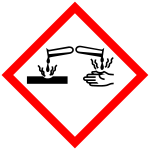
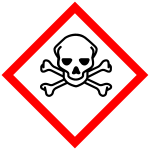
Signal word Danger
Hazard statement(s) H225 Highly flammable liquid and vapour
H302 Harmful if swallowed
H311 Toxic in contact with skin
H314 Causes severe skin burns and eye damage
H331 Toxic if inhaled
Precautionary statement(s) Prevention P210 Keep away from heat, hot surfaces, sparks, open flames and other ignition sources. No smoking.
P233 Keep container tightly closed.
P240 Ground and bond container and receiving equipment.
P241 Use explosion-proof [electrical/ventilating/lighting/...] equipment.
P242 Use non-sparking tools.
P243 Take action to prevent static discharges.
P280 Wear protective gloves/protective clothing/eye protection/face protection/hearing protection/...
P264 Wash ... thoroughly after handling.
P270 Do not eat, drink or smoke when using this product.
P260 Do not breathe dust/fume/gas/mist/vapours/spray.
P261 Avoid breathing dust/fume/gas/mist/vapours/spray.
P271 Use only outdoors or in a well-ventilated area.
Response P303+P361+P353 IF ON SKIN (or hair): Take off immediately all contaminated clothing. Rinse affected areas with water [or shower].
P370+P378 In case of fire: Use ... to extinguish.
P301+P317 IF SWALLOWED: Get medical help.
P330 Rinse mouth.
P302+P352 IF ON SKIN: Wash with plenty of water/...
P316 Get emergency medical help immediately.
P321 Specific treatment (see ... on this label).
P361+P364 Take off immediately all contaminated clothing and wash it before reuse.
P301+P330+P331 IF SWALLOWED: Rinse mouth. Do NOT induce vomiting.
P363 Wash contaminated clothing before reuse.
P304+P340 IF INHALED: Remove person to fresh air and keep comfortable for breathing.
P305+P351+P338 IF IN EYES: Rinse cautiously with water for several minutes. Remove contact lenses, if present and easy to do. Continue rinsing.
Storage P403+P235 Store in a well-ventilated place. Keep cool.
P405 Store locked up.
P403+P233 Store in a well-ventilated place. Keep container tightly closed.
Disposal P501 Dispose of contents/container to an appropriate treatment and disposal facility in accordance with applicable laws and regulations, and product characteristics at time of disposal.
Other hazards which do not result in classification
no data available
Handling and StoragePrecautions for safe handling
Handling in a well ventilated place. Wear suitable protective clothing. Avoid contact with skin and eyes. Avoid formation of dust and aerosols. Use non-sparking tools. Prevent fire caused by electrostatic discharge steam.
Conditions for safe storage, including any incompatibilities
Store the container tightly closed in a dry, cool and well-ventilated place. Store apart from foodstuff containers or incompatible materials.
-
-
Seller Information
-
Business Type:
Manufactory
-
Main Products:
Flavors & Fragrances,Catalyst & Auxiliary,Intermediates,Dyes & Pigments,Inorganic Chemistry,petro chemicals
-
Location:
17th Yuanlin Road ,Chongchuan area ,Nantong city ,Jiangsu province ,China
-
Payment Terms:
L/C,100% TT in advance
-
Average lead Time:
2 days
-
Total Annual Revenue:
Above $100 million
-
Total Employees:
201-300
-
Year of Establishment:
2008
Company Certificates-
 GB/T19001-2016 / Iso9001:2015
-
-
Country Product Purchase Quantity Date Posted Post an enquiry for this product
More from this Seller
-
-

-
3-Diethylaminophenol CAS91-68-9
Industrial Grade / 99%
-
-
-

-
Naphthalene
Industrial Grade / 99%
-
-
-

-
2-Aminoacetophenone
Industrial Grade / 99%
-
-
-

-
Ethylene glycol CAS NO.107-21-1 ethane-1, 99% High Quality Chemical Raw Materials
Industrial Grade / 99%
-
-
-

-
Cupric fluoride
Industrial Grade / 99%
-
-
-

-
PERKADOX PF-DBM25 CAS1931-62-0
Industrial Grade / 99%
-