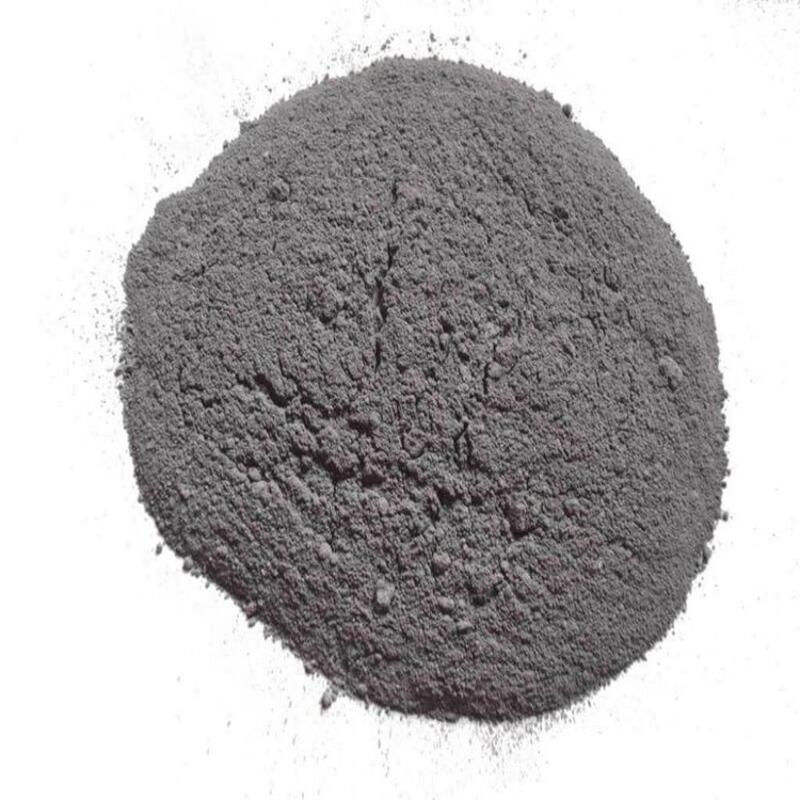


Nickel Powder Flake
TDS 6 Inquiries
7440-02-0
Industrial Grade
99.5%
Shanghai
Entrepreneur
1kg /bag, 25kg/drum
Yes
2024-02-29

Flavor & Fragrance Ingredients,Plasticizer,API,Pharmaceutical Intermediates,Thermal Powder,Plant Extract
-
Product Description
-
Seller Information
-
Inquiry History
-
DescriptionECHEMI Editorial Referencesilver white, hard, malleable metal chunks or grey powder RANEY NICKEL is a hard, ductile, magnetic metal with a silver-white color.
Metal catalyst, wetted appears as an extremely fine gray powder mixed with water. Insoluble in water and does not react with larger volumes of water.|Lustrous, silvery, odorless metallic solid. Insoluble in water.|Raney Nickel catalyst, is extremely fine powdered nickel. It is grayish colored. Insoluble in water. Nickel catalyst is used to promote the chemical action in manufacturing synthetics and to process vegetable oil and petroleum. If exposed to air or moisture, it may become hot enough to ignite. It is insoluble in water and does not react with larger volumes of water.|DryPowder; DryPowder, OtherSolid; OtherSolid; OtherSolid, Liquid; PelletsLargeCrystals; PelletsLargeCrystals, OtherSolid; WetSolid|SILVERY METALLIC LUSTROUS SOLID IN VARIOUS FORMS.|Lustrous, silvery odorless metal|Metal: Lustrous, silvery, odorless solid.
Metal catalyst, wetted appears as an extremely fine gray powder mixed with water. Insoluble in water and does not react with larger volumes of water.|Lustrous, silvery, odorless metallic solid. Insoluble in water.|Raney Nickel catalyst, is extremely fine powdered nickel. It is grayish colored. Insoluble in water. Nickel catalyst is used to promote the chemical action in manufacturing synthetics and to process vegetable oil and petroleum. If exposed to air or moisture, it may become hot enough to ignite. It is insoluble in water and does not react with larger volumes of water.|Nickel is a very abundant natural element. Pure nickel is a hard, silvery-white metal. Nickel can be combined with other metals, such as iron, copper, chromium, and zinc, to form alloys. These alloys are used to make coins, jewelry, and items such as valves and heat exchangers. Most nickel is used to make stainless steel.Nickel can combine with other elements such as chlorine, sulfur, and oxygen to form nickel compounds. Many nickel compounds dissolve fairly easy in water and have a green color. Nickel compounds are used for nickel plating, to color ceramics, to make some batteries, and as substances known as catalysts that increase the rate of chemical reactions.Nickel is found in all soil and is emitted from volcanoes. Nickel is also found in meteorites and on the ocean floor. Nickel and its compounds have no characteristic odor or taste.|Nickel atom is chemical element (nickel group element atom) with atomic number 28. It has a role as an epitope and a micronutrient. It is a nickel group element atom and a metal allergen.|Nickel occurs naturally in the environment at low levels. Nickel is an essential element in some animal species, and it has been suggested it may be essential for human nutrition. Nickel dermatitis, consisting of itching of the fingers, hands, and forearms, is the most common effect in humans from chronic (long-term) skin contact with nickel. Respiratory effects have also been reported in humans from inhalation exposure to nickel. Human and animal studies have reported an increased risk of lung and nasal cancers from exposure to nickel refinery dusts and nickel subsulfide. Animal studies of soluble nickel compounds (i.e., nickel carbonyl) have reported lung tumors. EPA has classified nickel refinery dust and nickel subsulfide as Group A, human carcinogens, and nickel carbonyl as a Group B2, probable human carcinogen.|Nickel is a Standardized Chemical Allergen. The physiologic effect of nickel is by means of Increased Histamine Release, and Cell-mediated Immunity.|Nickel is an element with atomic symbol Ni, atomic number 28, and atomic weight 58.69.|A trace element with the atomic symbol Ni, atomic number 28, and atomic weight 58.69. It is a cofactor of the enzyme UREASE.CertificatesBasic Info-
Product Name:
Nickel
Other Name:Nickel;C.I. 77775;Raney nickel;Ni 4303T;NP 2;Nickel element;Novamet HCA 1;Fibrex;Alcan 756;Fibrex P;E 12 (metal);E 12;NDHT 90;Fukuda 287;Nikko 255;Celmet;Fibrex (metal fiber);SF 300;N 1;Trimag;Trimag (metal);DNI 20;Novamet 4SP;T 123;Novamet NI 255;NI 255AC;NI 287;NI 123;NDT 90;N 154;R 239;R 239 (catalyst);Incofoam;Carbonyl Nickel 123;Carbonyl Nickel 287;Novamet 4SP10;Carbonyl 255;Ni-Flake 95;Carbonyl Ni 283;Carbonyl Nickel 283;Carbonyl Ni 123;Novamet 525;NOT 90;Celmet 4;CHT;CNS 10 Micron;NDT 65;R 205;SO 550;SNP 551;SNP 122;B 113W;SO 850;Exmet 4 Ni X-4/0;SFR-Ni;T 287;T 287 (metal);T 123 (metal);Cerac N 2003;Carbonyl nickel;T 210H;Fibrex P (metal);SNP-YH 6;Nicrobraz LM:BNi 2;Raney 2800;Ni 210;PF 20;PF 20 (metal);NDT 60;R 200 (metal);R 200;NiFW;NiFL;Novamet CNS 400;2020SS;SN 300;N 100ES;N 1000 (metal);SF-Ni;N 1000;HDNP 400;YH 641;Ni-J 20;CNP 525;NI 110104;B 111W;Celmet 8;UT 3PM;Novamet 123;NN 20;YH-623;Raney nickel 2800;Inco 210;CNS 20 Micron;CNS 20 μ;4SP400;Celmet 6;NN 100;H 467;BP 113EXP-B;NFP 201;HCA 1;SO 100A;SO 250G;SO 750;Ni Celmet;Sun Ti-Ni;Nicobraz LM BNI2;SS 2020;NFP 401;T 255;Nikko Rica 123;FV 50D;NFP 201S;Raney-Ni;2020SUS;2007SUS;Nickel nanoparticles;CNS 10;CNi 123;NiS 10;NI 313463;Ni 255;NIE 02PB;N 525;Nickel foam;RTH 2123E;CAT 1600;LC-Ni;Raney Ni 4200;Raney 5886;Raney 2486;Raney 3110;Raney Ni 3202;Raney 3202;Raney Ni 3110;Raney 4200;Raney Ni 2800;Raney Ni 5886;8049-31-8;17375-04-1;39303-46-3;53527-81-4;112084-17-0;134631-46-2;195161-84-3;623574-57-2;878162-96-0;1250376-70-5;1250376-73-8;1262528-31-3;1437722-77-4;1437723-06-2;1437723-36-8;1628452-65-2;2088200-08-0;2230258-36-1
CAS No.:7440-02-0
Molecular Formula:Ni
InChIKeys:InChIKey=PXHVJJICTQNCMI-UHFFFAOYSA-N
Molecular Weight:58.69340
Exact Mass:57.93530
EC Number:231-111-4
UNII:7OV03QG267|NUZ5T2QN2V
ICSC Number:0062
UN Number:1378|2881|3077
DSSTox ID:DTXSID2020925
NCI Thesaurus Code:C690
Color/Form:SILVERY METAL|Metal: Lustrous, silvery solid.|Lustrous, white, hard, ferromagnetic metal; face centered cubic crystals|Silvery, malleable, magnetic metal
HScode:38151100
Categories:
Characteristics-
PSA:
0
XLogP3:0.00000
Appearance:Metal catalyst, wetted appears as an extremely fine gray powder mixed with water. Insoluble in water and does not react with larger volumes of water.
Density:8.908 g/cm3
Melting Point:1455 °C
Boiling Point:2730 °C
Water Solubility:Insoluble
Storage Conditions:Flammables area
Vapor Pressure:0 mmHg (approx)
Vapor Density:5.8 (vs air)
Flammability characteristics:Metal: Combustible Solid; nickel sponge catalyst may ignite SPONTANEOUSLY in air.
Odor:Odorless
Experimental Properties:Heat capacity @ 25 °C: 6.23 cal/g-atom/deg C; Mohs' hardness 3.8; latent heat of fusion 73 cal/g; electrical resistivity @ 20 °C: 6.844 microohms/cm; burns in oxygen, forming nickel oxide; decomp steam @ a red heat; slowly attacked by dil hydrochloric or sulfuric acid; readily attacked by nitric acid; five naturally occurring isotopes: 58 (67.76%); 60 (26.16%); 61 (1.25%); 62 (3.66%); 64 (1.16%); artificial isotopes: 56; 57; 59; 63; 65-67|Not attacked by fused alkali hydroxides|Readily fabricated by hot and cold working; takes high polish|Atomic number 28; valence 2; seldom 1,3,4|For more Other Experimental Properties (Complete) data for NICKEL, ELEMENTAL (6 total), please visit the HSDB record page.
Air and Water Reactions:May ignite spontaneously in air. Insoluble in water.|Insoluble in water.|Pyrophoric, Ignites spontaneously in the presence of air; during storage, H2 escapes with fire and explosion hazards; reacts violently with acids forming H2. [Handling Chemicals Safely 1980. p. 807].
Reactive Group:Metals, Elemental and Powder, Active
Reactivity Alerts:Strong Reducing Agent
Reactivity Profile:NICKEL CATALYST tends to react with oxidizing agents. If exposed to air may react rapidly enough to ignite. Can generate hydrogen gas with fire and explosion hazards during storage [Handling Chemicals Safely 1980. p. 807]. Reacts violently with acids forming gaseous hydrogen. May react with azo/diazo compounds to form explosive products. Can catalyze polymerization reactions in several classes of organic compounds; these polymerizations sometimes proceed rapidly or even explosively. May form explosive products with halogenated hydrocarbons.|NICKEL METAL is not highly reactive in bulk. A reducing agent. Reacts with (is corroded by) acids to generate flammable hydrogen. Burns when heated in oxygen. Incompatible with oxidizing agents such as oxidizing acids, ammonium nitrate, chlorine, potassium perchlorate, nitryl fluoride. Powdered nickel is much more reactive; can ignite in air [Bretherick 1979 p. 170-171].|Metals, such as METAL CATALYST, are reducing agents and tend to react with oxidizing agents. Their reactivity is strongly influenced by their state of subdivision: in bulk they often resist chemical combination; in powdered form they may react very rapidly. Thus, as a bulk metal it is somewhat unreactive, but finely divided material may be pyrophoric. The metal reacts exothermically with compounds having active hydrogen atoms (such as acids and water) to form flammable hydrogen gas and caustic products. The reactions are less vigorous than the similar reactions of alkali metals, but the released heat can still ignite the released hydrogen. Materials in this group may react with azo/diazo compounds to form explosive products. These metals and the products of their corrosion by air and water can catalyze polymerization reactions in several classes of organic compounds; these polymerizations sometimes proceed rapidly or even explosively. Some metals in this group form explosive products with halogenated hydrocarbons. Can react explosively with oxidizing materials.
Flammable Limits:Flammable ... as dust or fume.|Metal: Combustible Solid; nickel sponge catalyst may ignite SPONTANEOUSLY in air.
Physical Dangers:If dry, it can be charged electrostatically by swirling, pneumatic transport, pouring, etc. Dust explosion possible if in powder or granular form, mixed with air.
Corrosivity:Excellent resistance to corrosion
Hazard IdentificationClassification of the substance or mixture
Skin sensitization, Category 1
Carcinogenicity, Category 2
Specific target organ toxicity â repeated exposure, Category 1
GHS label elements, including precautionary statements
Pictogram(s) 
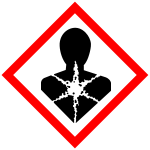
Signal word Danger
Hazard statement(s) H317 May cause an allergic skin reaction
H351 Suspected of causing cancer
H372 Causes damage to organs through prolonged or repeated exposure
Precautionary statement(s) Prevention P261 Avoid breathing dust/fume/gas/mist/vapours/spray.
P272 Contaminated work clothing should not be allowed out of the workplace.
P280 Wear protective gloves/protective clothing/eye protection/face protection/hearing protection/...
P203 Obtain, read and follow all safety instructions before use.
P260 Do not breathe dust/fume/gas/mist/vapours/spray.
P264 Wash ... thoroughly after handling.
P270 Do not eat, drink or smoke when using this product.
Response P302+P352 IF ON SKIN: Wash with plenty of water/...
P333+P317 If skin irritation or rash occurs: Get medical help.
P321 Specific treatment (see ... on this label).
P362+P364 Take off contaminated clothing and wash it before reuse.
P318 IF exposed or concerned, get medical advice.
P319 Get medical help if you feel unwell.
Storage P405 Store locked up.
Disposal P501 Dispose of contents/container to an appropriate treatment and disposal facility in accordance with applicable laws and regulations, and product characteristics at time of disposal.
Other hazards which do not result in classification
no data available
Handling and StoragePrecautions for safe handling
Closed system, dust explosion-proof electrical equipment and lighting. Prevent deposition of dust. Handling in a well ventilated place. Wear suitable protective clothing. Avoid contact with skin and eyes. Avoid formation of dust and aerosols. Use non-sparking tools. Prevent fire caused by electrostatic discharge steam.
Conditions for safe storage, including any incompatibilities
Separated from strong acids.PRECAUTIONS FOR "CARCINOGENS": Storage site should be as close as practicable to lab in which carcinogens are to be used, so that only small quantities required for ... expt need to be carried. Carcinogens should be kept in only one section of cupboard, an explosion proof refrigerator or freezer (depending on chemicophysical properties ...) that bears appropriate label. An inventory ... should be kept, showing quantity of carcinogen & date it was acquired ... Facilities for dispensing ... should be contiguous to storage area. Chemical Carcinogens
-
-
Seller Information
-
Business Type:
Trader
-
Main Products:
Flavor & Fragrance Ingredients,Plasticizer,API,Pharmaceutical Intermediates,Thermal Powder,Plant Extract
-
Location:
Room 902, 917, Hua Teng Bei Tang Business Plaza, No.37 Nan Mo Fang Road, Chao Yang District, Bei Jing, China
-
Payment Terms:
L/C,100% TT in advance
-
Average lead Time:
5 days
-
Total Annual Revenue:
$5 million-$10 million
-
Total Employees:
11-50
-
Year of Establishment:
2001
"> -
-
Inquiry History6 Inquiries
Country Product Purchase Quantity Date Posted  South Korea
Nickel
100 KG Feb 2, 2026  Pakistan
METCO308NS Powder Plasma
50 KG Oct 22, 2025
Pakistan
Nickel
10.00 KG Dec 15, 2023  Qatar
Qatar
Nickel
250 KG Feb 27, 2024  Italy
Italy
NiO powder
50 KG Feb 24, 2024
Pakistan
Nickel powder
1 20' Fcl Oct 30, 2023 Post an enquiry for this product


More from this Seller
-
-

-
ATPN-UV6250 Urethane Acrylate Oligomer
Industrial Grade
-
-
-

-
Coupling Agent 3-Aminopropyltriethoxysilane / KH-550 CAS 919-30-2
Industrial Grade / 95%
-
-
-
, 98%, FG")
-
Vanillyl butyl ether, natural (US), 98%, FG
Cosmetics Grade / 98%
-
-
-

-
99% 2,4-Diamino-6-chloropyrimidine CAS 156-83-2
Chemical Grade / 99%
-
-
-

-
3-Aminocrotononitrile CAS 1118-61-2
Pharmaceutical Grade / 98%
-



Hot Related Products
-
 Solvent for Bulk Buyers") South Korea Origin Supplier Selling Cas No. 67-63-0 Colorless Liquid Isopropyl Alcohol (IPA) Solvent for Bulk Buyers
South Korea Origin Supplier Selling Cas No. 67-63-0 Colorless Liquid Isopropyl Alcohol (IPA) Solvent for Bulk Buyers -
 soda ash Lisa shop
 -
 ISOPROPYL ALCOHOL 99% CAS: 67-63-0 transparent liquid YUSSEN
 -
 Urea 46 %
 -
 urea good
 -
 Chinese high-quality isopropanol supplier 99.9% Isopropyl Alcohol/ipa
 -
") Iso Propanol(IPA)
Iso Propanol(IPA) -
 Isopropyl alcohol-IPA
 -
 TUODA-Sodium carbonate
 -
 Industrial Grade Isopropyl Alcohol IPA CAS 67-63-0 Solvent & Disinfectant