high pure Tellurium Te 99.999% chemical basic material
1 Inquiries
13494-80-9
Industrial Grade
99.999%
USA
schpm
1kg/alumium bag
Yes
2024-02-09
fertilizer,amino acid podwer,amino acid fertiliser,amino acid chelate minerals,amino acid liquid,Compound fertilizer
-
Product Details
-
Seller Information
-
Inquiry History
-
DescriptionECHEMI Editorial ReferenceOdorless, dark-gray to brown, amorphous powder or grayish-white, brittle solid.
Grayish-white, lustrous, brittle, crystalline solid; dark-gray to brown, amorphous powder with metallic characteristics. Used as a coloring agent in chinaware, porcelains, enamels, glass; producing black finish on silverware; semiconductor devices and research; manufacturing special alloys of marked electrical resistance. Improves mechanical properties of lead; powerful carbide stabilizer in cast iron, tellurium vapor in "daylight" lamps, vulcanization of rubber. Blasting caps. Semiconductor research. (EPA, 1998)|DARK GREY-TO-BROWN AMORPHOUS POWDER, WITH METAL CHARACTERISTICS OR SILVERY-WHITE, LUSTROUS CRYSTALLINE SOLID.|Odorless, dark-gray to brown, amorphous powder or grayish-white, brittle solid.
Grayish-white, lustrous, brittle, crystalline solid; dark-gray to brown, amorphous powder with metallic characteristics. Used as a coloring agent in chinaware, porcelains, enamels, glass; producing black finish on silverware; semiconductor devices and research; manufacturing special alloys of marked electrical resistance. Improves mechanical properties of lead; powerful carbide stabilizer in cast iron, tellurium vapor in "daylight" lamps, vulcanization of rubber. Blasting caps. Semiconductor research. (EPA, 1998)|Tellurium atom is a chalcogen and a metalloid atom.|Tellurium is an element with atomic symbol Te, atomic number 52, and atomic weight 127.6.|An element that is a member of the chalcogen family. It has the atomic symbol Te, atomic number 52, and atomic weight 127.60. It has been used as a coloring agent and in the manufacture of electrical equipment. Exposure may cause nausea, vomiting, and CNS depression.Basic Info-
Product Name:
Tellurium
Other Name:Tellurium;Tellurium element;137322-20-4
CAS No.:13494-80-9
Molecular Formula:Te
InChIKeys:InChIKey=PORWMNRCUJJQNO-UHFFFAOYSA-N
Molecular Weight:127.6
Exact Mass:129.906219
EC Number:236-813-4
UNII:NQA0O090ZJ|7F4735942K
ICSC Number:0986
UN Number:1325
DSSTox ID:DTXSID9032119
NCI Thesaurus Code:C95192
Color/Form:Grayish-white, lustrous, brittle, crystalline solid, hexagonal, rhombohedral structure|Dark-gray to brown, amorphous powder with metal characteristics
Categories:
Characteristics-
PSA:
0
XLogP3:-0.15580
Appearance:Silver-white shot
Density:6.11-6.27 g/cm3
Melting Point:449.8 °C
Boiling Point:989.9 °C
Refractive Index:INDEX OF REFRACTION: 1.0025; SADTLER REFERENCE NUMBER: 5272 (IR, PRISM)
Water Solubility:Insoluble
Vapor Pressure:0 mmHg (approx)
Toxicity:Intraperitoneal-rat LDL0: 200mg/kg; Oral-guinea pig LD50: 45mg/kg
Flammability characteristics:High heat, open flame tellurium powder can be combusted to produce toxic tellurium oxide smoke
Explosive limit:A FINELY DIVIDED SUSPENSION /OF ELEMENTAL TELLURIUM/ IN AIR CAN BE EXPLODED.
Odor:Odorless.
Experimental Properties:Diatomic in vapor state; atomic number 52, valence 2, 4, 6; in air dissolves in potassium hydroxide; electrical resistivity at 19.6 °C: 200,000 micro-ohms/cm; reacts with nitric acid, not with hydrochloric acid; linear coefficient of thermal expansion: 16.8X10⁻⁶/deg C; latent heat of fusion: 4.27 kcal/mol; hardness (Mohs): 2.3; magnetic susceptibility at 18 °C: -0.31X10⁻⁶ cgs; specific heat (solid): 0.047 cal/g/deg C|Combines with halogens, does not react with sulfur or selenium; modulus of elasticity: 6000000 psi. ... Eight stable isotopes: 120, 122, 123, 124, 125, 126, 128, 130; reacts with concentrated or fuming sulfuric acid
Air and Water Reactions:A finely divided suspension of elemental tellurium in air will explode. Insoluble in water.
Reactive Group:Metals, Less Reactive
Reactivity Alerts:Pyrophoric
Reactivity Profile:TELLURIUM is attacked by chlorine fluoride with incandescence. When tellurium and potassium are warmed in an atmosphere of hydrogen, combination occurs with incandescence [Mellor 11:40. 1946-47]. Burning tellurium produces toxic tellurium oxide gas. Avoid solid sodium, halogens, interhalogens, metals, hexalithium disilicide. Reacts with nitric acid; reacts with concentrated sulfuric acid forming a red solution. Dissolves in potassium hydroxide in the presence of air with formation of deep red solution; combines with halogens. Avoid antimony and chlorine trifluoride; chlorine trifluoride reacts vigorously with tellurium producing flame. Fluorine and tellurium react with incandescence. Lithium silicide attacks tellurium with incandescence. Reaction with zinc is accompanied by incandescence (same potential with cadmium, only hazard is less). A vigorous reaction results when liquid tellurium is poured over solid sodium [EPA, 1998].
Autoignition Temperature:340 °C
Flammable Limits:Combustible Solid
Heat of Vaporization:46.0 kJ/g
Hazard IdentificationClassification of the substance or mixture
Skin sensitization, Sub-category 1B
Acute toxicity - Category 4, Inhalation
Reproductive toxicity, Category 1B
Hazardous to the aquatic environment, long-term (Chronic) - Category Chronic 4
GHS label elements, including precautionary statements
Pictogram(s) 
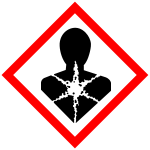
Signal word Danger
Hazard statement(s) H317 May cause an allergic skin reaction
H332 Harmful if inhaled
H413 May cause long lasting harmful effects to aquatic life
Precautionary statement(s) Prevention P261 Avoid breathing dust/fume/gas/mist/vapours/spray.
P272 Contaminated work clothing should not be allowed out of the workplace.
P280 Wear protective gloves/protective clothing/eye protection/face protection/hearing protection/...
P271 Use only outdoors or in a well-ventilated area.
P203 Obtain, read and follow all safety instructions before use.
P273 Avoid release to the environment.
Response P302+P352 IF ON SKIN: Wash with plenty of water/...
P333+P317 If skin irritation or rash occurs: Get medical help.
P321 Specific treatment (see ... on this label).
P362+P364 Take off contaminated clothing and wash it before reuse.
P304+P340 IF INHALED: Remove person to fresh air and keep comfortable for breathing.
P317 Get medical help.
P318 IF exposed or concerned, get medical advice.
Storage P405 Store locked up.
Disposal P501 Dispose of contents/container to an appropriate treatment and disposal facility in accordance with applicable laws and regulations, and product characteristics at time of disposal.
Other hazards which do not result in classification
no data available
Handling and StoragePrecautions for safe handling
NO open flames. Closed system, dust explosion-proof electrical equipment and lighting. Prevent deposition of dust. Handling in a well ventilated place. Wear suitable protective clothing. Avoid contact with skin and eyes. Avoid formation of dust and aerosols. Use non-sparking tools. Prevent fire caused by electrostatic discharge steam.
Conditions for safe storage, including any incompatibilities
Separated from halogens and interhalogens.
-
-
Seller Information
-
Business Type:
Manufactory
-
Main Products:
fertilizer,amino acid podwer,amino acid fertiliser,amino acid chelate minerals,amino acid liquid,Compound fertilizer
-
Location:
DEE PARK NEW YORK USA
-
Payment Terms:
TT against copy of documents,D/P,L/C,D/A,O/A,TT against B/L draft before shipment,100% TT in advance
-
Average lead Time:
10 days
-
Total Annual Revenue:
$25 million-$50 million
-
Total Employees:
301-500
-
Year of Establishment:
1991
-
-
Inquiry History1 Inquiries
Country Product Purchase Quantity Date Posted  South Korea
Tellurium(Te) Ingot or Granluie or Powder
100 KG Sep 9, 2026 Post an enquiry for this product
More from this Seller
-
-

-
Boiler Fuel Top Grade
Industrial Grade / 99.5%
-
-
-

-
Magnesium Fertilizer Industrial Grade Magnesium Sulfate Heptahydrate
Industrial Grade / 98%
-
-
-

-
Bismuth powder 99% see COA kanbei
Industrial Grade / 99%
-
-
-

-
99% White Powder Na2CO3 Soda Ash Dense/Soda Ash Light Sodium Carbonate Washing Soda
Industrial Grade / 99%
-
-
-
 disulfide)")
-
electroplating chemical SPS(Bis-(sodium sulfopropyl) disulfide)
Industrial Grade / 85%
-


Hot Related Products
-
 hydroxalamine hcl .5470-11-1
 -
 Hydroxylamine hydrochloride
 -
 Sodium Sulfide red and yellow flake 60%
 -
 Sodium sulfide 99% Powder 99%
 -
 Reliable Manufacturer Bulk Sodium Sulfide For Mining & Textile Dyeing
 -
 Sodium sulfide 44%
 -
 Sodium sulfide
 -
 Raw Gold Materials 99% Powder SAA89 SAA
$8700-9200/MT FOB
-
 Gold 99% powder 7440-57-5 Dideu
$1/KG FOB
-
 Sodium sulfide Tech Grade 60%