Pure Fenbutatin oxide
1 Inquiries
13356-08-6
Industrial Grade
Rotterdam
Fenbutatin oxide
bags
2025-01-03

ethanol,ascorbic acid,acetone,Poly(ethylene) LDPE,Polypropylene,sodium carbonate
-
Product Description
-
Seller Information
-
Inquiry History
-
DescriptionECHEMI Editorial ReferenceWhite crystalline solid or powder. Mild odorWhite crystalline solid with a mild odor.
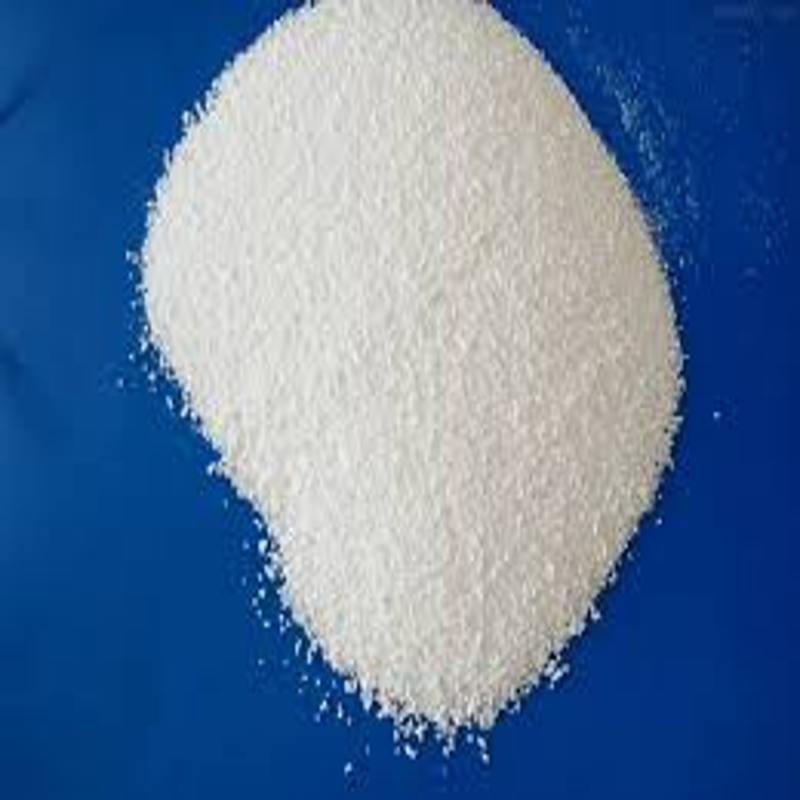
Fenbutatin oxide is a white crystalline solid with a mild odor.|Solid
Fenbutatin oxide is a white crystalline solid with a mild odor.|Fenbutatin oxide is an organotin acaricide.Basic Info-
Product Name:
Fenbutatin oxide
Other Name:Distannoxane,1,1,1,3,3,3-hexakis(2-methyl-2-phenylpropyl)-;Distannoxane,hexakis(β,β-dimethylphenethyl)-;Distannoxane,hexakis(2-methyl-2-phenylpropyl)-;1,1,1,3,3,3-Hexakis(2-methyl-2-phenylpropyl)distannoxane;Trineophyltin oxide;SD 14114;Vendex;Hexakis(2-methyl-2-phenylpropyl)distannoxane;Hexakis(β,β-dimethylphenethyl)distannoxane;Torque (pesticide);Fenbutatin oxide;Neostanox;Torque;Vendex 4L;Hexakis;Osadan;Vendex 4 Liquid;Bis[tris(2-methyl-2-phenylpropyl)tin] oxide;Partner;Bis[tri(2-phenyl-2-methylpropyl)tin] oxide;Bis[tris(2-phenyl-2-methylpropyl)tin] oxide;Bis[tri(2-methyl-2-phenylpropyl)tin] oxide;1,1,1,3,3,3-Hexakis(2,2-dimethyl-2-phenylethyl)distannoxane;12684-28-5;57547-75-8
CAS No.:13356-08-6
Molecular Formula:C60H78OSn2
InChIKeys:InChIKey=HOXINJBQVZWYGZ-UHFFFAOYSA-N
Molecular Weight:1052.68
Exact Mass:1052.68
EC Number:236-407-7
UNII:ZSV4C2L4E7
UN Number:2811
DSSTox ID:DTXSID7032391
Color/Form:White crytalline powder
HScode:2902909090
Categories:
Characteristics-
PSA:
9.2
XLogP3:5.2
Appearance:Fenbutatin oxide is a white crystalline solid with a mild odor.
Density:0.42 g/cm3
Melting Point:138-139 °C
Boiling Point:235-240 °C @ Press: 0.05 Torr
Flash Point:100 °C
Water Solubility:1.27e-05 mg/mL at 20 °C
Storage Conditions:APPROX 4°C
Vapor Pressure:8.5×10 -8 Pa (20 °C)
Toxicity:Oral-rat LD50: 2630 mg/kg; Oral-Mouse LD50: 1450 mg/kg
Flammability characteristics:Thermal decomposition of toxic tin-containing gas
Explosive limit:Not autoflammable but tech. will explode in a dust cloud if ignited.
Odor:Mild odor
Experimental Properties:Water causes conversion of fenbutatin oxide to tris(2-methyl-2-phenylpropyl)tin hydroxide which is reconverted to parent compound slowly at room temperature and rapidly at 98 °C.|Triorganotin oxides and hydroxides are moderately strong bases and react readily with a wide variety of acidic compounds. /Triorganotin oxides/
Air and Water Reactions:Insoluble in water.
Reactive Group:Hydrocarbons, Aromatic
Reactivity Profile:FENBUTATIN OXIDE is in the family of tin compounds widely used as stabilizers for plastics, additives to paint(as antifouling agents). Some have catalytic properties. Examples include butyl tin, dibutyl tin oxide. Their main hazard is associated with their high toxicity, in skin adsorption or inhalation.
Hazard IdentificationClassification of the substance or mixture
Skin irritation, Category 2
Eye irritation, Category 2
Acute toxicity - Category 2, Inhalation
Hazardous to the aquatic environment, short-term (Acute) - Category Acute 1
Hazardous to the aquatic environment, long-term (Chronic) - Category Chronic 1
GHS label elements, including precautionary statements
Pictogram(s) 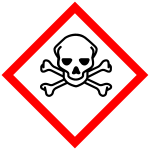

Signal word Danger
Hazard statement(s) H315 Causes skin irritation
H319 Causes serious eye irritation
H330 Fatal if inhaled
H410 Very toxic to aquatic life with long lasting effects
Precautionary statement(s) Prevention P264 Wash ... thoroughly after handling.
P280 Wear protective gloves/protective clothing/eye protection/face protection/hearing protection/...
P260 Do not breathe dust/fume/gas/mist/vapours/spray.
P271 Use only outdoors or in a well-ventilated area.
P284 [In case of inadequate ventilation] wear respiratory protection.
P273 Avoid release to the environment.
Response P302+P352 IF ON SKIN: Wash with plenty of water/...
P321 Specific treatment (see ... on this label).
P332+P317 If skin irritation occurs: Get medical help.
P362+P364 Take off contaminated clothing and wash it before reuse.
P305+P351+P338 IF IN EYES: Rinse cautiously with water for several minutes. Remove contact lenses, if present and easy to do. Continue rinsing.
P304+P340 IF INHALED: Remove person to fresh air and keep comfortable for breathing.
P316 Get emergency medical help immediately.
P320 Specific treatment is urgent (see ... on this label).
P391 Collect spillage.
Storage P403+P233 Store in a well-ventilated place. Keep container tightly closed.
Disposal P501 Dispose of contents/container to an appropriate treatment and disposal facility in accordance with applicable laws and regulations, and product characteristics at time of disposal.
Other hazards which do not result in classification
no data available
Handling and StoragePrecautions for safe handling
Handling in a well ventilated place. Wear suitable protective clothing. Avoid contact with skin and eyes. Avoid formation of dust and aerosols. Use non-sparking tools. Prevent fire caused by electrostatic discharge steam.
Conditions for safe storage, including any incompatibilities
Store the container tightly closed in a dry, cool and well-ventilated place. Store apart from foodstuff containers or incompatible materials.
-
-
Seller Information
-
Business Type:
Distributor
-
Main Products:
ethanol,ascorbic acid,acetone,Poly(ethylene) LDPE,Polypropylene,sodium carbonate
-
Location:
Admiraal Banckertweg 12 2315 SR, Leiden, Zuid-Holland
-
Payment Terms:
TT against copy of documents,L/C,TT against B/L draft before shipment
-
Average lead Time:
45 days
-
Total Annual Revenue:
$1 million-$2.5 million
-
Total Employees:
11-50
-
Year of Establishment:
2010
Company Certificates-
 business
-
-
Inquiry History1 Inquiries
Country Product Purchase Quantity Date Posted  Thailand
Fenbutatin oxide
1 20' Fcl Dec 2, 2024 Post an enquiry for this product
More from this Seller
-
-

-
Pure Sles 70%
Industrial Grade
-
-
-

-
Capryl Glucoside 68515-73-1
Cosmetics Grade
-
-
-

-
Potassium Laurate 10124-65-9
Industrial Grade
-
-
-

-
Hydroxyl Terminated Polybutadiene 69102-90-5
Industrial Grade
-
-
-
")
-
Muriate of Potash (MOP)
Industrial Grade / 60%
-



Hot Related Products
-
 Solvent for Bulk Buyers") South Korea Origin Supplier Selling Cas No. 67-63-0 Colorless Liquid Isopropyl Alcohol (IPA) Solvent for Bulk Buyers
South Korea Origin Supplier Selling Cas No. 67-63-0 Colorless Liquid Isopropyl Alcohol (IPA) Solvent for Bulk Buyers -
 ISOPROPYL ALCOHOL 99% CAS: 67-63-0 transparent liquid YUSSEN
 -
 Chinese high-quality isopropanol supplier 99.9% Isopropyl Alcohol/ipa
 -
") Iso Propanol(IPA)
Iso Propanol(IPA) -
 Isopropyl alcohol-IPA
 -
 Industrial Grade Isopropyl Alcohol IPA CAS 67-63-0 Solvent & Disinfectant
 -
 propanol
 -
 2-Propanol IPA 99.9%
 -
 Isopropyl alcohol 99% liquid
$763.56-954.45/MT EXW
-
 Isopropanol 99.9% Colorless Liquid CAS 67-63-0 Willway Petrochemical