Product
Supplier
Encyclopedia
Inquiry
Acetanilide103-84-4 buy - large image1
Acetanilide103-84-4 buy - image1
Acetanilide103-84-4 buy - image2
Acetanilide103-84-4 buy - image3
Acetanilide103-84-4 buy - image4
Acetanilide103-84-4 buy - image5
Acetanilide103-84-4 buy - image6

Acetanilide103-84-4

5 Inquiries

Unit Price:

$33-34/MT FOB

Get Latest Price
CAS No.:

103-84-4

Grade:

Pharmaceutical Grade

Content:

99.5%

Port:

上海

Brand:

OORENT

Packaging:

Vial/Bottle/Bag/Carton

Price valid (until):

2026-07-16

Company Type:
Trader
Location:
China
Qualification:
Main Products:

pharmaceutical intermediates,peptides,electronic chemicals

  • Product Description

  • Seller Information

  • Inquiry History

  • Description


      Product Detail  


    Acetanilide Basic information
    Product Name: Acetanilide
    Synonyms: ACETIC ACID ANILIDE;ACETYLAMINOBENZENE;ACETYLANILINE;ACETANIL;ACETANILIDE;AKOS BBS-00004291;'LGC' (4002);'LGC' (2605)
    CAS: 103-84-4
    MF: C8H9NO
    MW: 135.16
    EINECS: 203-150-7
    Product Categories: Aromatics;Intermediates & Fine Chemicals;Pharmaceutical Intermediates;Pharmaceuticals;PENTOTHAL;Dyestuff intermediate;API;bc0001
    Mol File: 103-84-4.mol
    Shop Acetanilide103-84-4-Detailed Image 1

    Acetanilide Chemical Properties
    Melting point  113-115 °C(lit.)
    Boiling point  304 °C(lit.)
    bulk density 370kg/m3
    density  1,121 g/cm3
    vapor density  4.65 (vs air)
    vapor pressure  1 mm Hg ( 114 °C)
    refractive index  1.5700 (estimate)
    Fp  173 °C
    storage temp.  Store below +30°C.
    solubility  Slightly soluble in water; very soluble in ethanol and acetone; soluble in ethyl ether.
    pka 0.5(at 25℃)
    form  Powder
    color  Off-white to beige to grayish-blue
    PH 5-7 (10g/l, H2O, 25℃)
    Water Solubility  5 g/L (25 ºC)
    Merck  14,50
    BRN  606468
    Henry's Law Constant 4.7×10² mol/(m3Pa) at 25℃, Yaws (2003)
    Dielectric constant 2.9(22.0℃)
    Stability: Stable. Combustible. Incompatible with strong oxidizing agents, caustics, alkalies.
    Cosmetics Ingredients Functions FRAGRANCE
    PERFUMING
    InChI 1S/C8H9NO/c1-7(10)9-8-5-3-2-4-6-8/h2-6H,1H3,(H,9,10)
    InChIKey FZERHIULMFGESH-UHFFFAOYSA-N
    SMILES CC(=O)Nc1ccccc1
    LogP 1.160
    CAS DataBase Reference 103-84-4(CAS DataBase Reference)
    NIST Chemistry Reference Acetamide, N-phenyl-(103-84-4)
    EPA Substance Registry System Acetanilide (103-84-4)

    Safety Information
    Hazard Codes  Xn
    Risk Statements  22-36/37/38
    Safety Statements  22-26-36
    WGK Germany  1
    RTECS  AD7350000
    Autoignition Temperature 540 °C
    TSCA  TSCA listed
    HS Code  29242995
    Storage Class 11 - Combustible Solids
    Hazard Classifications Acute Tox. 4 Oral
    Hazardous Substances Data 103-84-4(Hazardous Substances Data)
    Toxicity LD50 intragastric in rats: 800 mg/kg (Smith, Hambourger)

    Acetanilide Usage And Synthesis
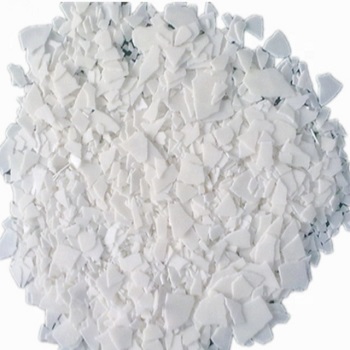
    Chemical Properties Acetanilide, also known as Nphenylacetamide, acetanil, or acetanilide is a white to gray solid with molecular formula CH3CONHC6H5. It is an odorless colorless, glossy, crystalline powder or flakes. Acetanilide was the first aniline derivative found to possess analgesic as well as antipyretic properties and was quickly introduced into medical practice (Weast, 1981; Gnanasambandan et al., 2014). Later, it was established that in the human body it is mostly metabolized to paracetamol, this compound being responsible for the analgesic and antipyretic properties of acetanilide (Bertolini et al., 2006; Gnanasambandan et al., 2014). In addition, it was discovered that it has unacceptable toxic effects, so that acetanilide is no longer used as a drug.
    Shop Acetanilide103-84-4-Detailed Image 2
    Acetanilide is mainly used as an intermediates in the synthesis of pharmaceuticals and dyes, as an additive for hydrogen peroxide and cellulose ester varnishes, and as a plasticizer in polymer industry as well as accelerator in the rubber industry.
    Physical properties White glossy flake crystal or white crystalline powder. Slightly soluble in cold water, soluble in hot water, methanol, ethanol, ether, chloroform, acetone, glycerol and benzene.
    History The department of internal medicine at the University of Strassburg in the 1880s was noted for its investigations into intestinal worms. Adolf Kussmaul, the director, asked two young assistants, Arnold Cahn and Paul Hepp, to treat patients with naphthalene as it had been used elsewhere as an internal antiseptic. The young doctors were disappointed with the initial results, but Hepp persevered with the naphthalene treatment in a patient suffering from a variety of complaints besides worms. Surprisingly, the fever chart revealed a pronounced antipyretic effect from this treatment. This had not been observed before, but further investigation revealed that Hepp had wrongly been supplied by Kopp’s Pharmacy in Strassburg with acetanilide instead of naphthalene! Cahn and Hepp lost no time in publishing a report on their discovery of a new antipyretic.
    For many years after its discovery in 1886, Acetanilide was used as an alternative to aspirin (i.e. acetyl salicylate) - an analgesic (painkiller) and antipyretic (fever reducing) drug to relieve e.g. headache, menstrual pain, and rheumatic pain. Under the name “Acetanilide” it formerly appeared in the formula of a number of patent medicines and over the counter drugs. In 1948, Julius Axelrod and Bernard Brodie discovered that Acetanilide is much more toxic in these applications than other drugs, causing methemoglobinemia and ultimately causing damage to the liver and kidneys. Thus, Acetanilide has largely been replaced by less toxic drugs, in particular acetaminophen (i.e. paracetamol), which is a metabolite of Acetanilide and whose use Axelrod and Brodie suggested in the same study.
    Uses Acetanilide is used as an intermediate in the synthesis of rubber accelerator, dyes and camphor. It is also used in the synthesis of penicillin and other pharmaceutical products. It is involved in the preparation of 4-acetamidobenzenesulfonyl chloride, which is an intermediate during the synthesis of sulfa drugs. Further, it is employed as a experimental photographic developer. In addition to this, it is used to stabilize cellulose ester varnishes.
    Application Acetanilide is used as an inhibitor of hydrogen peroxide decomposition and to stabilize cellulose ester varnishes. It is also used in the intermediation of rubber accelerator synthesis, dyes and dye intermediate synthesis, and camphor synthesis. Acetanilide is used for the production of 4-acetamidobenzenesulfonyl chloride, a key intermediate for the manufacture of the sulfa drugs. It is also a precursor in the synthesis of penicillin and other pharmaceuticals. In the 19th century acetanilide was one of a large number of compounds used as experimental photographic developers.
    Acetanilide is used as a EOF (electroosmotic flow) marker in the studies of affinity capillary electrophoresis for drug–protein binding.
    Acetanilide undergoes palladium-catalyzed cross-coupling reaction to form ortho-acylacetanilide.
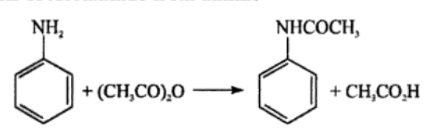
    Preparation Acetanilide is prepared from aniline by acetylating it with acetic anhydride in presence of glacial acetic acid. Aniline reacts with acetic anhydride to form Acetanilide by nucleophilic substitution reaction and the reaction is called acetylation.
    Shop Acetanilide103-84-4-Detailed Image 3
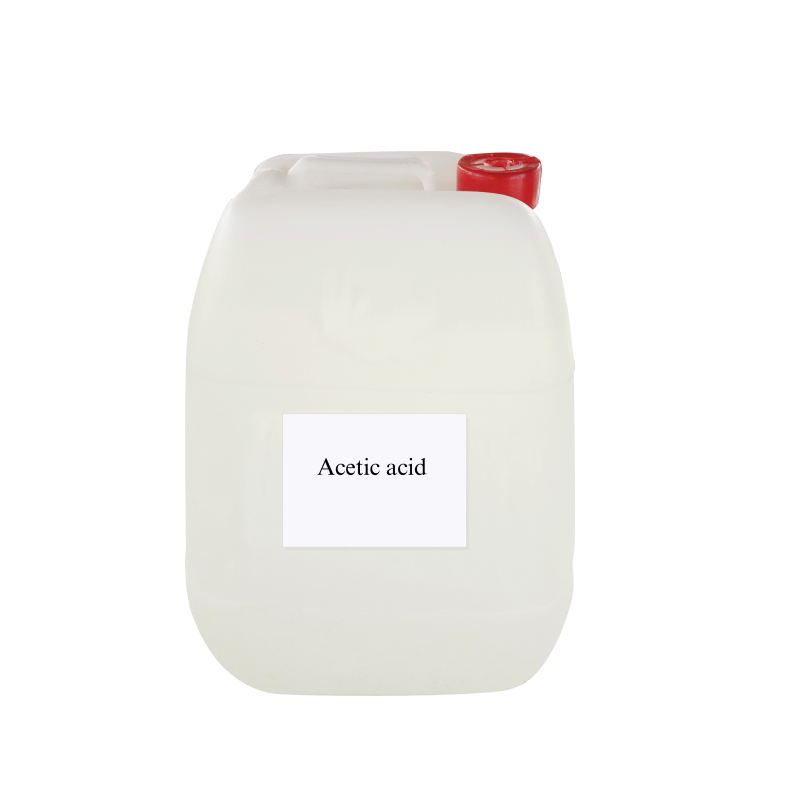
    In a 100 ml round bottom flask fitted with a reflux condensor place 5ml of aniline and 10 ml of 1:1 acetic acid and acetic anhydride mixture (5ml acetic acid and 5 ml acetic anhydride). Heat the mixture gently under reflux for 15-20 minutes on oil bath and then pour the contents while still hot with stirring into a 200ml beaker containing 100ml ice cold water. Stir the mixture vigorously to hydrolyse the excess acetic anhydride. After all the acetanilide has precipitated, collct it on buchner funnel and wash with cold water. Recrystallise the crude product from boiling water. If the product is excessively coloured add a pinch of animal charcoal to hot water and filter hot through glass wool/ cotton plug. Pure colourless crystals of acetanilide melts at 114°C (5-5.5g).
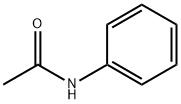
    Definition ChEBI: Acetanilide is a member of the class of acetamides that is acetamide in which one of the hydrogens attached to the nitrogen is substituted by a phenyl group. It has a role as an analgesic. It is a member of acetamides and an anilide. It is functionally related to an acetic acid.
    World Health Organization (WHO) Acetanilide, a para-aminophenol derivative with analgesic, antipyretic and weak antiinflammatory activity, was introduced into medicine in 1886. It subsequently proved to be excessively myelosuppressive and has been superseded by safer alternatives.
    Synthesis Reference(s) Tetrahedron Letters, 24, p. 4533, 1983 DOI: 10.1016/S0040-4039(00)85947-X
    General Description Acetanilide is a white to gray solid. (NTP, 1992)
    Air & Water Reactions Acetanilide is sensitive to prolonged exposure to air . Water insoluble.
    Reactivity Profile Acetanilide is an amide. Flammable gases are formed by the reaction of organic amides with strong reducing agents. Amides are very weak bases (weaker than water). Imides are less basic yet and in fact react with strong bases to form salts. That is, they can react as acids. Mixing amides with dehydrating agents such as P2O5 or SOCl2 generates the corresponding nitrile. The combustion of these compounds generates mixed oxides of nitrogen (NOx).
    Fire Hazard Acetanilide is combustible.
    Potential Exposure This amide compound is used in rubber industry as accelerator, in plastics industry as cellulose ester stabilizer, in pharmaceutical manufacture, stabilizer for hydrogen peroxide, azo dye manufacture
    Shipping UN2811 Toxic solids, organic, n.o.s., Hazard Class: 6.1; Labels: 6.1-Poisonous materials, Technical Name Required.
    Purification Methods Recrystallise acetanilide from water, aqueous EtOH, *benzene or toluene. [Beilstein 12 IV 373.]
    Incompatibilities Dust may form explosive mixture with air. Incompatible with oxidizers (chlorates, nitrates, peroxides, permanganates, perchlorates, chlorine, bromine, fluorine, etc.); contact may cause fires or explosions. Keep away from alkaline materials, strong bases, strong acids, oxoacids, epoxides, alkyl nitrates, alkalis (liberate aniline), chloral hydrate, phenols, ferric salts
    Waste Disposal Add to flammable solvents (alcohol or benzene) and incinerate. Oxides of nitrogenmay be scrubbed from combustion gases with alkaline solution


    Shop Acetanilide103-84-4-Detailed Image 4 Shop Acetanilide103-84-4-Detailed Image 5 Shop Acetanilide103-84-4-Detailed Image 6 Shop Acetanilide103-84-4-Detailed Image 7 Shop Acetanilide103-84-4-Detailed Image 8 Shop Acetanilide103-84-4-Detailed Image 9


    Basic Info
    Product Name:

    Acetanilide

    Other Name:

    Acetamide,N-phenyl-;Acetanilide;N-Phenylacetamide;Acetanil;Acetylaniline;Antifebrin;Benzenamine,N-acetyl-;Acetamidobenzene;Acetoanilide;N-Acetylaniline;Phenalgene;Phenalgin;N-Acetylaminobenzene;NSC 203231;NSC 7636;1-Acetylaminobenzene;Anilino methyl ketone

    CAS No.:

    103-84-4

    Molecular Formula:

    C8H9NO

    InChIKeys:

    InChIKey=FZERHIULMFGESH-UHFFFAOYSA-N

    Molecular Weight:

    135.16

    Exact Mass:

    135.16

    BRN:

    606468

    EC Number:

    203-150-7

    UNII:

    SP86R356CC

    NSC Number:

    757879|7636

    DSSTox ID:

    DTXSID2022543

    Color/Form:

    ORTHORHOMBIC PLATES OR SCALES FROM WATER|WHITE SHINING CRYSTALLINE SCALES|White, shining crystalline leaflets or white crystalline powder.|Colorless, glossy, crystalline material.

    HScode:

    29242995

    Characteristics
    PSA:

    29.1

    XLogP3:

    1.16

    Appearance:

    Off-white to beige to grayish-blue Powder

    Density:

    1.2190 g/cm3 @ Temp: 15 °C

    Melting Point:

    114.3 °C

    Boiling Point:

    304 °C @ Press: 760 Torr

    Flash Point:

    173 °C

    Refractive Index:

    1.5700 (estimate)

    Water Solubility:

    H2O: 5 g/L (25 ºC)

    Storage Conditions:

    Store below +30°C.

    Vapor Pressure:

    1 mm Hg ( 114 °C)

    Vapor Density:

    4.65 (vs air)

    Toxicity:

    Oral-Rat LD50: 800  mg/kg; Oral-Mouse LD50: 1210 mg/kg

    Flammability characteristics:

    Combustible in case of fire, high temperature and strong oxidant; burning and decomposition release toxic nitrogen oxide fumes

    Odor:

    ODORLESS

    Taste:

    SLIGHTLY BURNING

    Dissociation Constants:

    KB: 1X10-13 AT 28 °C|pKa = 0.50 at 25 °C (conjugate acid)

    Collision Cross Section:

    124.17 Ų [M-H]- [CCS Type: DT, Method: single field calibrated with Agilent tune mix (Agilent)]|125 Ų [M+H]+ [CCS Type: TW, Method: calibrated with polyalanine and drug standards]

    Experimental Properties:

    IT FORMS EUTECTIC MIXTURE WITH PHENOL, RESORCINOL, & THYMOL|VAPOR PRESSURE: 1 MM HG @ 114.0 °C

    Air and Water Reactions:

    This compound is sensitive to prolonged exposure to air (NTP, 1992). Water insoluble.

    Reactive Group:

    Amides and Imides

    Reactivity Profile:

    ACETANILIDE is an amide. Flammable gases are formed by the reaction of organic amides with strong reducing agents. Amides are very weak bases (weaker than water). Imides are less basic yet and in fact react with strong bases to form salts. That is, they can react as acids. Mixing amides with dehydrating agents such as P2O5 or SOCl2 generates the corresponding nitrile. The combustion of these compounds generates mixed oxides of nitrogen (NOx).

    Autoignition Temperature:

    1004 °F (NTP, 1992)|985 + or - 10 °F.

    Hazard Identification

    Classification of the substance or mixture

    Acute toxicity - Category 4, Oral

    GHS label elements, including precautionary statements

    Pictogram(s)

    Signal word

    Warning

    Hazard statement(s)

    H302 Harmful if swallowed

    Precautionary statement(s)
    Prevention

    P264 Wash ... thoroughly after handling.

    P270 Do not eat, drink or smoke when using this product.

    Response

    P301+P317 IF SWALLOWED: Get medical help.

    P330 Rinse mouth.

    Storage

    none

    Disposal

    P501 Dispose of contents/container to an appropriate treatment and disposal facility in accordance with applicable laws and regulations, and product characteristics at time of disposal.

    Other hazards which do not result in classification

    no data available

    Handling and Storage

    Precautions for safe handling

    Handling in a well ventilated place. Wear suitable protective clothing. Avoid contact with skin and eyes. Avoid formation of dust and aerosols. Use non-sparking tools. Prevent fire caused by electrostatic discharge steam.

    Conditions for safe storage, including any incompatibilities

    Store the container tightly closed in a dry, cool and well-ventilated place. Store apart from foodstuff containers or incompatible materials.

  • Seller Information
    Business Type:

    Trader

    Main Products:

    pharmaceutical intermediates,peptides,electronic chemicals

    Location:

    Room 102, 1st Floor, East Office Building, No. 45 Pengwan Road, Qianwan Bonded Port Area, Qingdao Zone, China (Shandong) Pilot Free Trade Zone

    Payment Terms:

    100% TT in advance

    Average lead Time:

    10

    Total Annual Revenue:

    $10 million-$25 million

    Total Employees:

    51-100

    Year of Establishment:

    2024

    A reliable supplier is like insurance.

    We are mainly specilized in supply of pharmaceutical intermediates, electronic chemicals,food additives, and other fine chemical products.
    Integrity is the foundation, quality is life. We would like to work together with you to build a greener and brighter future.

    Website: orientchem.cc
    Email: scarlett@orientchem.cc
    WhatsApp: +86 17753254221

  • Inquiry History
    5 Inquiries
    Country Product Purchase Quantity Date Posted
    Russia

    Acetanilide

    2000 KG Jan 21, 2025
    India

    Acetanilide

    1.00 20' Fcl Mar 17, 2025
    Panama

    Acetanilide

    25 KG Apr 11, 2025
    India

    ACETANILIDE

    60.00 MT Aug 7, 2023
    India

    Acetanilide

    1.00 20' Fcl Feb 6, 2024
    Post an enquiry for this product
pic ×

Scan the QR Code to Share

All products displayed on this website are only for non-medical purposes such as industrial applications or scientific research, and cannot be used for clinical diagnosis or treatment of humans or animals. They are not medicinal or edible.

According to relevant laws and regulations and the regulations of this website, units or individuals who purchase hazardous materials should obtain valid qualifications and qualification conditions.

The information shown above is provided by the enterprise itself, and the authenticity, accuracy and legitimacy of the content are the responsibility of the publishing company. ECHEMI does not bear any guarantee responsibility for this. Please be aware that risks in internet transactions objectively exist.

Feedback & Suggestions
Send Message

Thank you for your feedback. If you require further assistance, please contact us by email at info@echemi.com or call us at +86-532-55729510.