Product
Supplier
Encyclopedia
Inquiry
Leaddioxide buy - large image1
Leaddioxide buy - image1
Leaddioxide buy - image2
Leaddioxide buy - image3
Leaddioxide buy - image4
Leaddioxide buy - image5
Leaddioxide buy - image6

Leaddioxide

1 Inquiries

Unit Price:

$33-34/MT FOB

Get Latest Price
CAS No.:

1309-60-0

Grade:

Pharmaceutical Grade

Content:

99.5%

Port:

上海

Brand:

OORENT

Packaging:

Vial/Bottle/Bag/Carton

Price valid (until):

2026-07-17

Company Type:
Trader
Location:
China
Qualification:
Main Products:

pharmaceutical intermediates,peptides,electronic chemicals

  • Product Description

  • Seller Information

  • Inquiry History

  • Description


      Product Detail  

    Lead dioxide Basic information
    Uses
    Product Name: Lead dioxide
    Synonyms: Lead(IV) oxide, Puratronic, 99.995% (Metals basis), 99.995%;LEAD(+4)OXIDE;LEAD DIOXIDE;LEAD PEROXID;LEAD PEROXIDE;LEAD OXIDE, BROWN;LEAD OXIDE, DI;LEAD (SU)PEROXIDE
    CAS: 1309-60-0
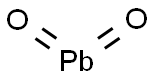
    MF: O2Pb
    MW: 239.2
    EINECS: 215-174-5
    Product Categories: Inorganics;metal oxide
    Mol File: 1309-60-0.mol
    Shop Leaddioxide-Detailed Image 1

    Lead dioxide Chemical Properties
    Melting point  290 °C
    density  9,38 g/cm3
    form  Powder
    color  Brown to black
    Specific Gravity 9.38
    Water Solubility  Insoluble
    Merck  14,5407
    crystal system Nogata
    Space group Pbcn
    Lattice constant
    a/nm b/nm c/nm α/o β/o γ/o V/nm3
    0.4948 0.5951 0.5497 90 90 90 0.1619
    Exposure limits ACGIH: TWA 0.05 mg/m3
    NIOSH: IDLH 100 mg/m3; TWA 0.050 mg/m3
    InChI InChI=1S/2O.Pb
    InChIKey YADSGOSSYOOKMP-UHFFFAOYSA-N
    SMILES [Pb](=O)=O
    CAS DataBase Reference 1309-60-0(CAS DataBase Reference)
    NIST Chemistry Reference Lead dioxide(1309-60-0)
    EPA Substance Registry System Lead dioxide (1309-60-0)

    Safety Information
    Hazard Codes  O,T,N
    Risk Statements  61-8-20/22-33-50/53-62
    Safety Statements  53-45-60-61
    RIDADR  UN 1872
    WGK Germany  3
    RTECS  OG0700000
    TSCA  TSCA listed
    HazardClass  5.1
    PackingGroup  III
    HS Code  28249090
    Storage Class 5.1B - Oxidizing hazardous materials
    Hazard Classifications Acute Tox. 4 Inhalation
    Acute Tox. 4 Oral
    Aquatic Acute 1
    Aquatic Chronic 1
    Ox. Sol. 3
    Repr. 1A
    STOT RE 2
    Hazardous Substances Data 1309-60-0(Hazardous Substances Data)
    Toxicity LD50 i.p. in guinea pigs: 220 mg/kg (Venugopal, Luckey)
    MSDS Information
    Provider Language
    SigmaAldrich English
    ACROS English
    ALFA English

    Lead dioxide Usage And Synthesis
    Uses Lead (IV) oxide (PbO2) is also known as lead dioxide. It is a brown substance important in the operation of the lead-acid storage battery.
    Description Lead dioxide, PbO2, also plumbic oxide, is an odorless dark-brown crystalline powder which is nearly insoluble in water. It exists in two crystalline forms. The a phase has orthorhombic symmetry, lattice constants a=0.497 nm, b=0.596 nm, c= 0.544 nm, Z=4 (four formula units per unit cell).
    Chemical Properties brown to black powder
    Chemical Properties Lead dioxide is a dark brown crystalline solid or powder.
    Physical properties Red tetragonal crystals or brown powder; density 9.64 g/cm3; decomposes on heating at 290°C; practically insoluble in water; also insoluble in alkalis; moderately soluble in hydrochloric acid and also, in nitric acid-hydrogen peroxide mixture; slowly dissolves in acetic acid.
    Occurrence Lead dioxide occurs in nature as the mineral plattnerite. It is used as an oxidizing agent in manufacturing dyes and intermediates. It also is used as a source of oxygen in matches, pyrotechnics, and explosives. In matches, the oxide is combined with amorphous phosphorus as an ignition surface. It also is used in making lead pigments, liquid polysulfide polymers and rubber substitutes. Lead dioxide electrodes are used in lead storage batteries in which lead dioxide accumulates on positive plates.
    Uses Lead dioxide is a strong oxidizing agent that is used in the manufacture of matches, pyrotechnics, dyes and other chemicals. It also has several important applications in the electrochemical industry, in particular as a component of lead–acid batteries used in almost all types of vehicles.
    Uses
    Industry
    Application
    Role/benefit
    Electrochemistry
    Regenerating potassium dichromate
    Anode material/inexpensive and has high oxygen evolution over voltage
    Electroplating copper and zinc in sulfate baths
    Oxidation electrolytic by clarification Water
    Production of glyoxylic acid from oxalic acid in a sulfuric acid electrolyte
    Lead acid batteries
    Rubber
    Vulcanized rubber
    Vulcanizing agent
    Chemical analysis
    Organic elemental analysis and chromatographic analysis
    Analytical reagent
    Others
    Production of matches, pyrotechnics, dyes
    Additive
    High-voltage lightning arresters
    Resistor element
    Coating of pipes
    Helps to reduce lead contamination of drinking water

    Uses Lead dioxide occurs in nature as the mineral plattnerite. It is used as an oxidizing agent in manufacturing dyes and intermediates. It also is used as a source of oxygen in matches, pyrotechnics, and explosives. In matches, the oxide is combined with amorphous phosphorus as an ignition surface. It also is used in making lead pigments, liquid polysulfide polymers and rubber substitutes. Lead dioxide electrodes are used in lead storage batteries in which lead dioxide accumulates on positive plates.
    Preparation Lead dioxide is produced by oxidizing an alkaline slurry of lead monoxide with chlorine, sodium hypochlorite, or bleaching powder. Alternatively, it is obtained by passing chlorine into a hot aqueous suspension of lead sulfate and magnesium hydroxide. The ionic reaction is:
    Pb(OH) +ClOˉ → PbO2 + Clˉ+ OHˉ + H2O
    It also is produced by electrolysis of acidic solutions of lead salts using a lead or platinum electrode. In such electrolytic process, lead dioxide is deposited on the anode of the cell.
    Insoluble powdered lead dioxide also may be obtained when lead tetroxide is heated with nitric acid:
    Pb3 O4 + 4HNO3 → 2Pb(N)3)2 + PbO2 + 2H2O
    Lead dioxide also can be prepared by fusing lead monoxide with a mixture of sodium nitrate and sodium chlorate.
    General Description Brown, hexagonal crystals. Insoluble in water. Used in matches, explosives, electrodes.
    Reactivity Profile Noncombustible but accelerates the burning of combustible material. Reacts violently with hydrogen sulfide [Bretherick 1979. p. 977-978]. Ignites with hydroxylamine [Mellor 8:291. 1946-47]. Reacts violently with hydrogen peroxide [Mellor 1:937 1946-47], with phenylhydrazine [Mellor 7:637 1946-47], or with sulfuryl chloride [Mellor 10:676. 1946-47]. Reacts with incandescence with sulfur dioxide [Mellor, 1941, Vol. 7, 689]. Explodes when ground with boron or yellow phosphorus [Mellor, 1946, Vol. 5, 17]. Mixtures with sulfur and red phosphorus ignite [Mellor, 1941, Vol. 7, 689]. Reacts vigorously when heated with calcium sulfide, strontium sulfide or barium sulfide [Mellor, 1941, Vol. 3, 745].
    Health Hazard Toxic by ingestion. Inhalation of dust is toxic. Fire may produce irritating, corrosive and/or toxic gases. Contact with substance may cause severe burns to skin and eyes. Runoff from fire control or dilution water may cause pollution.
    Fire Hazard These substances will accelerate burning when involved in a fire. May explode from heat or contamination. Some may burn rapidly. Some will react explosively with hydrocarbons (fuels). May ignite combustibles (wood, paper, oil, clothing, etc.). Containers may explode when heated. Runoff may create fire or explosion hazard.
    reaction suitability reagent type: catalyst
    core: lead
    Potential Exposure This material is used in electrodes for lead-acid batteries; in matches; explosives, and as a curing agent for polysulfide elastomers
    First aid If this chemical gets into the eyes, remove anycontact lenses at once and irrigate immediately for at least15 min, occasionally lifting upper and lower lids. Seek medical attention immediately. If this chemical contacts theskin, remove contaminated clothing and wash immediatelywith soap and water. Seek medical attention immediately. Ifthis chemical has been inhaled, remove from exposure,begin rescue breathing (using universal precautions, including resuscitation mask) if breathing has stopped and CPR ifheart action has stopped. Transfer promptly to a medicalfacility. When this chemical has been swallowed, get medical attention. Give large quantities of water and inducevomiting. Do not make an unconscious person vomit.Antidotes and special procedures for lead: Persons with significant lead poisoning are sometimes treated with CaEDTA while hospitalized. This “chelating” drug causes arush of lead from the body organs into the blood and kidneys, and thus has its own hazards, and must be administered only by highly experienced medical personnel undercontrolled conditions and careful observation. Ca EDTA or similar drugs should never be used to prevent poisoningwhile exposure continues or without strict exposure control,as severe kidney damage can result.Note to physician: For severe poisoning BAL [BritishAnti-Lewisite, dimercaprol, dithiopropanol (C3H8OS2)] hasbeen used to treat toxic symptoms of certain heavy metalspoisoning. In the case of lead poisoning it may haveSOME value. Although BAL is reported to have a largemargin of safety, caution must be exercised, because toxiceffects may be caused by excessive dosage. Most can beprevented by premedication with 1-ephedrine sulfate(CAS: 134-72-5).
    storage Color Code—Yellow: Reactive Hazard; Store in alocation separate from other materials, especially flammables and combustibles. Prior to working with this chemical you should be trained on its proper handling andstorage. Lead dioxide must be stored to avoid contact withoxidizers (such as perchlorates, peroxides, permanganates,chlorates and nitrates) chemically active metals (such aspotassium, sodium, magnesium and zinc), since violentreactions occur. Store in tightly closed containers in a cool,well-ventilated area away from combustible materials, suchas wood, paper, and oil. Lead dioxide is regulated byOSHA Standard 1910.1025. All requirements of the standard must be followed. See OSHA Standard 1910.104 andNFPA 43A Code for the Storage of Liquid and SolidOxidizers for detailed handling and storage regulations.
    Shipping UN1872 Lead dioxide, Hazard Class: 5.1; Labels: 5.1-Oxidizer.
    Incompatibilities Lead dioxide is a powerful oxidizer. Violent reaction with many compounds, including reducing agents; chemically active metals; combustible materials, strong acids, alkaline earth sulfides, aluminum carbides, aluminum, amines, calcium sulfide, carbides, chlorine trifluoride, glycerin, hydrides, hydrochloric acid, hydrogen peroxide, hydrogen sulfide, hydroxylamine, magnesium, metal powders, metal sulfides, molybdenum, phenylhydrazine, phosphorous red/friction, phosphorous trichloride, silicon, sulfides, sulfur, sulfur dioxide, sulfur/friction, sulfuric acid, tungsten, hydrogen trisulfide
    Waste Disposal Conversion to soluble salt, precipitation as sulfide and return to supplier. Do not discharge into drains or sewers. Dispose of waste material as hazardous waste using a licensed disposal contractor to an approved landfill. Consult with environmental regulatory agencies for guidance on acceptable disposal practices. Containers must be disposed of properly by following package label directions or by contacting your local or federal environmental control agency, or by contacting your regional EPA office.


    Shop Semaglutide 910463-68-2C187H291N45O59-Detailed Image 3 Shop Semaglutide 910463-68-2C187H291N45O59-Detailed Image 4 Shop Semaglutide 910463-68-2C187H291N45O59-Detailed Image 5 Shop Semaglutide 910463-68-2C187H291N45O59-Detailed Image 6 Shop Semaglutide 910463-68-2C187H291N45O59-Detailed Image 7 Shop Semaglutide 910463-68-2C187H291N45O59-Detailed Image 8


    Basic Info
    Product Name:

    Lead dioxide

    Other Name:

    Lead oxide (PbO2);C.I. 77580;Lead Brown;Lead oxide brown;Lead peroxide;Lead superoxide;Lead peroxide (PbO2);Lead oxide;Lead(IV) oxide;Plumbic oxide;Thiolead A;Lead dioxide;60525-54-4

    CAS No.:

    1309-60-0

    Molecular Formula:

    O2Pb

    InChIKeys:

    InChIKey=YADSGOSSYOOKMP-UHFFFAOYSA-N

    Molecular Weight:

    239.2

    Exact Mass:

    239.20

    EC Number:

    215-174-5

    ICSC Number:

    1001

    UN Number:

    1872

    DSSTox ID:

    DTXSID5025497

    Color/Form:

    Brown, hexagonal crystals|Dark-brown powder|Brownish black crystalline powder consisting of fine crystalline flakes in either alpha- or beta-form.

    HScode:

    2824909000

    Characteristics
    PSA:

    34.14000

    XLogP3:

    -0.61840

    Appearance:

    Brown to black Powder

    Density:

    9.38 g/cm3

    Melting Point:

    290 °C (decomp)

    Refractive Index:

    Index of refraction: omega 2.3 (Li /lamp/)

    Water Solubility:

    H2O: Insoluble

    Storage Conditions:

    Store in a location separate from other materials, especially flammables and combustibles. ... Lead dioxide must be stored to avoid contact with oxidizers (such as perchlorates, peroxides, permagnanates, chlorates and nitrates) and chemically active metals (such as potassium, sodium, magnesium and zinc), since violent reactions occur. Store in tightly closed containers in a cool, well-ventilated area away from combustible materials, such as wood, paper, and oil. Lead dioxide is regulated by OSHA

    Toxicity:

    Abdominal cavity-Guinea pig LD50: 220 mg/kg

    Flammability characteristics:

    Decomposes toxic lead vapor upon heating; combustible with reducing agent, organic matter, sulfur, phosphorus, etc.

    Experimental Properties:

    An oxidizing agent|Evolves oxygen when heated, first forming Pb3O4, at high temperature, PbO.|Decomposes rather easily to the lower oxide, releasing oxygen when heated to 290 °C and above|Heat capacity: 61.5 J/mol-K at 27 °C

    Air and Water Reactions:

    Insoluble in water.

    Reactive Group:

    Oxidizing Agents, Strong

    Reactivity Alerts:

    Strong Oxidizing Agent

    Reactivity Profile:

    LEAD DIOXIDE is a strong oxidizing agent. Noncombustible but accelerates the burning of combustible material. Reacts violently with hydrogen sulfide [Bretherick 1979. p. 977-978]. Ignites with hydroxylamine [Mellor 8:291. 1946-47]. Reacts violently with hydrogen peroxide [Mellor 1:937 1946-47], with phenylhydrazine [Mellor 7:637 1946-47], or with sulfuryl chloride [Mellor 10:676. 1946-47]. Reacts with incandescence with sulfur dioxide [Mellor, 1941, Vol. 7, 689]. Explodes when ground with boron or yellow phosphorus [Mellor, 1946, Vol. 5, 17]. Mixtures with sulfur and red phosphorus ignite [Mellor, 1941, Vol. 7, 689]. Reacts vigorously when heated with calcium sulfide, strontium sulfide or barium sulfide [Mellor, 1941, Vol. 3, 745].

    Hazard Identification

    Classification of the substance or mixture

    Acute toxicity - Category 4, Oral

    Acute toxicity - Category 4, Inhalation

    Reproductive toxicity, Category 1A

    Specific target organ toxicity – repeated exposure, Category 2

    Hazardous to the aquatic environment, short-term (Acute) - Category Acute 1

    Hazardous to the aquatic environment, long-term (Chronic) - Category Chronic 1

    GHS label elements, including precautionary statements

    Pictogram(s)
    Signal word

    Danger

    Hazard statement(s)

    H272 May intensify fire; oxidizer

    H302 Harmful if swallowed

    H332 Harmful if inhaled

    H360 May damage fertility or the unborn child

    H373 May cause damage to organs through prolonged or repeated exposure

    H410 Very toxic to aquatic life with long lasting effects

    Precautionary statement(s)
    Prevention

    P264 Wash ... thoroughly after handling.

    P270 Do not eat, drink or smoke when using this product.

    P261 Avoid breathing dust/fume/gas/mist/vapours/spray.

    P271 Use only outdoors or in a well-ventilated area.

    P203 Obtain, read and follow all safety instructions before use.

    P280 Wear protective gloves/protective clothing/eye protection/face protection/hearing protection/...

    P260 Do not breathe dust/fume/gas/mist/vapours/spray.

    P273 Avoid release to the environment.

    Response

    P301+P317 IF SWALLOWED: Get medical help.

    P330 Rinse mouth.

    P304+P340 IF INHALED: Remove person to fresh air and keep comfortable for breathing.

    P317 Get medical help.

    P318 IF exposed or concerned, get medical advice.

    P319 Get medical help if you feel unwell.

    P391 Collect spillage.

    Storage

    P405 Store locked up.

    Disposal

    P501 Dispose of contents/container to an appropriate treatment and disposal facility in accordance with applicable laws and regulations, and product characteristics at time of disposal.

    Other hazards which do not result in classification

    no data available

    Handling and Storage

    Precautions for safe handling

    NO contact with flammables. NO contact with reducing agents. Handling in a well ventilated place. Wear suitable protective clothing. Avoid contact with skin and eyes. Avoid formation of dust and aerosols. Use non-sparking tools. Prevent fire caused by electrostatic discharge steam.

    Conditions for safe storage, including any incompatibilities

    Separated from food and feedstuffs and incompatible materials. See Chemical Dangers.Keep container tightly closed in a dry and well-ventilated place. Keep in a dry place. Storage class (TRGS 510): Oxidizing hazardous materials.

  • Seller Information
    Business Type:

    Trader

    Main Products:

    pharmaceutical intermediates,peptides,electronic chemicals

    Location:

    Room 102, 1st Floor, East Office Building, No. 45 Pengwan Road, Qianwan Bonded Port Area, Qingdao Zone, China (Shandong) Pilot Free Trade Zone

    Payment Terms:

    100% TT in advance

    Average lead Time:

    10

    Total Annual Revenue:

    $10 million-$25 million

    Total Employees:

    51-100

    Year of Establishment:

    2024

    A reliable supplier is like insurance.

    We are mainly specilized in supply of pharmaceutical intermediates, electronic chemicals,food additives, and other fine chemical products.
    Integrity is the foundation, quality is life. We would like to work together with you to build a greener and brighter future.

    Website: orientchem.cc
    Email: scarlett@orientchem.cc
    WhatsApp: +86 17753254221

  • Inquiry History
    1 Inquiries
    Country Product Purchase Quantity Date Posted
    Pakistan

    Lead dioxide

    1 KG Jul 30, 2025
    Post an enquiry for this product
pic ×

Scan the QR Code to Share

All products displayed on this website are only for non-medical purposes such as industrial applications or scientific research, and cannot be used for clinical diagnosis or treatment of humans or animals. They are not medicinal or edible.

According to relevant laws and regulations and the regulations of this website, units or individuals who purchase hazardous materials should obtain valid qualifications and qualification conditions.

The information shown above is provided by the enterprise itself, and the authenticity, accuracy and legitimacy of the content are the responsibility of the publishing company. ECHEMI does not bear any guarantee responsibility for this. Please be aware that risks in internet transactions objectively exist.

Feedback & Suggestions
Send Message

Thank you for your feedback. If you require further assistance, please contact us by email at info@echemi.com or call us at +86-532-55729510.