Product
Supplier
Encyclopedia
Inquiry
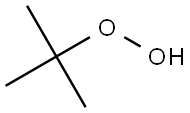
tert-butyl hydroperoxide75-91-2 buy - large image1
tert-butyl hydroperoxide75-91-2 buy - image1
tert-butyl hydroperoxide75-91-2 buy - image2
tert-butyl hydroperoxide75-91-2 buy - image3
tert-butyl hydroperoxide75-91-2 buy - image4
tert-butyl hydroperoxide75-91-2 buy - image5
tert-butyl hydroperoxide75-91-2 buy - image6

tert-butyl hydroperoxide75-91-2

25 Inquiries

Unit Price:

$33-34/MT FOB

Get Latest Price
CAS No.:

75-91-2

Grade:

Industrial Grade

Content:

99.5%

Port:

上海

Brand:

OORENT

Packaging:

Vial/Bottle/Bag/Carton

Price valid (until):

2026-07-17

Company Type:
Trader
Location:
China
Qualification:
Main Products:

pharmaceutical intermediates,peptides,electronic chemicals

  • Product Description

  • Seller Information

  • Inquiry History

  • Description

    Product Detail  


    tert-Butyl hydroperoxide Basic information
    Product Name: tert-Butyl hydroperoxide
    Synonyms: Butylhydroperoxid;1,1-Dimethylethyl hydroperoxide;1,1-dimethylethyl-hydroperoxid;1,1-dimethylethylhydroperoxide;trigonoxa-75(czech);trigonoxa-w70;USP -800;T-HYDRO(R)
    CAS: 75-91-2
    MF: C4H10O2
    MW: 90.12
    EINECS: 200-915-7
    Product Categories: Organic Peroxide;Synthetic Organic Chemistry;Organics
    Mol File: 75-91-2.mol
    Shop tert-butyl hydroperoxide75-91-2-Detailed Image 1

    tert-Butyl hydroperoxide Chemical Properties
    Melting point  -2.8 °C
    Boiling point  37 °C (15 mmHg)
    density  0.937 g/mL at 20 °C
    vapor pressure  62 mmHg at 45 °C
    refractive index  n20/D 1.403
    Fp  85 °F
    storage temp.  2-8°C
    pka pK1: 12.80 (25°C)
    form  Liquid
    color  Clear colorless
    PH 4.3
    Water Solubility  Miscible
    Merck  14,1570
    BRN  1098280
    Henry's Law Constant 4.2×100 mol/(m3Pa) at 25℃, Wang et al. (2017)
    Exposure limits No exposure limit is set. On the basis of its irritant properties a ceiling limit of 1.2 mg/m3 (0.3 ppm) is recommended.
    Stability: Stable, but may explode if heated under confinement. Decomposition may be accelerated by traces of metals, molecular sieve or other contaminants. Incompatible with reducing agents, combustible material, acids.
    InChI 1S/C4H10O2/c1-4(2,3)6-5/h5H,1-3H3
    InChIKey CIHOLLKRGTVIJN-UHFFFAOYSA-N
    SMILES CC(C)(C)OO
    LogP 1.230 (est)
    CAS DataBase Reference 75-91-2(CAS DataBase Reference)
    NIST Chemistry Reference Tert-butyl hydroperoxide(75-91-2)
    EPA Substance Registry System tert-Butyl hydroperoxide (75-91-2)

    Safety Information
    Hazard Codes  O,C,N,T
    Risk Statements  7-10-20/21/22-34-65-52/53-43-67-53-68-51/53-23-21/22
    Safety Statements  14-3/7-61-45-36/37/39-24-17-16-14A-26-62-47-43
    RIDADR  UN 3109 5.2
    WGK Germany  3
    RTECS  EQ4900000
    3-21
    Autoignition Temperature Self-accelerating decomposition at 88 to 93 °C
    TSCA  TSCA listed
    HazardClass  5.2
    PackingGroup  II
    HS Code  29094990
    Storage Class 5.2 - Organic peroxides and self-reacting hazardous materials
    Hazard Classifications Acute Tox. 2 Inhalation
    Acute Tox. 3 Dermal
    Acute Tox. 4 Oral
    Aquatic Acute 1
    Aquatic Chronic 1
    Asp. Tox. 1
    Eye Dam. 1
    Flam. Liq. 3
    Muta. 2
    Org. Perox. F
    Skin Corr. 1C
    Skin Sens. 1
    STOT SE 3
    Hazardous Substances Data 75-91-2(Hazardous Substances Data)
    Toxicity LD50 oral (rat) 406 mg/kg
    LD50 skin (rabbit) 460 mg/kg
    LC50 inhal (rat) 500 ppm (4 h)
    MSDS Information
    Provider Language
    TBHP English
    SigmaAldrich English
    ACROS English
    ALFA English

    tert-Butyl hydroperoxide Usage And Synthesis
    Chemical Properties tert-Butyl hydroperoxide (TBHP) is a water-white liquid commonly commercially available as a 70% solution in water; 80% solutions are also available. It is used to initiate polymerization reactions and in organic syntheses to introduce peroxy groups into the molecule.
    Uses TBHP is an intermediate in the production of propylene oxide and t-butyl alcohol from isobutane and propylene. It is primarily used as an initiator and finishing catalyst in the solution and emulsion polymerization methods for polystyrene and polyacrylates. Other uses are for the polymerization of vinyl chloride and vinyl acetate and as an oxidation and sulfonation catalyst in bleaching and deodorizing operations. It is a strong oxidant and reacts violently with combustible and reducing materials, and metallic and sulfur compounds.
    Uses tert-Butyl hydroperoxide is used as an initiator for radical polymerization and in various oxidation process such as sharpless epoxidation. It is involved in osmium catalyzed vicinal hydroxylation of olefins under alkaline conditions. Furthermore, it is used in catalytic asymmetric oxidation of sulfides to sulfoxides using binaphthol as a chiral auxiliary and in the oxidation of dibenzothiophenes. It plays an important role for the introduction of peroxy groups in organic synthesis.
    Production Methods TBHP is produced by the liquid-phase reaction of isobutane and molecular oxygen or by mixing equimolar amounts of t-butyl alcohol and 30–50% hydrogen peroxide. TBHP can also be prepared from t-butyl alcohol and 30% hydrogen peroxide in the presence of sulfuric acid or by oxidation of tert-butylmagnesium chloride. The manufacturing process of TBHP is in a closed system.
    Description Tert-butyl hydroperoxide is an alkyl hydroperoxide in which the alkyl group is tert-butyl. It is widely used in a variety of oxidation processes. It has a role as an antibacterial agent and an oxidising agent.Shop tert-butyl hydroperoxide75-91-2-Detailed Image 2
    Application tert-Butyl hydroperoxide (t-BOOH) decomposes under the catalysis of metal ions to form other alkoxy and peroxy radicals, thereby generating reactive oxygen species including hydrogen peroxide. This accelerates the chain reaction of lipid peroxidation, leading to DNA damage, cytotoxicity, and alterations in intracellular calcium homeostasis, ultimately causing cellular injury and apoptosis. In scientific research, t-BOOH is frequently employed to induce pharmacological oxidative stress responses and establish an oxidative stress model in cell cultures[3].
    General Description Watery odorless colorless liquid. Floats and mixes slowly with water.
    Reactivity Profile Most alkyl monohydroperoxides are liquid. The explosivity of the lower members (e.g., methyl hydroperoxide, or possibly, traces of the dialkyl peroxides) decreasing with increasing chain length and branching [Bretherick 2nd ed. 1979 p. 10]. Though relatively stable, explosions have been caused by distillation to dryness [Milas, JACS 1946, 68, 205] or attempted distillation at atmospheric pressure [Castrantas 1965 p. 15].
    Health Hazard tert-Butyl hydroperoxide is a strong irritant.Floyd and Stockinger (1958) observed thatdirect cutaneous application in rats did notcause immediate discomfort, but the delayedaction was severe. The symptoms were erythemaand edema within 2–3 days. Exposureto 500 mg in 24 hours produced asevere effect on rabbit skin, while a rinse of150 mg/min was severe to eyes.
    It is moderately toxic; the effects aresomewhat similar to those of MEK peroxide.Symptoms from oral administration in ratswere weakness, shivering, and prostration.
    LD50 value, intraperitoneal (rats): 87 mg/kg
    LD50 value, oral (rats): 406 mg/kg.
    Flammability and Explosibility tert-Butyl hydroperoxide is a flammable liquid and a highly reactive oxidizing agent. Pure TBHP is shock sensitive and may explode on heating. Carbon dioxide or dry chemical extinguishers should be used for fires involving tert-butyl hydroperoxide.
    reaction suitability reagent type: oxidant
    Mechanism of action The general mechanism of transition metal-catalyzed oxidative Mannich reactions of N, N-dialkyl anilines with tert-butyl hydroperoxide (TBHP) as the oxidant consists of a rate-determining single electron transfer (SET) that is uniform from 4-methoxy- to 4-cyano-N, N-dimethylanilines. The tert-butylperoxy radical is the major oxidant in the rate-determining SET step that is followed by competing backward SET and irreversible heterolytic cleavage of the carbon–hydrogen bond at the α-position to nitrogen. A second SET completes the conversion of N, N-dimethylaniline to an iminium ion that is subsequently trapped by the nucleophilic solvent or the oxidant prior to the formation of the Mannich adduct[1].
    Tert-butyl hydroperoxide could induce oxidative stress in liver mitochondria at low concentrations. The damaging effect of low concentrations of tBHP in the course of pyruvate oxidation in isolated liver mitochondria is caused by the opening of the nonspecific Ca2+-dependent cyclosporin A-sensitive pore in the inner mitochondrial membrane[2].
    Safety Profile Moderately toxic by ingestion and inhalation. A severe skin and eye irritant. Mutation data reported. At highest dosage levels, symptoms noted were severe depression, incoordmation, and cyanosis. Death was due to respiratory arrest. Very dangerous fire hazard when exposed to heat or flame, or by spontaneous chemical reaction such as with reducing materials. Moderately explosive; may explode during distillation. Violent reaction with traces of acid. Concentrated solutions may ignite spontaneously on contact with molecular sieve. Mixtures with transition metal salts may react vigorously and release oxygen. Forms an unstable solution with 1,2-dichloroethane. To fight fire, use alcohol foam, CO2, dry chemical. When heated to decomposition it emits acrid smoke and fumes.
    Carcinogenicity A study performed to evaluate the carcinogenicity of TBHP found it was not carcinogenic when applied to the skin of mice at 16.6% of the peroxide 6 times a week for 45 weeks. However, if its application was preceded by 0.05 mg of 4-nitroquinoline-1-oxide as a 0.25% solution in benzene applied 20 times over 7 weeks followed by TBHP (16.6% in benzene), then malignant skin tumors appeared between days 390 and 405 of the experiment . This supports the theory that peroxides are not complete carcinogens, but may act as promoters . The effects of TBHP on promotable and nonpromotable mouse epidermal cell culture lines were reported by Muehlematter et al. .
    storage tert-butyl hydroperoxide should be stored in the dark at room temperature (do not refrigerate) separately from oxidizable compounds, flammable substances, and acids. Reactions involving this substance should be carried out behind a safety shield.
    Toxicity evaluation TBHP accelerates oxidation of glutathione and decreases the metabolism of sodium hexobarbital in rat livers and is a strong oxidation agent.
    Incompatibilities tert-Butyl hydroperoxide and concentrated aqueous solutions of TBHP react violently with traces of acid and the salts of certain metals, including, in particular, manganese, iron, and cobalt. Mixing anhydrous tert-butyl hydroperoxide with organic and readily oxidized substances can cause ignition and explosion. TBHP can initiate polymerization of certain olefins.
    Waste Disposal Excess tert-butyl hydroperoxide and waste material containing this substance should be placed in an appropriate container, clearly labeled, and handled according to your institution's waste disposal guidelines.
    References [1] Maxim O, et al. Mechanistic Investigation of Oxidative Mannich Reaction with tert-Butyl Hydroperoxide. The Role of Transition Metal Salt. Journal of the American Chemical Society, 2013; 135: 1549–1557.
    [2] Fedotcheva N, et al. Mechanism of induction of oxidative stress in liver mitochondria by low concentrations of tert-butyl hydroperoxide. Biochemistry (Moscow), 2013; 78: 75–79.
    [3] MARIO ALÍA. Response of the antioxidant defense system to tert-butyl hydroperoxide and hydrogen peroxide in a human hepatoma cell line (HepG2)†[J]. Journal of Biochemical and Molecular Toxicology, 2005, 19 2: 119-128. DOI:10.1002/jbt.20061.

    Shop Fluorobenzene462-06-6C6H5F-Detailed Image 2 Shop Fluorobenzene462-06-6C6H5F-Detailed Image 3 Shop Fluorobenzene462-06-6C6H5F-Detailed Image 4 Shop Fluorobenzene462-06-6C6H5F-Detailed Image 5 Shop Fluorobenzene462-06-6C6H5F-Detailed Image 6 Shop Fluorobenzene462-06-6C6H5F-Detailed Image 7


    Basic Info
    Product Name:

    tert-Butyl hydroperoxide

    Other Name:

    Hydroperoxide,1,1-dimethylethyl;tert-Butyl hydroperoxide;1,1-Dimethylethyl hydroperoxide;Cadox TBH;Perbutyl H;2-Hydroperoxy-2-methylpropane;Trigonox A-W 70;Kayabutyl H;Perbutyl H 69T;t-Butyl hydroperoxide;Perbutyl H 80;tert-Butyl hydrogen peroxide;TBHP;Perbutyl H 69;Luperox TBH 70X;NSC 672;Luperox H 70;Kayabutyl H 70;T-HYDRO;Luperox TBHP;Peroxan BHP 10;Luperox TBH;H 70;2-Methylpropane-2-peroxol

    CAS No.:

    75-91-2

    Molecular Formula:

    C4H10O2

    InChIKeys:

    InChIKey=CIHOLLKRGTVIJN-UHFFFAOYSA-N

    Molecular Weight:

    90.12

    Exact Mass:

    90.12

    BRN:

    1098280

    EC Number:

    200-915-7

    HScode:

    29094990

    Characteristics
    PSA:

    29.5

    XLogP3:

    -1.3 (calculated)

    Appearance:

    Clear colorless Liquid

    Density:

    0.8960 g/cm3 @ Temp: 20 °C

    Melting Point:

    -8 °C

    Boiling Point:

    35 °C @ Press: 20 Torr

    Flash Point:

    85 °F

    Refractive Index:

    1.399

    Water Solubility:

    Solubility in water: miscible

    Storage Conditions:

    2-8°C

    Vapor Pressure:

    Vapour pressure, kPa at 20°C: 3.07 (calculated)

    Vapor Density:

    Relative vapour density (air = 1): 3.1

    Toxicity:

    Oral-Rat LD50: 406  mg/kg; Oral-Mouse LD50: 710 mg/kg

    Flammability characteristics:

    In case of heat, open flame, reducing agent is flammable; burning produces irritating smoke

    Explosive limit:

    vol% in air: 50

    Hazard Identification

    Classification of the substance or mixture

    Germ cell mutagenicity, Category 2

    GHS label elements, including precautionary statements

    Pictogram(s)

    Signal word

    Warning

    Hazard statement(s)

    H341 Suspected of causing genetic defects

    Precautionary statement(s)
    Prevention

    P203 Obtain, read and follow all safety instructions before use.

    P280 Wear protective gloves/protective clothing/eye protection/face protection/hearing protection/...

    Response

    P318 IF exposed or concerned, get medical advice.

    Storage

    P405 Store locked up.

    Disposal

    P501 Dispose of contents/container to an appropriate treatment and disposal facility in accordance with applicable laws and regulations, and product characteristics at time of disposal.

    Other hazards which do not result in classification

    no data available

    Handling and Storage

    Precautions for safe handling

    NO open flames, NO sparks and NO smoking. NO contact with flammables. Above 43°C use a closed system, ventilation and explosion-proof electrical equipment. Handling in a well ventilated place. Wear suitable protective clothing. Avoid contact with skin and eyes. Avoid formation of dust and aerosols. Use non-sparking tools. Prevent fire caused by electrostatic discharge steam.

    Conditions for safe storage, including any incompatibilities

    Fireproof. Separated from combustible substances and reducing agents. Cool. Inspect container frequently to identify bulging and leaking.

  • Seller Information
    Business Type:

    Trader

    Main Products:

    pharmaceutical intermediates,peptides,electronic chemicals

    Location:

    Room 102, 1st Floor, East Office Building, No. 45 Pengwan Road, Qianwan Bonded Port Area, Qingdao Zone, China (Shandong) Pilot Free Trade Zone

    Payment Terms:

    100% TT in advance

    Average lead Time:

    10

    Total Annual Revenue:

    $10 million-$25 million

    Total Employees:

    51-100

    Year of Establishment:

    2024

    A reliable supplier is like insurance.

    We are mainly specilized in supply of pharmaceutical intermediates, electronic chemicals,food additives, and other fine chemical products.
    Integrity is the foundation, quality is life. We would like to work together with you to build a greener and brighter future.

    Website: orientchem.cc
    Email: scarlett@orientchem.cc
    WhatsApp: +86 17753254221

  • Inquiry History
    25 Inquiries
    Country Product Purchase Quantity Date Posted
    India

    tert-butyl hydroperoxide 

    50.00 KG May 27, 2025
    India

    tert-butyl hydroperoxide

    10.00 MT Jan 19, 2024
    Kuwait

    TERT BUTYL HYDROPEROXIDE

    1.00 KG Mar 24, 2025
    Pakistan

    tert-butyl hydroperoxide

    200.00 L Jan 14, 2025
    India

    tert-Butyl hydroperoxide

    1.00 MT Jul 22, 2024
    Russia

    TBHP

    20 MT May 3, 2024
    Sri Lanka

    Tera Butyl Hydroperoxide

    30.00 KG Feb 18, 2024
    India

    tert-Butyl hydroperoxide

    500.00 KG Mar 3, 2026
    United States

    Tert-butyl hydroperoxide

    10 MT Jan 14, 2026
    United Arab Emirates

    Tert-butyl hydroperoxide

    3.81 MT Dec 4, 2025
    United Arab Emirates

    (TBHP) Tert-butyl Hydroperoxide

    10.00 KG Sep 16, 2025
    Sri Lanka

    tert butyl hydroxyperoxide

    1.00 MT Nov 8, 2024
    Saudi Arabia

    TBHP

    1 40' Fcl Aug 12, 2024
    Kuwait

    Tert-butyl Hydroperoxide (TBHP)

    50.00 KG Aug 5, 2025
    Vietnam

    Tert-butyl hydroperoxide

    20 TON May 22, 2025
    United Arab Emirates

    tert-butyl hydroperoxide

    1.00 20' Fcl Mar 4, 2025
    Germany

    tert-Butyl hydroperoxide solution sol. 70% (75-91-2)

    40 MT Nov 19, 2024
    United Kingdom

    Trigonox

    25 MT Jun 28, 2024
    Pakistan

    Tert-Butyl Hydroperoxide

    5 MT Feb 14, 2024
    South Africa

    TBHP 85% Colorless Transparent Liquid Do Sender

    100 KG Jul 28, 2023
    • 1
    • 2
    • Go to Page Go
    Post an enquiry for this product
pic ×

Scan the QR Code to Share

All products displayed on this website are only for non-medical purposes such as industrial applications or scientific research, and cannot be used for clinical diagnosis or treatment of humans or animals. They are not medicinal or edible.

According to relevant laws and regulations and the regulations of this website, units or individuals who purchase hazardous materials should obtain valid qualifications and qualification conditions.

The information shown above is provided by the enterprise itself, and the authenticity, accuracy and legitimacy of the content are the responsibility of the publishing company. ECHEMI does not bear any guarantee responsibility for this. Please be aware that risks in internet transactions objectively exist.

Feedback & Suggestions
Send Message

Thank you for your feedback. If you require further assistance, please contact us by email at info@echemi.com or call us at +86-532-55729510.