1,4-DIAMINOBUTANE CAS No:110-60-1
TDS 2 Inquiries
110-60-1
Industrial Grade
99%
Qingdao
Orient
25kg/bag,500kg/bag, customized
2027-12-31

pharmaceutical intermediates,peptides,electronic chemicals
-
Product Description
-
Seller Information
-
Inquiry History
-
DescriptionECHEMI Editorial Referencecolourless liquidChEBI: A four-carbon alkane-alpha,omega-diamine. It is obtained by the breakdown of amino acids and is responsible for the foul odour of putrefying flesh.Putrescine is a low-molecular-weight nitrogenous base with the systematic name 1,4-diaminobutane. It is an aliphatic diamine belonging to the group of biogenic amines (Bas). Two basic amino groups are present, which at the physiological pH of 7.4 carry a positive charge that makes them suitable for a wide range of functions in
Solid
Putrescine is a four-carbon alkane-alpha,omega-diamine. It is obtained by the breakdown of amino acids and is responsible for the foul odour of putrefying flesh. It has a role as a fundamental metabolite and an antioxidant. It is a conjugate base of a 1,4-butanediammonium.|Putrescine is a toxic diamine formed by putrefaction from the decarboxylation of arginine and ornithine. Putrescine is a solid. This compound belongs to the polyamines. These are compounds containing more than one amine group. Known drug targets of putrescine include putrescine-binding periplasmic protein, ornithine decarboxylase, and S-adenosylmethionine decarboxylase proenzyme.|Putrescine is a four carbon diamine produced during tissue decomposition by the decarboxylation of amino acids. Polyamines, including putrescine, may act as growth factors that promote cell division; however, putrescine is toxic at high doses.|A toxic diamine formed by putrefaction from the decarboxylation of arginine and ornithine.CertificatesBasic Info-
Product Name:
Putrescine
Other Name:1,4-Butanediamine;Tetramethylenediamine;1,4-Diaminobutane;Putrescine;Putrescin;1,4-Butylenediamine;1,4-Tetramethylenediamine;1,4-Diamino-n-butane;α,ω-Butanediamine;NSC 60545;Putramine;Putrascine
CAS No.:110-60-1
Molecular Formula:C4H12N2
InChIKeys:InChIKey=KIDHWZJUCRJVML-UHFFFAOYSA-N
Molecular Weight:88.15
Exact Mass:88.15
BRN:605282
EC Number:203-782-3
UNII:V10TVZ52E4
NSC Number:60545
DSSTox ID:DTXSID4041107
NCI Thesaurus Code:C129011
Color/Form:Colorless oil|Colorless crystals|Leaflets
HScode:29212900
Categories:
Characteristics-
PSA:
52
XLogP3:-0.70
Appearance:Clear colorless to slightly yellow lyophilized powder
Density:0.877 g/cu cm at 25 deg C
Melting Point:27.5 °C
Boiling Point:158.5 °C
Flash Point:125 °F
Refractive Index:n 20/D 1.457(lit.)
Water Solubility:H2O: almost transparency;cell culture medium: 0.16 mg/mL
Storage Conditions:−20°C
Vapor Pressure:436 Pa (25 °C)
Toxicity:Oral-Mouse LDL0: 1600 mg/kg
Flammability characteristics:Open flame is flammable; high heat decomposes toxic nitrogen oxide fumes
Explosive limit:0.7-11.2%(V)
Odor:Strong piperidine-like odor
PKA:10.8(at 20 °C)
Henrys Law Constant:Henry's Law constant = 3.54X10⁻¹⁰ atm-cu m/mol at 25 °C (est)
Dissociation Constants:pKa = 10.80 (conjugate acid)
Experimental Properties:Crystals on cooling|When heated to decompoistion it emits toxic fumes of NOx.|Crystals from 85% alcohol, mp >275 °C /Putrescine hydrochloride/|Hydroxyl radical reaction rate constant = 6.62X10⁻¹¹ cu cm/molec-sec at 25 °C (est)
Hazard IdentificationClassification of the substance or mixture
Flammable liquids, Category 3
Acute toxicity - Category 4, Oral
Acute toxicity - Category 3, Dermal
Skin corrosion, Sub-category 1B
Serious eye damage, Category 1
Acute toxicity - Category 2, Inhalation
GHS label elements, including precautionary statements
Pictogram(s) 
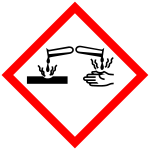
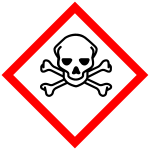
Signal word Danger
Hazard statement(s) H226 Flammable liquid and vapour
H302 Harmful if swallowed
H311 Toxic in contact with skin
H314 Causes severe skin burns and eye damage
H330 Fatal if inhaled
Precautionary statement(s) Prevention P210 Keep away from heat, hot surfaces, sparks, open flames and other ignition sources. No smoking.
P233 Keep container tightly closed.
P240 Ground and bond container and receiving equipment.
P241 Use explosion-proof [electrical/ventilating/lighting/...] equipment.
P242 Use non-sparking tools.
P243 Take action to prevent static discharges.
P280 Wear protective gloves/protective clothing/eye protection/face protection/hearing protection/...
P264 Wash ... thoroughly after handling.
P270 Do not eat, drink or smoke when using this product.
P260 Do not breathe dust/fume/gas/mist/vapours/spray.
P271 Use only outdoors or in a well-ventilated area.
P284 [In case of inadequate ventilation] wear respiratory protection.
Response P303+P361+P353 IF ON SKIN (or hair): Take off immediately all contaminated clothing. Rinse affected areas with water [or shower].
P370+P378 In case of fire: Use ... to extinguish.
P301+P317 IF SWALLOWED: Get medical help.
P330 Rinse mouth.
P302+P352 IF ON SKIN: Wash with plenty of water/...
P316 Get emergency medical help immediately.
P321 Specific treatment (see ... on this label).
P361+P364 Take off immediately all contaminated clothing and wash it before reuse.
P301+P330+P331 IF SWALLOWED: Rinse mouth. Do NOT induce vomiting.
P363 Wash contaminated clothing before reuse.
P304+P340 IF INHALED: Remove person to fresh air and keep comfortable for breathing.
P305+P351+P338 IF IN EYES: Rinse cautiously with water for several minutes. Remove contact lenses, if present and easy to do. Continue rinsing.
P305+P354+P338 IF IN EYES: Immediately rinse with water for several minutes. Remove contact lenses, if present and easy to do. Continue rinsing.
P317 Get medical help.
P320 Specific treatment is urgent (see ... on this label).
Storage P403+P235 Store in a well-ventilated place. Keep cool.
P405 Store locked up.
P403+P233 Store in a well-ventilated place. Keep container tightly closed.
Disposal P501 Dispose of contents/container to an appropriate treatment and disposal facility in accordance with applicable laws and regulations, and product characteristics at time of disposal.
Other hazards which do not result in classification
no data available
Handling and StoragePrecautions for safe handling
Handling in a well ventilated place. Wear suitable protective clothing. Avoid contact with skin and eyes. Avoid formation of dust and aerosols. Use non-sparking tools. Prevent fire caused by electrostatic discharge steam.
Conditions for safe storage, including any incompatibilities
Store the container tightly closed in a dry, cool and well-ventilated place. Store apart from foodstuff containers or incompatible materials.
-
-
Seller Information
-
Business Type:
Trader
-
Main Products:
pharmaceutical intermediates,peptides,electronic chemicals
-
Location:
Room 102, 1st Floor, East Office Building, No. 45 Pengwan Road, Qianwan Bonded Port Area, Qingdao Zone, China (Shandong) Pilot Free Trade Zone
-
Payment Terms:
100% TT in advance
-
Average lead Time:
10
-
Total Annual Revenue:
$10 million-$25 million
-
Total Employees:
51-100
-
Year of Establishment:
2024
-
-
Inquiry History2 Inquiries
Country Product Purchase Quantity Date Posted  Hongkong, China
1,4-DIAMINOBUTANE
50 KG Oct 18, 2024  United States
1,4-Diaminobutane
150 KG Aug 23, 2024 Post an enquiry for this product



- Hot Searches
- price of formic acid
- potassium sulfide
- scopolamine powder for sale
- carbon black price
- butane price
- 1 4 bdo for sale
- heat+shrinkable+fluoropolymer+tubing
- buy nandrolone decanoate
- compound retatrutide
- flour treatment agent
- polypropylene price per ton in nigeria 2026
- where to buy anhydrous ammonia