Quercetin CAS NO.117-39-5 Quercetin content 99%HPLC Canary yellow powder_LYNA Bio
TDS 10 Inquiries
117-39-5
Food Grade
99%
guangzhou
LN
1kg/aluminum foil bag 25kg/drum
2026-09-25

Urolithiasis B/Spermine Hydrochloride/ Apigenin/ Theacrine/FAA/OEA/PEA Theobromine/ Squid Ink Powder
-
Product Description
-
Seller Information
-
Inquiry History
-
DescriptionECHEMI Editorial ReferenceIt is yellow needle-like crystalline powder. It has good thermal stability with the decomposition temperature being 314 °C. It can improve the light-tolerance property of food pigment for preventing the change of the flavor of food. Its color will change in case of metal ion. It is slightly soluble in water, soluble in an alkaline aqueous solution. Quercetin and its derivatives is a kind of flavonoid compound which are widely present in a variety of vegetables and fruits such as onions, sea buc
Quercetin appears as yellow needles or yellow powder. Converts to anhydrous form at 203-207°F. Alcoholic solutions taste very bitter. (NTP, 1992)|Solid
Quercetin appears as yellow needles or yellow powder. Converts to anhydrous form at 203-207°F. Alcoholic solutions taste very bitter. (NTP, 1992)|Quercetin is a pentahydroxyflavone having the five hydroxy groups placed at the 3-, 3'-, 4'-, 5- and 7-positions. It is one of the most abundant flavonoids in edible vegetables, fruit and wine. It has a role as an antibacterial agent, an antioxidant, a protein kinase inhibitor, an antineoplastic agent, an EC 1.10.99.2 [ribosyldihydronicotinamide dehydrogenase (quinone)] inhibitor, a plant metabolite, a phytoestrogen, a radical scavenger, a chelator, an Aurora kinase inhibitor and a geroprotector. It is a pentahydroxyflavone and a 7-hydroxyflavonol. It is a conjugate acid of a quercetin-7-olate.|Quercetin is a flavonol widely distributed in plants. It is an antioxidant, like many other phenolic heterocyclic compounds. Glycosylated forms include RUTIN and quercetrin.|Quercetin is a flavonoid found in many foods and herbs and is a regular component of a normal diet. Extracts of quercetin have been used to treat or prevent diverse conditions including cardiovascular disease, hypercholesterolemia, rheumatic diseases, infections and cancer but have not been shown to be effective in clinical trials for any medical condition. Quercetin as a nutritional supplement is well tolerated and has not been linked to serum enzyme elevations or to episodes of clinically apparent liver injury.|Quercetin is a polyphenolic flavonoid with potential chemopreventive activity. Quercetin, ubiquitous in plant food sources and a major bioflavonoid in the human diet, may produce antiproliferative effects resulting from the modulation of either EGFR or estrogen-receptor mediated signal transduction pathways. Although the mechanism of action of action is not fully known, the following effects have been described with this agent in vitro: decreased expression of mutant p53 protein and p21-ras oncogene, induction of cell cycle arrest at the G1 phase and inhibition of heat shock protein synthesis. This compound also demonstrates synergy and reversal of the multidrug resistance phenotype, when combined with chemotherapeutic drugs, in vitro. Quercetin also produces anti-inflammatory and anti-allergy effects mediated through the inhibition of the lipoxygenase and cyclooxygenase pathways, thereby preventing the production of pro-inflammatory mediators.|A flavonol widely distributed in plants. It is an antioxidant, like many other phenolic heterocyclic compounds. Glycosylated forms include RUTIN and quercetrin.CertificatesBasic Info-
Product Name:
Quercetin
Other Name:4H-1-Benzopyran-4-one,2-(3,4-dihydroxyphenyl)-3,5,7-trihydroxy-;Flavone,3,3′,4′,5,7-pentahydroxy-;Flavone,3,4′,5,5′,7-pentahydroxy-;2-(3,4-Dihydroxyphenyl)-3,5,7-trihydroxy-4H-1-benzopyran-4-one;C.I. 75670;Meletin;3,5,7,3′,4′-Pentahydroxyflavone;Quercetin;Quercetine;Quercetol;Quertine;Sophoretin;Xanthaurine;3,3′,4′,5,7-Pentahydroxyflavone;Cyanidelonon 1522;Quertin;NSC 57655;NSC 9219;2-(3,4-Dihydroxyphenyl)-3,5,7-trihydroxy-4H-benzopyran-4-one;Corvitin;Korvitin;3′-Hydroxykaempferol;LDN 0052529;Lipoflavon;3,5,7-Trihydroxy-2-(3,4-dihydroxyphenyl)-4H-chromen-4-one;2-(3,4-Dihydroxyphenyl)-3,5,7-trihydroxychromen-4-one;2-(3,4-Dihydroxyphenyl)-3,5,7-trihydroxy-4H-chromen-4-one;73123-10-1;74893-81-5
CAS No.:117-39-5
Molecular Formula:C15H10O7
InChIKeys:InChIKey=REFJWTPEDVJJIY-UHFFFAOYSA-N
Molecular Weight:302.24
Exact Mass:302.24
EC Number:204-187-1
UNII:9IKM0I5T1E
NSC Number:9219
UN Number:2811
DSSTox ID:DTXSID4021218
NCI Thesaurus Code:C792
Color/Form:Yellow needles (dilute alcohol, +2 water)
HScode:29329990
Categories:
Characteristics-
PSA:
127
XLogP3:1.5
Appearance:Quercetin appears as yellow needles or yellow powder. Converts to anhydrous form at 203-207°F. Alcoholic solutions taste very bitter. (NTP, 1992)
Density:1.3616 (rough estimate)
Melting Point:316.5 °C
Boiling Point:Sublimes
Flash Point:248.1±25.0 °C
Refractive Index:1.4790 (estimate)
Water Solubility:H2O: <0.1 g/100 mL at 21 ºC
Storage Conditions:Store at 0-5°C
Vapor Pressure:2.81X10⁻¹⁴ mm Hg at 25 deg C (est)
Toxicity:LD50 oral in rat: 161mg/kg
Henrys Law Constant:Henry's Law constant = 6.60X10⁻²¹ atm-cu m/mol at 25 °C (est)
Dissociation Constants:pKa1 = 7.17 (phenol); pKa2 = 8.26 (phenol); pKa3 = 10.13 (phenol); pKa4 = 12.30 (phenol); pKa5 = 13.11 (phenol) (est)
Collision Cross Section:166.7 Ų [M+H]+ [CCS Type: DT, Method: single field calibrated with Agilent tune mix (Agilent)]|158.98 Ų [M-H]- [CCS Type: DT, Method: single field calibrated with Agilent tune mix (Agilent)]|163.4 Ų [M+H]+ [CCS Type: TW, Method: calibrated with polyalanine and drug standards]
Experimental Properties:Yellow needles from dil alcohol. Becomes anhydrous at 95-97 °C. When anhydrous, decomposes at 314 °C; uv max (alcohol) 258, 375 nm (log epsilon 2.75, 2.75). One gram dissolves in 290 mL absolute alcohol, in 25 mL boiling alcohol. Soluble in glacial acetic acid; in aqueous alkaline solutions with yellow color. Practically insoluble in water. Alcoholic solutions taste very bitter. /Dihydrate/|Crystals; mp 123-125 °C; UV max (chloroform): 249, 343 nm (log epsilon 4.43, 4.14) /Pentabenzyl ether/|Hydroxyl radical reaction rate constant = 2.39X10⁻¹⁰ cu cm/molec-sec at 25 °C (est)|Ozone reaction rate constant = 1.05X10⁻¹⁶ cu cm/molec-sec at 25 °C (est)
Air and Water Reactions:Sensitive to exposure to air and light. Insoluble in water.
Reactive Group:Ketones
Reactivity Profile:QUERCETIN is a strong antioxidant and a metal chelator. Promotes the formation of nitrosamines (NTP, 1992).
Hazard IdentificationClassification of the substance or mixture
Acute toxicity - Category 3, Oral
GHS label elements, including precautionary statements
Pictogram(s) 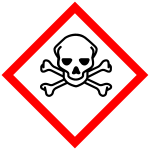
Signal word Danger
Hazard statement(s) H301 Toxic if swallowed
Precautionary statement(s) Prevention P264 Wash ... thoroughly after handling.
P270 Do not eat, drink or smoke when using this product.
Response P301+P316 IF SWALLOWED: Get emergency medical help immediately.
P321 Specific treatment (see ... on this label).
P330 Rinse mouth.
Storage P405 Store locked up.
Disposal P501 Dispose of contents/container to an appropriate treatment and disposal facility in accordance with applicable laws and regulations, and product characteristics at time of disposal.
Other hazards which do not result in classification
no data available
Handling and StoragePrecautions for safe handling
Handling in a well ventilated place. Wear suitable protective clothing. Avoid contact with skin and eyes. Avoid formation of dust and aerosols. Use non-sparking tools. Prevent fire caused by electrostatic discharge steam.
Conditions for safe storage, including any incompatibilities
Quercetin tablets and capsules should be stored at room temp, away from heat, moisture, and direct light.
-
-
Seller Information
-
Business Type:
Manufactory
-
Main Products:
Urolithiasis B/Spermine Hydrochloride/ Apigenin/ Theacrine/FAA/OEA/PEA Theobromine/ Squid Ink Powder
-
Location:
Room 1502, Unit 3, Building 2, Nanshan Garden, Jianye 2nd Road, Guodu Subdistrict, Chang'an District, Xi'an City, Shaanxi Province, P.R.China
-
Total Employees:
101-200
-
Year of Establishment:
2017
-
-
Inquiry History10 Inquiries
Country Product Purchase Quantity Date Posted  Switzerland
Quercetine
100 G Aug 12, 2026  South Africa
Quercetin
5 KG Nov 26, 2023
South Africa
Quercetin powder
1 KG Aug 18, 2026  Saudi Arabia
95% HPLC Quercetin
10 KG Dec 26, 2023  Pakistan
Quercetin
2 KG Nov 3, 2023  Argentina
Quercetin
5 KG Jan 7, 2026  United States
Meletin
1 KG Jul 4, 2025  Kenya
Kenya
quercetin
1 KG Apr 14, 2024  Taiwan, China
Quercetin
50 KG Feb 1, 2024
South Africa
Quercetin
1 MT Jan 26, 2024 Post an enquiry for this product