Product
Supplier
Encyclopedia
Inquiry
Diallylamine124-02-7 buy - large image1
Diallylamine124-02-7 buy - image1
Diallylamine124-02-7 buy - image2
Diallylamine124-02-7 buy - image3
Diallylamine124-02-7 buy - image4
Diallylamine124-02-7 buy - image5
Diallylamine124-02-7 buy - image6

Diallylamine124-02-7

Unit Price:

$33-34/MT FOB

Get Latest Price
CAS No.:

124-02-7

Grade:

Pharmaceutical Grade

Content:

99.5%

Port:

shanghai

Brand:

OORENT

Packaging:

Vial/Bottle/Bag/Carton

Sample Available:

Yes

Price valid (until):

2026-12-09

Company Type:
Trader
Location:
China
Payment Terms:
100% TT in advance
Average Lead Time:
10 days
Qualification:
Main Products:

pharmaceutical intermediates,peptides,electronic chemicals

  • Product Details

  • Seller Information

  • Description

    Product Detailv

    Diallylamine Basic information
    Product Name: Diallylamine
    Synonyms: (CH2=CHCH2)2NH;2-Propen-1-amine,N-2-propenyl-;diallyl-amin;N,N-Di(2-propenyl)amine;N,N-Diallylamine;n-2-propenyl-2-propen-1-amin;dillylamine;DI-2-PROPENYLAMINE
    CAS: 124-02-7
    MF: C6H11N
    MW: 97.16
    EINECS: 204-671-2
    Product Categories: Pharmaceutical Intermediates;Acyclic;Alkenes;Organic Building Blocks;K00001
    Mol File: 124-02-7.mol
    Shop Diallylamine124-02-7-Detailed Image 1

    Diallylamine Chemical Properties
    Melting point  −88 °C (−126 °F; 185 K)
    Boiling point  111 °C (232 °F; 384 K)
    density  0.7874 g/cm3
    vapor density  3.35 (vs air)
    vapor pressure  18 mm Hg ( 20 °C)
    refractive index  1.44
    Fp  14 °C
    storage temp.  Store below +30°C.
    solubility  86g/l
    pka pK1:9.29(+1) (25°C,μ=0.02)
    form  liquid
    color  colorless
    Odor ammonia-like odor
    PH 11.5 (9.7g/l, H2O)
    explosive limit 0.93-14.2%(V)
    Water Solubility  8.6 g/100mL
    Sensitive  Air Sensitive
    Merck  14,2971
    BRN  773718
    Henry's Law Constant 3.3×10⁻¹ mol/(m3Pa) at 25℃, Duchowicz et al. (2020)
    Dielectric constant 3.7799999999999998
    InChI 1S/C6H11N/c1-3-5-7-6-4-2/h3-4,7H,1-2,5-6H2
    InChIKey DYUWTXWIYMHBQS-UHFFFAOYSA-N
    SMILES C=CCNCC=C
    LogP -0.653 at 23℃
    CAS DataBase Reference 124-02-7(CAS DataBase Reference)
    NIST Chemistry Reference 2-Propen-1-amine, N-2-propenyl-(124-02-7)
    EPA Substance Registry System Diallylamine (124-02-7)

    Safety Information
    Hazard Codes  F,T
    Risk Statements  11-20/22-24-34
    Safety Statements  16-26-36/37/39-45-28A
    RIDADR  UN 2359
    WGK Germany  3
    RTECS  UC6650000
    F  2-10
    Autoignition Temperature 273 °C
    TSCA  TSCA listed
    HS Code  2921199090
    HazardClass  3
    PackingGroup  II
    Storage Class 3 - Flammable liquids
    Hazard Classifications Acute Tox. 3 Dermal
    Acute Tox. 4 Inhalation
    Acute Tox. 4 Oral
    Eye Dam. 1
    Flam. Liq. 2
    Skin Corr. 1B
    Hazardous Substances Data 124-02-7(Hazardous Substances Data)
    Toxicity LD50 orally in rats: 0.65 g/kg (Smyth)
    MSDS Information
    Provider Language
    ACROS English
    SigmaAldrich English
    ALFA English

    Diallylamine Usage And Synthesis
    Chemical Properties Diallylamine is a clear colourless to yellow flammable liquid. Soluble in water, alcohol, ether, benzene, with ammonia smell. It can be detected, but it is not unpleasant at 2-9 ppm and is not intolerable at 70 ppm.
    Uses Diallylamine is used as a solvent and in organic synthesis, including crop protection, an auxiliary in paper making, ionic water purifier, polymer monomer, pharmaceutical intermediate, etc. It is also used in the production of N,N-diallyldimethylammonium chloride and N,N-diallyldichloroacetamide, which is used as a safener in the preemergence herbicide EPTC (S-ethyl dipropylthiocarbamate).
    Preparation Diallylamine is synthesized by hydrolysis of diallyl cyanamide. The hydrolysis reaction was carried out in a sulfuric acid medium, and the reflux was moderated for 6h. Yield 80-88%.
    Application Diallylamine can be used:
    (1) as a copper hole filling additive in printed circuit board (PCB) stacking technology. The adsorption behaviour of Diallylamine levelers agent was probed by adding it to copper sulphate electroplating solution. And the relationship between alkalinity and electrodeposition was investigated by changing the length and functional groups of the side chains.
    (2) A weak base poly(diallylamine) resin was prepared for gold extraction. The resin showed high adsorption capacity (up to 5 mmol/g dry resin) and good gold selectivity for most pH ranges and many different types of solutions, including contaminated wastewater. However, the slow dissolution of the uncrosslinked polymer chains in the resin matrix limits the gold adsorption properties at low gold concentrations (less than 5 mg/dm3).
    General Description A liquid with a disagreeable odor. Less dense than water. Flash point 70°F. May be toxic by inhalation and skin absorption. Irritates skin and eyes. Used to make other chemicals.
    Air & Water Reactions Highly flammable. Soluble in water.
    Reactivity Profile Diallylamine neutralizes acids in exothermic reactions to form salts plus water. May be incompatible with isocyanates, halogenated organics, peroxides, phenols (acidic), epoxides, anhydrides, and acid halides. Flammable gaseous hydrogen may be generated in combination with strong reducing agents, such as hydrides.
    Health Hazard May cause toxic effects if inhaled or ingested/swallowed. Contact with substance may cause severe burns to skin and eyes. Fire will produce irritating, corrosive and/or toxic gases. Vapors may cause dizziness or suffocation. Runoff from fire control or dilution water may cause pollution.
    Fire Hazard Diallylamine is a flammable liquid and a dangerous fire hazard when exposed to heat or flame. Vapors may travel to a source of ignition and flash back, while containers may explode in the heat of a fire. The compound may present a vapor explosion hazard indoors, outdoors, or in sewers. When heated to decomposition, diallylamine emits toxic fumes of NOx (Lewis, 1992).
    Toxicology Diallylamine can cause myocardial degeneration as well as damage to the kidneys and liver. This has been observed in rats and rabbits. Allylamines cause a severe primary fibrosis of the myocardium, The oral application of allylamine in the drinking water over 81–104 days caused a dose-dependent myocardial degeneration in rats.
    Safety Profile Poison by ingestion, skin contact, and intraperitoneal routes. Moderately toxic by inhalation. Human systemic effects by inhalation route: eye lachrymation and changes in the trachea or bronchi. A skin and severe eye irritant. A dangerous fire hazard when exposed to heat or flame. When heated to decomposition it emits toxic fumes of NOx. See also AMINES and ALLYL COMPOUNDS.
    Synthesis Diallylamine is synthesized by refluxing diallylcyanamide with diluted sulfuric acid. It has also been synthesized by treating allylamine with allyl bromide or allyl chloride.
    Purification Methods Keep the amine over KOH pellets overnight, decant and distil it from a few pellets of KOH at atmospheric pressure (b 108-111o), then fractionate through a Vigreux column (p 11). [Vliet J Am Chem Soc 46 1307 1924, Org Synth Coll Vol 1 201 1941.] The hydrochloride has m 164-165o (from Me2CO/EtOH). [Butler & Angels J Am Chem Soc 79 3128 1957.]

    Diallylamine Preparation Products And Raw materials
    Raw materials 3-Butenenitrile
     
    Shop Tirzepatide2023788-19-2-Detailed Image 2 Shop Tirzepatide2023788-19-2-Detailed Image 3 Shop Tirzepatide2023788-19-2-Detailed Image 4 Shop Tirzepatide2023788-19-2-Detailed Image 5 Shop Tirzepatide2023788-19-2-Detailed Image 6 Shop Tirzepatide2023788-19-2-Detailed Image 7


    ECHEMI Editorial Reference
    CLEAR COLOURLESS TO YELLOW LIQUID Diallylamine is a flammable liquid. Diallylamine can be detected, but it is not unpleasant at 2–9 ppm and is not intolerable at 70 ppm.A liquid with a disagreeable odor. Less dense than water. Flash point 70°F. May be toxic by inhalation and skin absorption. Irritates skin and eyes. Used to make other chemicals.
    Diallylamine appears as a liquid with a disagreeable odor. Less dense than water. May be toxic by inhalation and skin absorption. Irritates skin and eyes. Used to make other chemicals.|Liquid|COLOURLESS LIQUID WITH CHARACTERISTIC ODOUR.
    Diallylamine appears as a liquid with a disagreeable odor. Less dense than water. May be toxic by inhalation and skin absorption. Irritates skin and eyes. Used to make other chemicals.

    Basic Info
    Product Name:

    Diallylamine

    Other Name:

    2-Propen-1-amine,N-2-propen-1-yl-;Diallylamine;2-Propen-1-amine,N-2-propenyl-;N-2-Propen-1-yl-2-propen-1-amine;Di-2-propenylamine;N-2-propenyl-2-propen-1-amine;NSC 20948;Bisallylamine;N,N-Bis(allyl)amine;Bis-allylamine;1263263-74-6

    CAS No.:

    124-02-7

    Molecular Formula:

    C6H11N

    InChIKeys:

    InChIKey=DYUWTXWIYMHBQS-UHFFFAOYSA-N

    Molecular Weight:

    97.15820

    Exact Mass:

    97.16

    EC Number:

    204-671-2

    UNII:

    N18EXB6V6P

    ICSC Number:

    0866

    NSC Number:

    20948

    UN Number:

    2359

    DSSTox ID:

    DTXSID1024918

    Color/Form:

    Liquid

    HScode:

    2921300090

    Characteristics
    PSA:

    12.03000

    XLogP3:

    1.33890

    Appearance:

    Diallylamine appears as a liquid with a disagreeable odor. Less dense than water. May be toxic by inhalation and skin absorption. Irritates skin and eyes. Used to make other chemicals.

    Density:

    0.7889 g/cm3 @ Temp: 20 °C

    Melting Point:

    -88.4 °C

    Boiling Point:

    111 °C

    Flash Point:

    7ºC

    Refractive Index:

    1.4395-1.4415

    Water Solubility:

    H2O: 8.6 g/100mL

    Storage Conditions:

    Flammables area

    Vapor Pressure:

    18 mm Hg ( 20 °C)

    Vapor Density:

    3.35 (vs air)

    Toxicity:

    LD50 orally in rats: 0.65 g/kg (Smyth)

    Explosive limit:

    vol% in air: 2.22

    Odor:

    RECOGNIZABLE BUT REFRESHING ODOR @ 4-9 PPM

    Taste:

    SWEETISH TASTE

    Dissociation Constants:

    pKa= 9.29 (conjugate acid)|pKb = 4.87 @ 25 °C

    Experimental Properties:

    Conversion units: 1 mg/l= 252 ppm, 1 ppm= 3.97 mg/cu m

    Air and Water Reactions:

    Highly flammable. Soluble in water.

    Reactive Group:

    Amines, Phosphines, and Pyridines

    Reactivity Alerts:

    Highly Flammable

    Reactivity Profile:

    DIALLYLAMINE neutralizes acids in exothermic reactions to form salts plus water. May be incompatible with isocyanates, halogenated organics, peroxides, phenols (acidic), epoxides, anhydrides, and acid halides. Flammable gaseous hydrogen may be generated in combination with strong reducing agents, such as hydrides.

    Autoignition Temperature:

    273 °C

    Physical Dangers:

    The vapour mixes well with air, explosive mixtures are easily formed. As a result of flow, agitation, etc., electrostatic charges can be generated.

    Heat of Vaporization:

    4.86X10+7 J/Kmol @ 184.75 K

    Critical Temperature & Pressure:

    Critical temperature: 556.0 K; Critical pressure: 3.32X10+6 Pa

    Hazard Identification

    Classification of the substance or mixture

    Flammable liquids, Category 2

    Acute toxicity - Category 4, Oral

    Acute toxicity - Category 3, Dermal

    Skin corrosion, Sub-category 1B

    Serious eye damage, Category 1

    Acute toxicity - Category 4, Inhalation

    Hazardous to the aquatic environment, long-term (Chronic) - Category Chronic 3

    GHS label elements, including precautionary statements

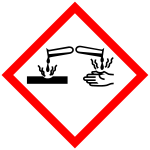
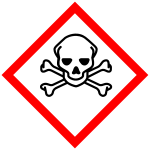
    Pictogram(s)
    Signal word

    Danger

    Hazard statement(s)

    H225 Highly flammable liquid and vapour

    H302 Harmful if swallowed

    H311 Toxic in contact with skin

    H314 Causes severe skin burns and eye damage

    H332 Harmful if inhaled

    H412 Harmful to aquatic life with long lasting effects

    Precautionary statement(s)
    Prevention

    P210 Keep away from heat, hot surfaces, sparks, open flames and other ignition sources. No smoking.

    P233 Keep container tightly closed.

    P240 Ground and bond container and receiving equipment.

    P241 Use explosion-proof [electrical/ventilating/lighting/...] equipment.

    P242 Use non-sparking tools.

    P243 Take action to prevent static discharges.

    P280 Wear protective gloves/protective clothing/eye protection/face protection/hearing protection/...

    P264 Wash ... thoroughly after handling.

    P270 Do not eat, drink or smoke when using this product.

    P260 Do not breathe dust/fume/gas/mist/vapours/spray.

    P261 Avoid breathing dust/fume/gas/mist/vapours/spray.

    P271 Use only outdoors or in a well-ventilated area.

    P273 Avoid release to the environment.

    Response

    P303+P361+P353 IF ON SKIN (or hair): Take off immediately all contaminated clothing. Rinse affected areas with water [or shower].

    P370+P378 In case of fire: Use ... to extinguish.

    P301+P317 IF SWALLOWED: Get medical help.

    P330 Rinse mouth.

    P302+P352 IF ON SKIN: Wash with plenty of water/...

    P316 Get emergency medical help immediately.

    P321 Specific treatment (see ... on this label).

    P361+P364 Take off immediately all contaminated clothing and wash it before reuse.

    P301+P330+P331 IF SWALLOWED: Rinse mouth. Do NOT induce vomiting.

    P363 Wash contaminated clothing before reuse.

    P304+P340 IF INHALED: Remove person to fresh air and keep comfortable for breathing.

    P305+P351+P338 IF IN EYES: Rinse cautiously with water for several minutes. Remove contact lenses, if present and easy to do. Continue rinsing.

    P305+P354+P338 IF IN EYES: Immediately rinse with water for several minutes. Remove contact lenses, if present and easy to do. Continue rinsing.

    P317 Get medical help.

    Storage

    P403+P235 Store in a well-ventilated place. Keep cool.

    P405 Store locked up.

    Disposal

    P501 Dispose of contents/container to an appropriate treatment and disposal facility in accordance with applicable laws and regulations, and product characteristics at time of disposal.

    Other hazards which do not result in classification

    no data available

    Handling and Storage

    Precautions for safe handling

    NO open flames, NO sparks and NO smoking. Closed system, ventilation, explosion-proof electrical equipment and lighting. Do NOT use compressed air for filling, discharging, or handling. Prevent build-up of electrostatic charges (e.g., by grounding). Handling in a well ventilated place. Wear suitable protective clothing. Avoid contact with skin and eyes. Avoid formation of dust and aerosols. Use non-sparking tools. Prevent fire caused by electrostatic discharge steam.

    Conditions for safe storage, including any incompatibilities

    Provision to contain effluent from fire extinguishing. Fireproof. Separated from strong oxidants, strong acids and food and feedstuffs. Well closed. Store in an area without drain or sewer access.

  • Seller Information
    Business Type:

    Trader

    Main Products:

    pharmaceutical intermediates,peptides,electronic chemicals

    Location:

    Room 102, 1st Floor, East Office Building, No. 45 Pengwan Road, Qianwan Bonded Port Area, Qingdao Zone, China (Shandong) Pilot Free Trade Zone

    Payment Terms:

    100% TT in advance

    Average lead Time:

    10 days

    Total Annual Revenue:

    $10 million-$25 million

    Total Employees:

    51-100

    Year of Establishment:

    2024

    A reliable supplier is like insurance.

    We are mainly specilized in supply of pharmaceutical intermediates, electronic chemicals,food additives, and other fine chemical products.
    Integrity is the foundation, quality is life. We would like to work together with you to build a greener and brighter future.

    Website: orientchem.cc
    Email: scarlett@orientchem.cc
    WhatsApp: +86 17753254221

  • Country Product Purchase Quantity Date Posted
    Post an enquiry for this product
pic ×

Scan the QR Code to Share

All products displayed on this website are only for non-medical purposes such as industrial applications or scientific research, and cannot be used for clinical diagnosis or treatment of humans or animals. They are not medicinal or edible.

According to relevant laws and regulations and the regulations of this website, units or individuals who purchase hazardous materials should obtain valid qualifications and qualification conditions.

The information shown above is provided by the enterprise itself, and the authenticity, accuracy and legitimacy of the content are the responsibility of the publishing company. ECHEMI does not bear any guarantee responsibility for this. Please be aware that risks in internet transactions objectively exist.

Feedback & Suggestions
Send Message

Thank you for your feedback. If you require further assistance, please contact us by email at info@echemi.com or call us at +86-532-55729510.