




3-Bromo-7-azaindole
-
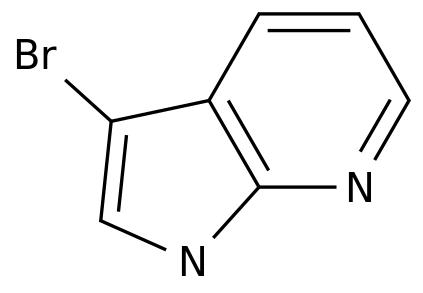
3-Bromo-7-azaindole
structure -
-
CAS No:
74420-15-8
-
Formula:
C7H5BrN2
-
Chemical Name:
3-Bromo-7-azaindole
-
Synonyms:
3-BROMO-7-AZAINDOLE;3-BROMO-1H-PYRROLO[2,3-B]PYRIDINE;1H-PYRROLO[2,3-B]PYRIDINE, 3-BROMO-;3-Bromo-7-azaindole (3-bromo-1H-pyrrolo[2,3-b]pyridine);3-broMo-1H-pyrrolo[2,3-b]pyridine 5-(trifluoroMethyl)-1H-iMidazole;3-BroMo-pyrrolo[2,3-b]pyridine;3-Bromo-7-azaindole 97%
- Categories:
-
CAS No:
Characteristics
28.7
2
White to brown Powder
1.8±0.1 g/cm3
172-175
336.4°C at 760 mmHg
157.3ºC
1.728
Safety Information
6.1
UN 2811
3
22-37/38-41
26-36/37/39
Xi,Xn
Irritant
P261-P280-P301 + P310-P305 + P351 + P338
H301-H315-H318-H335
|Danger|H301 (92.86%): Toxic if swallowed [Danger Acute toxicity, oral]|P261, P264, P270, P271, P280, P301+P310, P302+P352, P304+P340, P305+P351+P338, P310, P312, P321, P330, P332+P313, P362, P403+P233, P405, and P501|Aggregated GHS information provided by 42 companies from 4 notifications to the ECHA C&L Inventory. Each notification may be associated with multiple companies.
3-Bromo-7-azaindole Use and Manufacturing
100mmol 7-azaindole was dissolved in organic solvent. Add into a reaction kettle. Add 40mmol catalyst. Maintain the temperature at 100 °C. 90 rpm/min of stirring. Place 300mmol bromine gas. Reflux reaction for 3h. Afterwards, completion of the reaction, purification to obtain 3-bromo-7-azaindole. Wherein the catalyst is nickel(II) acetate and triethanolamine boratemole ratio of 3:1 mixture. The yield of the product is 99.0percent4.2.19
3-(4, 4, 5, 5-tetramethyl-l, 3, 2-dioxaborolan-2-yl)-l-tosyl-lH- pyrrolo[2, 3-b]pyridine (la)
3-bromo-lH-pyrrolo[2, 3-b]pyridine (6a) [0381] 7-azaindole (5a) (6.9 kg, 58.4 moles) was added to a 200L glass-lined reactor containing 52.6 kg DMF. A solution of Br2 in DMF (9.7 kg Br2 in 14.7 kg DMF) was added drop wise to maintain the mixture temperature of about 0-10 °C. After the addition was complete, the temperature was maintained at about 0-10 °C. The completeness of the reaction was measured by HPLC (method A) with sample aliquots after 30 minutes. The reaction was considered complete when the 7-azaindole was less than 3percent (after about 2 hours and 40 minutes). The reaction was quenched with 10percent aqueous solution of NaHSC>3 (17.5 kg) while maintaining the temperature below 15 °C. A saturated aqueous solution of NaHCC>3 (61.6 kg) below 25 °C was added to adjust the pH to about 7 to 8. After neutralization, the mixture was transferred into a 50 L vacuum filter and filtered. The resultant cake was washed with water (18 kg) and then petroleum ether (12 kg). The cake was dried in a tray dryer at about 50-60 °C until the water content detected by KF (Karl Fisher reaction) was less than 0.8percent. A yellow solid resulted (10.3 kg, 99.1percent purity as measured by HPLC (method A), 89.6percent yield of 3-bromo-lH-pyrrolo[2, 3-b]pyridine (6a)).3-bromo-lH-pyrrolo[2, 3-bJpyridine: [00384] Commercially available 7-Azaindole (6.9 kg, 58.4 moles) was added to a 200L glass-lined reactor containing 52.6 kg DMF. A solution of Br[0268] 3-bromo-l H-pyrrolo[2, 3-b]pyridine: Commercially available 7-Azaindole (6.9 kg, 58.4 moles) was added to a 200L glass-lined reactor containing 52.6 kg DMF. A solution of Br 3-bromo-1H-pyrrolo[2, 3-b]pyridine: [0391] Commercially available 7-Azaindole (6.9 kg, 58.4 moles) was added to a 200 L glass-lined reactor containing 52.6 kg DMF. A solution of BrGeneral procedure: DBDMH (157 mg, 0.55 mmol) was added in five potion to a solution ofindoles (1.0 mmol) in dioxane at 10 °C over two minutes with stir, and the resulting solution was stirred for 5to 10 minutes. TLC indicate that the reaction is completed. The reactionsolution was poured into the saturated NaHCOAzaindole 1 (4g, 0.025 mol) in 100 mL of chloroform was cooled to 0°C. Bromine in 20 mL of chloroform was added dropwise the resulting mixture was stirred at 0°C for 1 h. The resulting suspension was diluted with 0.5N HCl and the aqueous layer was made basic with 0.5 N NaOH and the solid filtered to provide 4g (82percent) of crude product 2 that was used directly for the next step.To a solution of 7-azaindole (5 g, 42.2 mmol) in THF (400 mL) were added first the solid N-bromosuccinimide (8 g, 45.0 mmol) then 20 drops of conc. sulfuric acid at room temperature. While stirring some suspension was formed during 2 days. The mixture was diluted with saturated ammonium chloride solution and the two layers were separated. The aqueous layer was extracted with ethyl acetate (4.x.150 mL). The combined organic extracts were washed with brine solution and dried over anhydrous magnesium sulfate. Filtration of the drying agent and removal of the solvent under the vacuum gave the crude yellow solid. This solid was dissolved in ethyl acetate (100 mL) at hot condition and then stored in the refrigerator overnight. The solids were collected by filtration and washed with ethyl acetate. After drying in air, 6.2 g (75percent yield) of 3-bromo-1H-pyrrolo[2, 3-b]pyridine was isolated as an yellow solid: EI-HRMS m/e calcd for C10.0 g (84.65 mmol) of 7-azaindole was suspended in 300 ml of CCl 4 and 4.35 mL (84.65 mmol) of Br 2 slowly at room temperatureAnd stirred for 12 hours under a stream of nitrogen. After completion of the reaction, the resulting solid was filtered, The reaction mixture was dissolved in loromethane and extracted with Na2S2O3. The organic solvent was removed and dried to obtain 12.0 g (yield: 72percent) of the intermediate product (A)lH-Pyrrolo[2, 3-b]pyridine (5.0 grams, 42.29 mmol) was dissolved in chloroform (67 ml) under a nitrogen atmosphere and chilled to 0 7-azaindole (5.000 g, 42.32 mmol) was added to carbon tetrachloride (150 mL) at 0 . To the mixture, bromine (2.182 mL, 42.32 mmol) was added, followed by stirring at the same temperature for 2 hours. Then, 0.5 N hydrochloric acid aqueous solution (500 mL) was added to the reaction mixture, followed by extraction. To the water layer, 0.5 N sodium hydroxide aqueous solution (700 mL) was added, followed by stirring. The precipitated solid was filtered, washed with water, and then dried to afford the title compound (4.820 g, 58percent) as a brown solid.The solution of 1H-pyrrolo[2, 3-b]pyridine (1.0 g, 1 equiv.) in DMF (30 mL) at 0 oc wastreated portionwise with NBS ( 1. 51 g, 1 equiv.) under argon, and the resulting solution was20 stirred at 0 oc for 20 min. The reaction mixture was allowed to warm toRT and stirringwas continued for 10 min. Then, the reaction mixture was transferred to a separatoryfunnel containing distilled water, and extracted with EtOAc (2 x 150 mL). The combinedorganic extracts were dried over Na2S04, filtered, and solvent was removed in vacuo.Crude product was recrystallized from DCM to afford the expected product (1.55 g).25 LCMS: MW (calcd): 197.03; MS (ES+, m/z): 197.3, 199.3 [M+HGeneral procedure: A hot aqueous solution (10 cm3) of K2PtCl4 (0.5 mmol) wasmixed with the ethanol solution of the appropriate ligand(1.0 mmol, 20 cm3) and stirred at 318 K for 48 h. The obtained paleyellow solids were filtered off, washed with ethanol and thendried. The results of the elemental analysis are collected inTable S1 in the Supplementary Data.General procedure: N, N-dimethyl-4-[5-(4, 4, 5, 5-tetramethyl-l, 3, 2-dioxaborolan-2-yl)-3- pyridyl]benzamide (70 mg, 0.2 mmol), 4-chloro-l, 6-naphthyridine (36 mg, 0.22 mmol), Pd(PPh3)4 (12 mg, 0.01 mmol) and K2CO3 (69 mg, 0.5 mmol) were taken up in l, 4-dioxane (1 ml) and water (0.25 ml) and the resulting mixture was stirred at 90 C for 1 h. When cooled to rt the mixture was filtered through celite and the filter cake rinsed with EtOAc. The filtrate was concentrated and purified by preparative HPLC to give the product as a solid (18 mg, 26%).
A reagent used in the preparation of biologically active Azaindoles.
Computed Properties
Molecular Weight:197.03
XLogP3:2
Hydrogen Bond Donor Count:1
Hydrogen Bond Acceptor Count:1
Exact Mass:195.96361
Monoisotopic Mass:195.96361
Topological Polar Surface Area:28.7
Heavy Atom Count:10
Complexity:129
Covalently-Bonded Unit Count:1
Compound Is Canonicalized:Yes
Recommended Suppliers of 3-Bromo-7-azaindole
-
![China]() CN
1 YR
Business licensed Certified factoryManufactory Supplier of SR17018

Learn More Other Chemicals
-
3-(3-CHLOROPROPYLCARBAMOYL)BENZENEBORONIC ACID
874288-10-5
-
3-Pyridinecarboxylic acid, 2,6-dichloro-, ethyl ester
58584-86-4
-
(+)-Mesembrenone
468-54-2
-
1,5-Methano-1H-3-benzazepine, 2,3,4,5-tetrahydro-, hydrochloride (1:1) Formula
230615-52-8
-
(4-acetyloxyphenyl)-(4-acetyloxyphenyl)imino-oxidoazanium Formula
79030-44-7
-
1-(4-Methoxy-phenyl)-2,5-dimethyl-1H-pyrrole-3-carbaldehyde Formula
347331-30-0
-
2,2'-DIAMINODIPHENYL SULFIDE Structure
5873-51-8
-
AC-ARG-PHE-MET-TRP-MET-ARG-NH2 Structure
152274-65-2
-
What is 1,1-Dimethylethyl 2-bromo-2-methylpropanoate
23877-12-5
-
What is 1,3-Dichloro-2,4-difluorobenzene
36556-37-3