




3-Isoxazolecarboxylic acid, 5-cyclopropyl-, ethyl ester
-
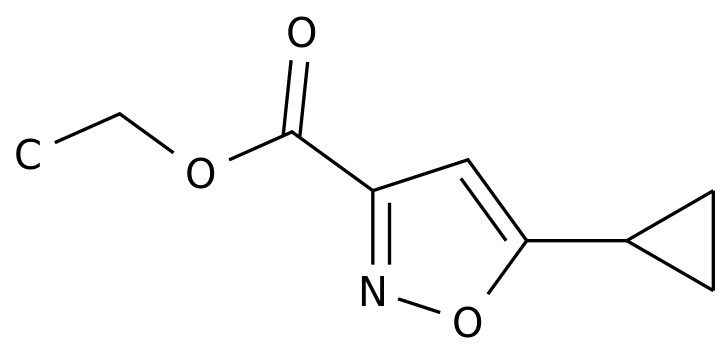
3-Isoxazolecarboxylic acid, 5-cyclopropyl-, ethyl ester
structure -
-
CAS No:
21080-81-9
-
Formula:
C9H11NO3
-
Chemical Name:
3-Isoxazolecarboxylic acid, 5-cyclopropyl-, ethyl ester
-
Synonyms:
3-Isoxazolecarboxylic acid,5-cyclopropyl-,ethyl ester;Ethyl 5-cyclopropylisoxazole-3-carboxylate;Ethyl 5-cyclopropylisoxazle-3-carboxylate
-
CAS No:
3-Isoxazolecarboxylic acid, 5-cyclopropyl-, ethyl ester Basic Attributes
181.18854
181.19
-0
DTXSID80716930
2934999090
3-Isoxazolecarboxylic acid, 5-cyclopropyl-, ethyl ester Use and Manufacturing
Sodium ethoxide (10 g, 147 mmol) is combined with absolute EtOH (60 mL) in an oven-dried flask, under nitrogen and heated to 70° C. to aid dissolution. The mixture is cooled to 0° C., treated drop-wise with a mixture of cyclopropyl methyl ketone (14.56 mL, 147 mmol) and diethyl oxylate (19.96 mL, 147 mmol) and warmed to RT. Stirring was difficult, so additional EtOH (60 mL) is added and the mixture is stirred for 1 h, then heated to 80° C. for 45 min. The mixture is cooled to RT and concentrated to dryness. The resulting solid is triturated with EtOAc, filtered, and rinsed with EtOAc and Et2O to remove the reddish color. The solid is dissolved in water (300 mL), acidified to pH 2 with dilute H2SO4, extracted with Et2O (400 mL total), dried (Na2SO4) and concentrated to afford 18.0 g (66percent yield) of ethyl 4-cyclopropyl-2, 4-dioxobutanoate as an amber oil. HRMS (ESI) calcd for C9H12O4 +H: 185.0814, found 185.0821 (M+H)+. Ethyl 4-cyclopropyl-2, 4-dioxobutanoate (12.92 g, 70.1 mmol) is combined with hydroxylamine hydrochloride (14.62 g, 210.4 mmol) in EtOH (250 mL), heated to reflux for 1 h, cooled, and concentrated to dryness. The residue is partitioned between H2O (250 mL) and EtOAc (2.x.250 mL) and the combined organics are dried (MgSO4) and concentrated to an amber oil (13.89 g). The crude material is chromatographed over 500 g silica gel, eluting with 25percent EtOAc/hexane. The appropriate fractions are combined and concentrated to afford 10.71 g (84percent yield) of ethyl 5-cyclopropylisoxazole-3-carboxylate as a yellow oil. MS (CI) m/z: 182 (M+H)+. Sodium hydroxide (1.76 g, 44.0 mmol) in H2O (5 mL) is added to a solution of ethyl 5-cyclopropylisoxazole-3-carboxylate (1.97 g, 10.9 mmol) in MeOH (10 mL). The mixture is stirred at RT for 3 h, concentrated to remove the MeOH, and acidified to pH 2 with 5percent HCl. The acid is extracted with CH2Cl2 (6.x.20 mL), dried (MgSO4) and concentrated to afford 1.56 g (93percent yield) of 5-cyclopropylisoxazole-3-carboxylic acid as a white solid. MS (Cl) m/z: 154 (M+H)+. 5-Cyclopropylisoxazole-3-carboxylic acid (1.53 g, 10 mmol) is dissolved in benzene (30 mL), treated with oxalyl chloride (3.46 mL, 40 mmol) and heated to reflux for 2 h. The mixture is cooled, concentrated to dryness and the residual benzene is azeotroped off with CH2Cl2. The resulting acid chloride is dissolved in Me2CO (15 mL) and treated with a solution of NaN3 (1.95 g, 30 mmol) in H2O (7 mL). The mixture is vigorously stirred for 1 h, concentrated to remove the Me2CO, triturated with H2O, filtered, rinsed with water and dried under vacuum to afford 1.76 g (99percent yield) of 5-cyclopropylisoxazole-3-carbonyl azide as an off-white solid. 1H NMR (CDCl3, 400 MHz): δ 1.02, 1.14, 2.10, 6.35 ppm. 5-Cyclopropylisoxazole-3-carbonyl azide (447 mg, 2.5 mmol) is combined with 5-chloro-2, 4-dimethoxyaniline (471 mg, 2.5 mmol) in anhydrous MeCN (30 mL) and heated to reflux for 18 h. The mixture is cooled and the resulting solid is filtered, rinsed with Et2O and dried in a vacuum oven to afford 619 mg (73percent yield) of Example 621 as a very light purple solid. HRMS (ESI) calcd for C15H16N3O4Cl +H: 338.0907, found 338.0896 (M+H)+.Into a 10 L round-bottom flask, was placed a solution of ethyl 4-cyclopropyl-2, 4- dioxobutanoate (177 g) in ethanol (1.1 L) and NHInto a 10 L round-bottom flask, was placed a solution of ethyl 4-cyclopropyl-2, 4- dioxobutanoate (177 g) in ethanol (1.1 L) and NHInto a 10 L round-bottom flask, was placed a solution of ethyl 4-cyclopropyl-2, 4- dioxobutanoate (177 g) in ethanol (1.1 L) and NH[0265] Into a 10 L round-bottom flask, was placed a solution of ethyl 4-cyclopropyl-2, 4- dioxobutanoate (177 g) in ethanol (1.1 L) and NHInto a 10 L round-bottom flask, was placed a solution of ethyl 4-cyclopropyl-2, 4- dioxobutanoate (177 g) in ethanol (1.1 L) and NHINTERMEDIATE 15 - PREPARATION OF Ethyl δ-cyclopropylisoxazole-S-carboxylate.; A solution of ethynylcyclopropane (0.40 mlA mixture of ethyl 2-nitroacetate (1.0 g, 7.6 mmol, 2.5 eq), ethynylcyclopropane (0.2 g, 3.0 mmol, 1 eq), DABCO (33.9 mg, 303 imol, 0.1 eq) in 2 mL of EtOH was degassed and purged with N2 three times. The mixture was stirred at 150 °C for 30 mm under microwave condition. It was evaporated under reduced pressure to give a residue. The residue was purified by column chromatography (Si02 eluting with petroleum ether:ethyl acetate = 30:1) to give 0.4 g of ethyl 5 -cyclopropylisoxazole-3 -carboxylate as a colorless liquid.
Computed Properties
Molecular Weight:181.19
XLogP3:1.5
Hydrogen Bond Acceptor Count:4
Rotatable Bond Count:4
Exact Mass:181.07389321
Monoisotopic Mass:181.07389321
Topological Polar Surface Area:52.3
Heavy Atom Count:13
Complexity:203
Covalently-Bonded Unit Count:1
Compound Is Canonicalized:Yes
Learn More Other Chemicals
-
Cyclohexanecarboxylic acid, 1,3,4,5-tetrahydroxy-, ethyl ester, (1alpha,3R,4alpha,5R)- (9CI)
463325-95-3
-
Cyclopropanecarboxylic acid, 1-formyl-2-methyl-, ethyl ester (9CI)
260261-27-6
-
Cyclopentanecarboxylic acid, 2-(hydroxyimino)-, methyl ester (9CI)
170016-09-8
-
3-CYCLOPROPYL-2-METHYL-3-OXO-PROPIONIC ACID ETHYL ESTER Formula
21741-37-7
-
Cyclopropanecarboxylic acid, 1-amino-2-phenyl-, ethyl ester, (1R,2R)-rel- (9CI) Formula
669058-57-5
-
Cyclopropanecarboxylic acid, 1-amino-2-ethenyl-, ethyl ester, (1R,2S)-rel- (9CI) Formula
213316-32-6
-
Cyclopropanecarboxylic acid, 1-amino-2-ethenyl-, ethyl ester, hydrochloride (9CI) Structure
681807-60-3
-
3-Cyclopentene-1-carboxylic acid, 1-(chlorocarbonyl)-, ethyl ester (9CI) Structure
76910-09-3
-
What is Cyclopropanecarboxylic acid, 2-propyl-, ethyl ester, (1R,2S)- (9CI)
492468-18-5
-
What is 1,2-Benzenedicarboxylic acid, decyl isoundecyl ester
96507-80-1
3-Isoxazolecarboxylic acid, 5-cyclopropyl-, ethyl ester
SDSRequest for Quotation