




[1,1′-Biphenyl]-4,4′-diamine hydrochloride (1:2)
-
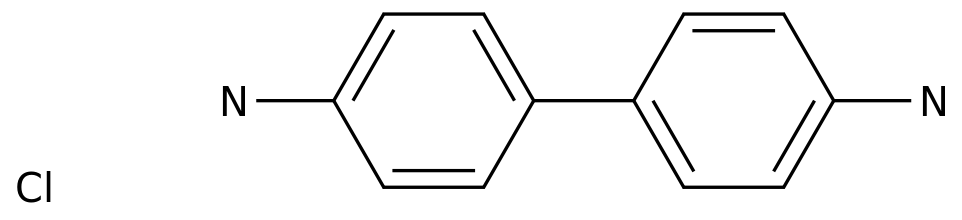
[1,1′-Biphenyl]-4,4′-diamine hydrochloride (1:2)
structure -
-
CAS No:
531-85-1
-
Formula:
C12H12N2.2ClH
-
Chemical Name:
[1,1′-Biphenyl]-4,4′-diamine hydrochloride (1:2)
-
Synonyms:
[1,1′-Biphenyl]-4,4′-diamine,hydrochloride (1:2);Benzidine,dihydrochloride;[1,1′-Biphenyl]-4,4′-diamine,dihydrochloride;[1,1′-Biphenyl]-4,4′-diamine hydrochloride (1:2)
- Categories:
-
CAS No:
Description
PHYSICAL DESCRIPTION: White crystalline powder. (NTP, 1992)
Benzidine dihydrochloride is a white crystalline powder. (NTP, 1992)
Benzidine dihydrochloride is a white crystalline powder. (NTP, 1992)
[1,1′-Biphenyl]-4,4′-diamine hydrochloride (1:2) Basic Attributes
257.16
256.05300
208-519-6
LVU06XHC39
DTXSID7020138
2921590090
Characteristics
52.04000
5.28440
Benzidine dihydrochloride is a white crystalline powder. (NTP, 1992)
1.156g/cm3
≥300 °C
>402ºC
203.5ºC
H2O: 0.1-0.5 g/100 mL at 23.5 ºC
Reference value: (benzidine) Oral-rat LD50: 309 mg/kg; Oral-mouse LD50; 214 mg/kg
Flammable; emits toxic hydrogen chloride and nitrogen oxide gas when heated
This chemical may be sensitive to prolonged exposure to light and air. Slightly soluble in water.
Salts, Acidic
Acidic organic/inorganic salts, such as BENZIDINE DIHYDROCHLORIDE, are generally soluble in water. The resulting solutions contain moderate to high concentrations of hydrogen ions and have pH's of less than 7.0. They react as acids to neutralize bases. These neutralizations generate heat, but less or far less than is generated by neutralization of inorganic acids, inorganic oxoacids, and carboxylic acid. They usually do not react as either oxidizing agents or reducing agents but such behavior is not impossible. Many of these compounds catalyze organic reactions.
Safety Information
UN 2811 6.1/PG 2
3
45-22-50/53-36/37/38-20/21/22
53-45-60-61-36-26
DD0600000
T,N,Xn
The warehouse is ventilated, low temperature and dry; stored and transported separately from food materials
P201-P273-P308 + P313-P501
H302-H350-H410
Flash point data for this chemical are not available; however, it is probably combustible. (NTP, 1992)
|Danger|H302: Harmful if swallowed [Warning Acute toxicity, oral]|P201, P202, P264, P270, P273, P281, P301+P312, P308+P313, P330, P391, P405, and P501
Fires involving this material can be controlled with a dry chemical, carbon dioxide or Halon extinguisher. (NTP, 1992)
SMALL SPILLS AND LEAKAGE: If you spill this chemical, you should dampen the solid spill material with water, then transfer the dampened material to a suitable container. Use absorbent paper dampened with water to pick up any remaining material. Seal your contaminated clothing and the absorbent paper in a vapor-tight plastic bag for eventual disposal. Wash all contaminated surfaces with a soap and water solution. Do not reenter the contaminated area until the Safety Officer (or other responsible person) has verified that the area has been properly cleaned. STORAGE PRECAUTIONS: You should protect this chemical from exposure to light. Keep the container tightly closed under an inert atmosphere, and store under refrigerated temperatures. (NTP, 1992)
MINIMUM PROTECTIVE CLOTHING: If Tyvek-type disposable protective clothing is not worn during handling of this chemical, wear disposable Tyvek-type sleeves taped to your gloves. RECOMMENDED RESPIRATOR: Where the neat test chemical is weighed and diluted, wear a NIOSH-approved half face respirator equipped with a combination filter cartridge, i.e. organic vapor/acid gas/HEPA (specific for organic vapors, HCl, acid gas, SO2 and a high efficiency particulate filter). (NTP, 1992)
Drug Information
SYMPTOMS: Symptoms of exposure to this compound include nausea, vomiting, liver damage and kidney damage. ACUTE/CHRONIC HAZARDS: This chemical is rapidly absorbed through the skin. When heated to decomposition it emits very toxic fumes of nitrogen oxides and hydrogen chloride gas. (NTP, 1992)|Carcinogens
EYES: First check the victim for contact lenses and remove if present. Flush victim's eyes with water or normal saline solution for 20 to 30 minutes while simultaneously calling a hospital or poison control center. Do not put any ointments, oils, or medication in the victim's eyes without specific instructions from a physician. IMMEDIATELY transport the victim after flushing eyes to a hospital even if no symptoms (such as redness or irritation) develop. SKIN: IMMEDIATELY flood affected skin with water while removing and isolating all contaminated clothing. Gently wash all affected skin areas thoroughly with soap and water. IMMEDIATELY call a hospital or poison control center even if no symptoms (such as redness or irritation) develop. IMMEDIATELY transport the victim to a hospital for treatment after washing the affected areas. INHALATION: IMMEDIATELY leave the contaminated area; take deep breaths of fresh air. IMMEDIATELY call a physician and be prepared to transport the victim to a hospital even if no symptoms (such as wheezing, coughing, shortness of breath, or burning in the mouth, throat, or chest) develop. Provide proper respiratory protection to rescuers entering an unknown atmosphere. Whenever possible, Self-Contained Breathing Apparatus (SCBA) should be used; if not available, use a level of protection greater than or equal to that advised under Protective Clothing. INGESTION: DO NOT INDUCE VOMITING. If the victim is conscious and not convulsing, give 1 or 2 glasses of water to dilute the chemical and IMMEDIATELY call a hospital or poison control center. Be prepared to transport the victim to a hospital if advised by a physician. If the victim is convulsing or unconscious, do not give anything by mouth, ensure that the victim's airway is open and lay the victim on his/her side with the head lower than the body. DO NOT INDUCE VOMITING. IMMEDIATELY transport the victim to a hospital. OTHER: Since this chemical is a known or suspected carcinogen you should contact a physician for advice regarding the possible long term health effects and potential recommendation for medical monitoring. Recommendations from the physician will depend upon the specific compound, its chemical, physical and toxicity properties, the exposure level, length of exposure, and the route of exposure. (NTP, 1992)
benzidine
[1,1′-Biphenyl]-4,4′-diamine hydrochloride (1:2) Use and Manufacturing
[1,1'-Biphenyl]-4,4'-diamine, hydrochloride (1:2): ACTIVE|S - indicates a substance that is identified in a final Significant New Use Rule.
Health Hazards -> Carcinogens
Computed Properties
Molecular Weight:257.16
Hydrogen Bond Donor Count:4
Hydrogen Bond Acceptor Count:2
Rotatable Bond Count:1
Exact Mass:256.0534038
Monoisotopic Mass:256.0534038
Topological Polar Surface Area:52
Heavy Atom Count:16
Complexity:145
Covalently-Bonded Unit Count:3
Compound Is Canonicalized:Yes
Recommended Suppliers of [1,1′-Biphenyl]-4,4′-diamine hydrochloride (1:2)
-
![China]() CN
YRS
Business licensed Certified factoryManufactory Supplier of Flavors & Fragrances,Catalyst & Auxiliary,Intermediates,Dyes & Pigments,Inorganic Chemistry,petro chemicals,Surfactant,Food Additives,Water Treatment Chemicals

Learn More Other Chemicals
-
4H-1-Benzopyran-4-one, 2-[4-[3-(dibutylamino)propoxy]-3,5-dimethylbenzoyl]-, hydrochloride (1:1)
67652-33-9
-
Cyclopropanecarboxylic acid, 1-amino-2-ethenyl-, ethyl ester, hydrochloride (9CI)
681807-60-3
-
CYCLOPENTYL-(3,4,5-TRIMETHOXY-BENZYL)-AMINE HYDROCHLORIDE
1052525-88-8
-
2-Cyclopropylbenzenemethanamine hydrochloride Formula
118184-64-8
-
Des[4-(2-cycloproylMethoxy)] Betaxolol Hydrochloride Formula
464877-45-0
-
Ethanamine, 2-(decylthio)-, hydrochloride (1:1) Formula
36362-09-1
-
4,7-Dichloro-2-propylquinoline hydrochloride Structure
1204812-22-5
-
6,7-Dichloro-4-hydrazino-2-methylquinoline hydrochloride Structure
1170377-12-4
-
What is 2,8-Diazaspiro[4.5]decan-1-one, 2-[(4-bromophenyl)methyl]-, hydrochloride (1:1)
832710-56-2
-
What is 6,7-Dichloro-4-hydrazinoquinoline hydrochloride
1171843-02-9
[1,1′-Biphenyl]-4,4′-diamine hydrochloride (1:2)
SDSRequest for Quotation