




Perillyl alcohol
-
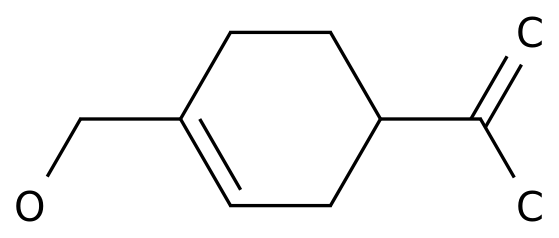
Perillyl alcohol
structure -
-
CAS No:
536-59-4
-
Formula:
C10H16O
-
Chemical Name:
Perillyl alcohol
-
Synonyms:
1-Cyclohexene-1-methanol,4-(1-methylethenyl)-;p-Mentha-1,8-dien-7-ol;4-(1-Methylethenyl)-1-cyclohexene-1-methanol;Perillic alcohol;Perillyl alcohol;Perilla alcohol;Perillol;dl-Perillyl alcohol;NSC 641066;(±)-Perillyl alcohol;4-Isopropenyl-1-cyclohexene-methanol;4-Isopropenyl-1-cyclohexenylmethanol;(4-(Prop-1-en-2-yl)cyclohex-1-en-1-yl)methanol;[4-(Prop-1-en-2-yl)cyclohex-1-en-1-yl]methanol;(4-Prop-1-en-2-ylcyclohexen-1-yl)methanol;1406-56-0;7644-38-4;66141-69-3
- Categories:
-
CAS No:
Description
Perillyl alcohol is a monoterpene isolated from the essential oils of lavendin, peppermint, spearmint, cherries, celery seeds, and several other plants. Perillyl alcohol is active in inducing apoptosis in tumor cells without affecting normal cells[1].
Solid|Colourless to pale-yellow, dense, oily liquid; characteristic odour similar to linalool and terpineol
Perillyl alcohol is a limonene monoterpenoid consists of a cyclohexene ring substituted by a hydroxymethyl and a prop-1-en-2-yl group at positions 1 and 4 respectively. It is a constituent of a variety of essential oils including lavender. It has a role as a plant metabolite and a volatile oil component.
Characteristics
20.2
2.1
Solid
0.9640 g/cm3 @ Temp: 29 °C
271-272 °C
244 °C
99.6±17.8 °C
1.491
Slightly soluble in water; soluble in alcohols and oils
LD50 orl-rat: 2100 mg/kg FCTXAV 19,253,81
Safety Information
3
37/38-41
S26;S39
OS8395000
Xi: Irritant;
P261, P264, P272, P280, P302+P352, P305+P351+P338, P321, P332+P313, P333+P313, P337+P313, P362, P363, P501
H315
|Warning|H315 (100%): Causes skin irritation [Warning Skin corrosion/irritation]|P261, P264, P272, P280, P302+P352, P305+P351+P338, P321, P332+P313, P333+P313, P337+P313, P362, P363, and P501|Aggregated GHS information provided by 1572 companies from 4 notifications to the ECHA C&L Inventory. Each notification may be associated with multiple companies.
Drug Information
Substances that inhibit or prevent the proliferation of NEOPLASMS. (See all compounds classified as Antineoplastic Agents.)|Compounds or agents that combine with an enzyme in such a manner as to prevent the normal substrate-enzyme combination and the catalytic reaction. (See all compounds classified as Enzyme Inhibitors.)
Limonen-10-ol has known human metabolites that include (2S,3S,4S,5R)-3,4,5-trihydroxy-6-[(4-prop-1-en-2-ylcyclohexen-1-yl)methoxy]oxane-2-carboxylic acid.
(-)-p-mentha-1,8-dien-7-ol
Perillyl alcohol Use and Manufacturing
Hydrogenation Reaction of Perillaldehyde (S/C=500)Into a stainless steel autoclave equipped with a glass inner tube, [Cu(NO(Example 13) Hydrogenation Reaction of Perillaldehyde (S/C=500) Into a stainless steel autoclave equipped with a glass inner tube, [Cu(NOGeneral procedure: Degassed CH2Cl2 (0.25 mL) was added to a microwave tube containing the ligand dppf (8.3 mg, 0.015 mmol) and AgPF6 (2.5 mg, 0.01 mmol) under argon. The resulting suspension was stirred at r.t., until a clear, colorless solution was obtained; then the solvent was removed under high vacuum. Benzaldehyde (1a; 20.3 μL, 0.2 mmol), tripropylsilane (2a;125 μL, 0.6 mmol), DIPEA (6.9 μL, 0.04 mmol), and H2O(0.5 mL) were subsequently added. The reaction mixture was stirred for 24 h at 100 °C, then cooled to r.t. and extracted with CH2Cl2 (3 × 10 mL). The combined organicphase was concentrated and purified by flash column chromatography on silica gel (hexane–EtOAc, 20:1) to give the desired product 3a as a colorless oil (19.5 mg, 90percent).Example 13Hydrogenation Reaction of Perillaldehyde (S/C=500)Into a stainless steel autoclave equipped with a glass inner tube, [Cu(NO(Example 13) Hydrogenation Reaction of Perillaldehyde (S/C=500) Into a stainless steel autoclave equipped with a glass inner tube, [Cu(NOGeneral procedure: Degassed CH2Cl2 (0.25 mL) was added to a microwave tube containing the ligand dppf (8.3 mg, 0.015 mmol) and AgPF6 (2.5 mg, 0.01 mmol) under argon. The resulting suspension was stirred at r.t., until a clear, colorless solution was obtained; then the solvent was removed under high vacuum. Benzaldehyde (1a; 20.3 μL, 0.2 mmol), tripropylsilane (2a;125 μL, 0.6 mmol), DIPEA (6.9 μL, 0.04 mmol), and H2O(0.5 mL) were subsequently added. The reaction mixture was stirred for 24 h at 100 °C, then cooled to r.t. and extracted with CH2Cl2 (3 × 10 mL). The combined organicphase was concentrated and purified by flash column chromatography on silica gel (hexane–EtOAc, 20:1) to give the desired product 3a as a colorless oil (19.5 mg, 90percent).
antineoplastic, apoptosis inducer; skin irritant, LD50(rat) 2100 mg/kg po
1-Cyclohexene-1-methanol, 4-(1-methylethenyl)-: ACTIVE
Food additives -> Flavoring Agents|Flavouring Agent -> FLAVOURING_AGENT; -> JECFA Functional Classes|Flavoring Agents -> JECFA Flavorings Index
Flavoring Agents|Flavouring Agent -> FLAVOURING_AGENT;
Computed Properties
Molecular Weight:152.23
XLogP3:2.1
Hydrogen Bond Donor Count:1
Hydrogen Bond Acceptor Count:1
Rotatable Bond Count:2
Exact Mass:152.120115130
Monoisotopic Mass:152.120115130
Topological Polar Surface Area:20.2
Heavy Atom Count:11
Complexity:179
Undefined Atom Stereocenter Count:1
Covalently-Bonded Unit Count:1
Compound Is Canonicalized:Yes
Recommended Suppliers of Perillyl alcohol
-
![China]() CN
CN
8 YRS
Business licensed Certified factoryManufactory Supplier of Biochemicals Ingredients,Vitamin Amino Acid Ingredients,Cosmestic Ingredients,Pharma Chemicals,Organic Fine Chemicals,Food Nutrient Ingredients,Natural Plant Ingredients,APIS Intermidiates,Daily Chemicals,Agricultural Chemicals,Surfactant Chemicals,Ultraviolet Absorbents,Antioxidant Ingredients,Scientific Research Chemical,Flavors and Fragrances ChemicalsInquiryCAS No.: 536-59-4Grade: Pharmaceutical GradeContent: 99%

Learn More Other Chemicals
-
3-(3,4-Dichlorophenyl)benzyl alcohol
885963-67-7
-
2-BROMO-5-(TRIFLUOROMETHOXY)BENZYL ALCOHOL
886763-15-1
-
4-BROMO-3',3''-DICHLOROTRITYL ALCOHOL
845790-85-4
-
4-(3-Chlorophenyl)benzyl alcohol Formula
773872-31-4
-
4-(2-Cyanophenyl)benzyl alcohol Formula
154709-19-0
-
4-(3,4-Dichlorophenyl)benzyl alcohol Formula
885949-98-4
-
(2,6-DICHLORO-3-NITRO)BENZYL ALCOHOL Structure
160647-01-8
-
Dichlorobenzyl alcohol Structure
12041-76-8
-
What is 3-ACETYLAMINO-2-FLUOROBENZYL ALCOHOL
1003707-72-9
-
What is ETHYL-2-13C ALCOHOL
14770-41-3