




Bethanechol chloride

-
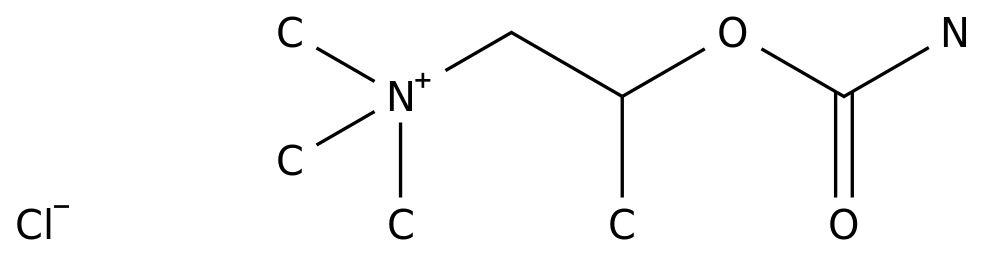
Bethanechol chloride
structure -
-
CAS No:
590-63-6
-
Formula:
C7H17N2O2.Cl
-
Chemical Name:
Bethanechol chloride
-
Synonyms:
1-Propanaminium,2-[(aminocarbonyl)oxy]-N,N,N-trimethyl-,chloride (1:1);(2-Hydroxypropyl)trimethylammonium chloride carbamate;Ammonium,(2-hydroxypropyl)trimethyl-,chloride,carbamate;1-Propanaminium,2-[(aminocarbonyl)oxy]-N,N,N-trimethyl-,chloride;Bethanechol chloride;Carbamylmethylcholine chloride;Mechothane;β-Methylcholine chloride urethan;Urecholine;Urecholine chloride;Mechotane;Myocholine;Mictone;Myotonine chloride;Uro-Carb;β-Methyl carbachol chloride;Trimethyl(2-carbamoyloxypropyl)ammonium chloride;Mecothane;Besacholine;(±)-Bethanechol;Myotonachol;NSC 30783;1-(Trimethylazaniumyl)propan-2-yl carbamate chloride;21293-39-0
- Categories:
-
CAS No:
Description
Bethanechol Chloride is a selective muscarinic receptor agonist without any effect on nicotinic receptors.Target: mAChRBethanechol is a parasympathomimetic choline carbamate that selectively stimulates muscarinic receptors without any effect on nicotinic receptors. Unlike acetylcholine, bethanechol is not hydrolyzed by cholinesterase and will therefore have a long duration of action. Oral bethanechol significantly improves contraction pressures and bolus transit in the smooth muscle port
Bethanechol chloride is the chloride salt of bethanechol. A slowly hydrolysed muscarinic agonist with no nicotinic effects, it is used to increase smooth muscle tone, as in the gastrointestinal tract following abdominal surgery, treatment of gastro-oesophageal reflux disease, and as an alternative to catheterisation in the treatment of non-obstructive urinary retention. It has a role as a muscarinic agonist. It is a carbamate ester, a quaternary ammonium salt and a chloride salt. It contains a bethanechol.|Bethanechol Chloride is a synthetic quaternary ammonium base derivative, parasympathomimetic Bethanechol is a slowly hydrolyzed muscarinic agonist with no nicotinic effects. Generally used to increase smooth muscle tone, Bethanechol is used to treat reflux esophagitis and to initiate urination after surgery, in urinary infections, or for enlarged prostate. It may cause hypotension, cardiac rate changes, and bronchial spasms. (NCI04)|A slowly hydrolyzing muscarinic agonist with no nicotinic effects. Bethanechol is generally used to increase smooth muscle tone, as in the GI tract following abdominal surgery or in urinary retention in the absence of obstruction. It may cause hypotension, HEART RATE changes, and BRONCHIAL SPASM.
Bethanechol chloride Basic Attributes
196.67500
196.09800
209-686-8
755913|30783
DTXSID2022676
C28866
2924199090
Characteristics
52.32000
218-219 °C (decomp)
H2O: 1.7 g/mL stable for several days at 4°C.
2-8ºC
133 Ų [M]+ [CCS Type: TW, Method: calibrated with polyalanine and drug standards]
Safety Information
NONH for all modes of transport
3
R22
S36
BR5425000
Xn
P301 + P312 + P330
H302
|Warning|H302 (100%): Harmful if swallowed [Warning Acute toxicity, oral]|P264, P270, P301+P312, P330, and P501|Aggregated GHS information provided by 43 companies from 3 notifications to the ECHA C&L Inventory.
Drug Information
Drugs that bind to and activate muscarinic cholinergic receptors (RECEPTORS, MUSCARINIC). Muscarinic agonists are most commonly used when it is desirable to increase smooth muscle tone, especially in the GI tract, urinary bladder and the eye. They may also be used to reduce heart rate. (See all compounds classified as Muscarinic Agonists.)|Drugs that mimic the effects of parasympathetic nervous system activity. Included here are drugs that directly stimulate muscarinic receptors and drugs that potentiate cholinergic activity, usually by slowing the breakdown of acetylcholine (CHOLINESTERASE INHIBITORS). Drugs that stimulate both sympathetic and parasympathetic postganglionic neurons (GANGLIONIC STIMULANTS) are not included here. (See all compounds classified as Parasympathomimetics.)
Bethanechol
Bethanechol chloride Use and Manufacturing
1. Cholinergic
2. A selective muscarinic receptor stimulant, used to treat cerebral palsy.
1-Propanaminium, 2-[(aminocarbonyl)oxy]-N,N,N-trimethyl-, chloride (1:1): ACTIVE
Human Drugs -> FDA Approved Drug Products with Therapeutic Equivalence Evaluations (Orange Book) -> Active Ingredients
Computed Properties
Molecular Weight:196.67
Hydrogen Bond Donor Count:1
Hydrogen Bond Acceptor Count:3
Rotatable Bond Count:4
Exact Mass:196.0978555
Monoisotopic Mass:196.0978555
Topological Polar Surface Area:52.3
Heavy Atom Count:12
Complexity:140
Undefined Atom Stereocenter Count:1
Covalently-Bonded Unit Count:2
Compound Is Canonicalized:Yes
Recommended Suppliers of Bethanechol chloride
-
![China]() CN
CN
5 YRS
Business licensedTrader Supplier of Intermediates,Building blocks,API,Silicones,Peptides,Lab chemicals,Biochemicals,Pharmaceuticals,Screening Compounds,Food Additives -
![China]() CN
CN
5 YRS
Business licensed Certified factoryManufactory Supplier of D-Biotin,Tobramycin base,L(-)-Carnitine base,Polymyxin B sulfate USP,Kanamycin sulfate monohydrate,Finasteride 99% USP -
![China]() CN
CN
6 YRS
Business licensedDistributor Supplier of Isoprinosine,Inosine,Pyraloxime Methylchloride,Butapho,Praziquantel,Lysozyme,Bethanechol Chloride,4-Aminobenzamidine dihydrochloride,2,Aminophylline,Etamsylate,2--diphenol,Dexamethasone sodium phosphate -
![China]() CN
CN
5 YRS
Business licensedTrader Supplier of PVC resin,pvc paste resin,melamineInquiryCAS No.: 590-63-6Grade: Industrial GradeContent: 99% -
![China]() CN
CN
3 YRS
Business licensedTrader Supplier of CHEMICALS,REAGENTSInquiryCAS No.: 590-63-6Grade: Pharmaceutical GradeContent: 99%

Latest News on Bethanechol chloride
- BMS Over $900 Million to Help Develop Potential 'Best-in-class' SHP2 Inhibitors
- AbbVie's blockbuster product for atopic dermatitis, Upadacitinib, has been approved for marketing in the EU and Japan
- Designing peptide inhibitors for possible COVID-19 treatments
- Chinese scientists discover the inhibitors of SARS-CoV-2
Learn More Other Chemicals
-
1,3,5-Cycloheptatriene-1-carbonyl chloride (9CI)
103533-75-1
-
3'-De(diMethylaMino)-3'-[[(2-Methoxyethoxy)Methyl]diMethylaMMonio]erythroMycin 9-OxiMe Chloride
151750-47-9
-
4-[3-(3,5-DICHLORO-PHENYL)-UREIDO]-BENZENESULFONYL CHLORIDE
677326-84-0
-
2,5-DICHLOROBENZYLZINC CHLORIDE Formula
737797-20-5
-
2,5-DIBROMO-3,6-DIFLUOROBENZENESULFONYL CHLORIDE Formula
207853-66-5
-
Dibenzofuran-3-sulfonyl chloride Formula
42138-14-7
-
2,4-Dibromo-5-fluorobenzenesulfonyl chloride Structure
1000578-09-5
-
Selenium(I) chloride (99%-Se) Structure
21317-32-8
-
What is 2,6-dibromo-4-methylbenzene-1-sulfonyl chloride
73732-31-7
-
What is 5-phenylfuran-2-carbonyl chloride
57489-93-7