




Benzoic acid, 4-[2-(1-piperidinyl)ethoxy]-, hydrochloride (1:1)
-
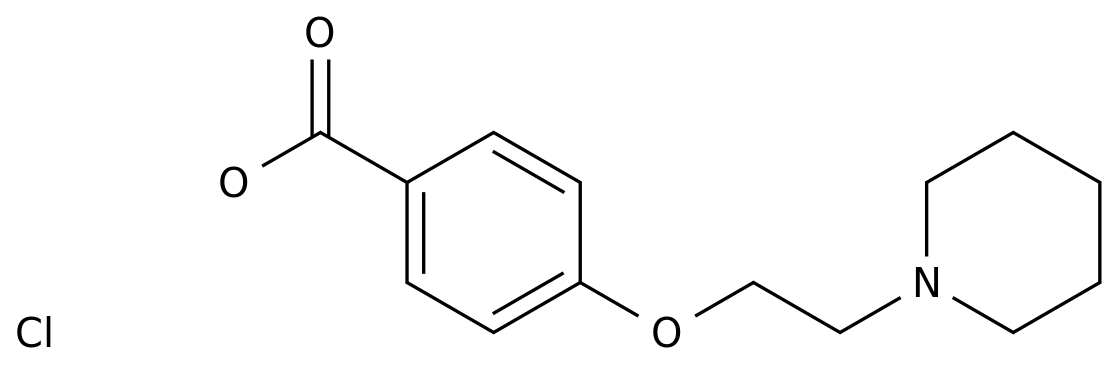
Benzoic acid, 4-[2-(1-piperidinyl)ethoxy]-, hydrochloride (1:1)
structure -
-
CAS No:
84449-80-9
-
Formula:
C14H19NO3.ClH
-
Chemical Name:
Benzoic acid, 4-[2-(1-piperidinyl)ethoxy]-, hydrochloride (1:1)
-
Synonyms:
Benzoic acid,4-[2-(1-piperidinyl)ethoxy]-,hydrochloride (1:1);Benzoic acid,4-[2-(1-piperidinyl)ethoxy]-,hydrochloride;4-(2-Piperidinoethoxy)benzoic acid hydrochloride;4-[2-(1-Piperidinyl)ethoxy]benzoic acid hydrochloride;1-(2-(4-Carboxyphenoxy)ethyl)piperidin-1-ium chloride
- Categories:
-
CAS No:
Benzoic acid, 4-[2-(1-piperidinyl)ethoxy]-, hydrochloride (1:1) Basic Attributes
285.77
285.113159
282-882-9
DTXSID4057841
2933399090
Characteristics
49.8
2.98940
276-277 °C @ Solvent: Ethanol
413.2°C at 760 mmHg
203.7ºC
Hygroscopic, -20ºC Freezer, Under Inert Atmosphere
Safety Information
P261, P264, P270, P271, P280, P301+P312, P302+P352, P304+P312, P304+P340, P305+P351+P338, P312, P321, P330, P332+P313, P337+P313, P362, P403+P233, P405, P501
H302
|Warning|H302 (50%): Harmful if swallowed [Warning Acute toxicity, oral]|P261, P264, P270, P271, P280, P301+P312, P302+P352, P304+P312, P304+P340, P305+P351+P338, P312, P321, P330, P332+P313, P337+P313, P362, P403+P233, P405, and P501|Aggregated GHS information provided by 6 companies from 3 notifications to the ECHA C&L Inventory. Each notification may be associated with multiple companies.
Benzoic acid, 4-[2-(1-piperidinyl)ethoxy]-, hydrochloride (1:1) Use and Manufacturing
In a round bottomed flask equipped with nitrogen inlet and magnetic stir bar, a solution of ethyl 4-(2-(piperidin-l-yl)ethoxy)benzoate (1.58 g, 5.7 mmol) in methanol (25 mL) was added. To the above solution, 8 mL of 5percent NaOH solution was added and the reaction was stirred overnight. Methanol was evaporated and 15 mL cold water was added to the residue. The precipitated solid was filtered, washed with 5 mL water and the, dried in vacuo to give 1.36 g of 1 -(2-(4-carboxyphenoxy)ethyl)piperidin-l -ium chloride (0271) lH NMR (400 MHz, Chloroform-d) δ 7.93 (d, J = 8.9 Hz, 2H), 6.85 (d, J = 8.9 Hz, 2H), 6.30 (bs, 1H), 4.84 (bs, 1H), 4.32 (q, J = 7.1 Hz, 2H), 3.86 (bs, 1H), 2.07 - 1.53 (m, 4H), 1.36 (t, J = 7.1 Hz, 2H). HPLC-MS: Expected: 250; Found: 250.EXAMPLE 5 In a round bottomed flask equipped with a magnetic stir bar and a nitrogen inlet, a mixture of l -(2-(4-carboxyphenoxy)ethyl)piperidin-l -ium chloride, EDC hydrochloride (138 g, 0.72 mmol) and HOBt-hydrate (1 10 mg, 0.72 mmol) and DIPEA (0.21 mL, 1.21 mmol) in 10 mL acetonitrile were added. The mixture was then stirred at room temperature for one hour. To the above solution, 2-(piperidin-4-yl)-lH-benzo[cf|imidazole (121 mg, 0.6 mmol) was added. The mixture was stirred at room temperature overnight. To the reaction mixture water was added. Precipitate was filtered, washed with CH3CN and then dried in vacuo yielding 123 mg of the crude. The crude was washed with water and then dried in vacuo to give 50 mg (19 percent) of (4- (lH-benzo[(i]imidazol-2-yl)piperidin-l-yl)(4-(2-(piperidin-l -yl)ethoxy)phenyl)methanone as tan color solid. (0277) lH NMR (400 MHz, DMSO-d6) delta 12.23 (bs, 1H), 7.57-7.40 (m, 2H), 7.38 (d, J = 8.8 Hz, 2H), 7.16 - 7.07 (m, 2H), 7.00 (d, J = 8.8 Hz, 2H), 4.11 (t, J = 5.9 Hz, 2H), 3.27-3.01 (m, 4H), 2.67 (t, J = 5.9 Hz, 2H), 2.44-2.42 (m, 4H), 2.10-1.87 (m, 2H), 1.81 (qd, J = 12.0, 4.1 Hz, 2H), 1.51 (p, J = 5.5 Hz, 4H), 1.39 (p, J = 6 Hz, 1H). (0278) 1 C NMR (101 MHz, DMSO-d6) delta 169.42, 162.71, 159.79, 157.67, 143.32, 134.61 , 129.20, 128.54, 122.04, 118.82, 114.59, 11 1.28, 66.09, 57.72, 54.82, 36.18, 32.10 - 30.06 (m), 25.99, 24.36. (0279) HRMS : Found = MH+ = 433.25980 (theoretical MH+ = 433.25980)EXAMPLE 5 6-acetoxy-2-(4-acetoxyphenyl)-3-[4(2-piperidinoethoxy)benzoyl]benzo[B]thiophene, hydrochloride An acylating agent, in acid chloride form, was prepared by combining 26.3 g of 4-(2-piperidino-ethoxy)benzoic acid, hydrochloride, 36.5 g of thionylchloride and 1 drop of dimethylformamide in 200 ml. of 1, 2-dichloroethane, and stirring the mixture under reflux for 2 hours under a nitrogen atmosphere. The mixture was then evaporated to dryness under vacuum to obtain the desired 4-(2-piperidinoethoxy)benzoyl chloride, hydrochloride, which was dissolved in 1 liter of 1, 2-dichloroethane.6-acetoxy-2-(4-acetoxyphenyl)-3-[4-(2-piperidinoethoxy)benzoyl]benzo[b]thiophene, hydrochloride An acylating agent, in acid chloride form, was prepared by combining 26.3 g. of 4-(2-piperidinoethoxy)benzoic acid, hydrochloride, 36.5 g. of thionyl chloride and 1 drop of dimethylformamide in 200 ml. of 1, 2-dichloroethane, and stirring the mixture under reflux for 2 hours under a nitrogen atmosphere. The mixture was then evaporated to dryness under vacuum to obtain the desired 4-(2-piperidinoethoxy)benzoyl chloride, hydrochloride, which was dissolved in 1 liter of 1, 2-dichloroethane.6-acetoxy-2-(4-acetoxyphenyl)-3-[4-(2-piperidinoethoxy)benzoyl]benzo[b]thiophene, hydrochloride An acylating agent, in acid chloride form, was prepared by combining 26.3 g. of 4-(2-piperidinoethoxy)benzoic acid, hydrochloride, 36.5 g. of thionyl chloride and 1 drop of dimethylformamide in 200 ml. of 1, 2-dichloroethane, and stirring the mixture under reflux for 2 hours under a nitrogen atmosphere. The mixture was then evaporated to dryness under vacuum to obtain the desired 4-(2-piperidinoethoxy)benzoyl chloride, hydrochloride, which was dissolved in 1 liter of 1, 2-dichloroethane.PHASE A 42 kg of methylene chloride and 7.8 kg of 4- (2-piperidinoethoxy)-benzoic acid hydrochloride (0.027 KMOL), 0.12 kg pyridine (0.0015 KMOL) are fed into a reactor and heated under reflux and then 3.96 kg of thionyl chloride (0.033 KMOL) are added. The mixture is stirred for 1 hour then about 20 litres of methylene chloride are distilled off. The mixture is cooled to 20-30 C and 6 kg of 6-ACETOXY-2- (4- ACETOXYPHENYL) benzo [b] thiophene (IV) (0.018 KMOL) are added. The mixture is stirred until is completely homogenised. PHASE B 36 kg of methylene chloride and 16.8 kg of aluminium trichloride (0.126 KMOL) are fed into a reactor. While stirring, the CHLOROMETHYLENE suspension, comprised of phase A prepared as described above, is added at 15-30 C. The mixture is stirred for 1 hour then the entire reaction mixture is poured into a reactor containing 60 kg of ice. The mixture is stirred at 15-30 C then the suspension is centrifuged, washing with 3 kg of methylene chloride and 3 kg of deionised water. The centrifuged mother liquors, containing the product, are fed into a reactor and the phases are separated. The organic phase is distilled off until obtaining an oily residue and 15 kg of methyl alcohol are added, stirred at 20-40 C and, maintaining the same temperature, 9.1 kg of 30percent sodium hydroxide (0.068 KMOL) are poured in. The mixture is stirred for 1 hour and 30 kg of deionised water and 30 kg of ethyl acetate are added. At the same temperature 7.2 kg of 37percent hydrochloric acid (0.073 KMOL) are then added. The suspension is centrifuged, washing with 6 kg of ethyl acetate and 6 kg of deionised water. At the end 6.6 kg of dried product with HPLC purity > 98percent and low aluminium content are obtained. The reaction yield calculated on the 6- ACETOXY-2- (4-ACETOXYPHENYL) benzo [b] thiophene (IV) is equal to a yield of 70.4percent.Example 4 Preparation of [6-hydroxy-2-(4-hydroxyphenyl)-3-[4-(2-piperidinoethoxy)benzyl]benzo[b]thiophene hydrochloride] A solution of 4-(2-piperidinoethoxy) benzoic acid hydrochloride (30.01 g) and dimethylformamide (2 mL) in methylene chloride (500 mL) is treated with oxalyl chloride (10.5 mL) over a 30-35 minute period. After stirring for about 18 hours, the reaction is assayed for completion by HPLC analysis. Additional oxalyl chloride may be added to the reaction if the starting carboxylic acid is present. Upon completion, the reaction solution is evaporated to dryness in vacuo. The residue was dissolved in methylene chloride (200 mL), and the resulting solution evaporated to dryness. The dissolution/evaporation procedure is repeated and 6-methoxy-2-(4-methoxyphenyl) benzo[b]thiophene (25.4 g), and 1, 2-dichloroethane (450 mL) is added and the reaction is cooled to 0°C. Boron trichloride gas is condensed into a cold graduated cylinder (24.4 mL), and added to the cold mixture described above. After 8 hours at 0°C, the reaction mixture is treated with additional boron trichloride gas (24.4 mL). The resulting solution is heated to 35°C. After 16 hours the reaction is complete. Methanol (250 mL) is added to the reaction mixture over about 20 minutes, causing the methanol to reflux. The resulting slurry is stirred at 25°C. After 1 hour, the crystalline prouduct was filtered, washed with cold methanol (64 mL), and dried at 40°C in vacuo to give the title compound. m.p. 225°C. HPLC.6-benzenesulfonyloxy-2-(4-benzenesulfonyloxyphenyl)-3-[4-(2-piperidinoethoxy)benzoyl]benzo[b]thiophene, hydrochloride An acid chloride was formed from 8.21 g. of 4-(2-piperidinoethoxy)benzoic acid, hydrochloride, as described in Example 9, and was combined with 10 g. of 6-benzenesulfonyloxy-2-(4-benzenesulfonyloxyphenyl)benzo[b]thiophene in 500 ml. of 1, 2-dichloroethane and treated with 22.9 g. of aluminum chloride. The mixture was stirred at ambient temperature overnight, and worked up as described in above. The product was 15 g. of tan foam which would not crystallize. A 1 g. sample of the crude product was purified by column chromatography over a 4*20 cm. silica gel column, eluding first with chloroform, and then with 25percent methanol in chloroform. The product-containing fractions were combined, treated with hydrochloric acid to form the hydrochloride salt, and evaporated to dryness under vacuum to provide the product as an oil, the identity of which was confirmed by an absorption maximum at 1645 cm-1 in its infrared spectrum, indicative of the --CO-- function of the desired product. Its identity was further confirmed by its conversion to 6-hydroxy-2-(4-hydroxyphenyl)-3-[4-(2-piperidinoethoxy)benzoyl]benzo[b]thiophene in Example 28 below.Preparation 7 6-benzenesulfonyloxy-2-(4-benzenesulfonyloxyphenyl)-3-[4-(2-piperidinoethoxy)benzoyl]benzo-[b]thiophene, hydrochloride An acid chloride was formed from 8.21 g. of 4-(2-piperidinoethoxy)benzoic acid, hydrochloride, as described in Example 1, and was combined with 10 g. of 6-benzenesulfonyloxy-2-(4-benzenesulfonyloxyphenyl)-benzo[b]thiophene in 500 ml. of 1, 2-dichloroethane and treated with 22.9 g. of aluminum chloride. The mixture was stirred at ambient temperature overnight, and worked up as described in above. The product was 15 g. of tan foam which would not crystallize. A 1 g. sample of the crude product was purified by column chromatography over a 4*20 cm. silica gel column, eluding first with chloroform, and then with 25percent methanol in chloroform. The product-containing fractions were combined, treated with hydrochloric acid to form the hydrochloride salt, and evaporated to dryness under vacuum to provide the product as an oil, the identity of which was confirmed by an absorption maximum at 1645 cm-1 in its infrared spectrum, indicative of the --CO-- function of the desired product. Its identity was further confirmed by its conversion to 6-hydroxy-2-(4-hydroxyphenyl)-3-[4-(2-piperidinoethoxy)benzoyl]-benzo[b]thiophene in Example 6 below.
An intermediate in the synthesis of Raloxifene hydrochloride
Computed Properties
Molecular Weight:285.76
Hydrogen Bond Donor Count:2
Hydrogen Bond Acceptor Count:4
Rotatable Bond Count:5
Exact Mass:285.1131712
Monoisotopic Mass:285.1131712
Topological Polar Surface Area:49.8
Heavy Atom Count:19
Complexity:256
Covalently-Bonded Unit Count:2
Compound Is Canonicalized:Yes
Recommended Suppliers of Benzoic acid, 4-[2-(1-piperidinyl)ethoxy]-, hydrochloride (1:1)
-
![China]() CN
YRS
Business licensed Certified factoryManufactory Supplier of fine chemicals,pharmaceutical materialsInquiryCAS No.: 84449-80-9Grade: industrial GradeContent: 98% -
![China]() CN
YRS
Business licensedTrader Supplier of Medetomidine,Medetomidine hydrochloride,D-Lysergic Acid Methyl Ester,SR17018,Fluralaner,GS-441524,Milbemycin oxime,MeloxicamInquiryUnit Price: nullnull /null nullCAS No.: 84449-80-9Grade: Reagent GradeContent: 99%

Learn More Other Chemicals
-
Cyclopropanecarboxylic acid, 1-amino-2-ethenyl-, ethyl ester, hydrochloride (9CI)
681807-60-3
-
Benzoic acid, 4-hydroxy-, potassium salt (1:1)
16782-08-4
-
Carbonic acid, 4-[[(4-amino-2-methyl-5-pyrimidinyl)methyl]formylamino]-3-[(ethoxycarbonyl)thio]-3-penten-1-yl ethyl ester, hydrochloride (1:1)
616-96-6
-
Benzoic acid, 2,3-dichloro-, sodium salt (1:1) Formula
118537-84-1
-
Benzoic acid, 2-hydroxy-5-(2-phenyldiazenyl)-, sodium salt (1:1) Formula
10143-07-4
-
Benzoic acid, 3-hydroxy-4,5-dimethoxy-, 2-(aminoiminomethyl)hydrazide, sulfate (2:1) (salt) Formula
35607-24-0
-
Carbamic acid, N-[2-(heptyloxy)phenyl]-, 2-(1-piperidinyl)ethyl ester, hydrochloride (1:1) Structure
55792-21-7
-
Benzoic acid, 4-amino-2-methyl-, 2-(diethylamino)ethyl ester Structure
27951-79-7
-
What is Benzoic acid, 4-(1,1-dimethylethyl)-, magnesium salt (2:1)
52509-83-8
-
What is Benzeneacetic acid, α-imino-3,4-dimethoxy-, methyl ester, hydrochloride (1:1)
67828-59-5
Benzoic acid, 4-[2-(1-piperidinyl)ethoxy]-, hydrochloride (1:1)
SDSRequest for Quotation