How is a 2% solution of glacial acetic acid prepared?
This article explores how acetic acid dilution is properly done in a lab to make a two percent solution of this acid.
Introduction:
You might not know but acetic acid (also known as ethanoic acid) is one of the most common chemicals which comes in contact with us through food consumption. The edible white vinegar, a common recipe ingredient in our food is actually 5% acetic acid and the rest is water.
It has a transparent and colorless appearance, has a chemical formula of CH₃COOH, and is one of the carboxylic acids. It has an acid dissociation constant or pKa value of 4.76 in an aqueous solution. It can dissolve both polar and nonpolar compounds. Acetic acid dilution is done to produce commercially available vinegar and for various other food production processes.
If in pure form, it is called glacial acetic acid or anhydrous acetic acid and is widely used as a solvent and as an important material for various industrial processes. The acetic acid glacial concentration is actually 99.5 percent to be exact. The name glacial comes from the fact that in this pure form, anhydrous acetic acid solidifies and becomes crystals even below room temperature (at 16.7 °C to be exact). Glacial acetic acid has many industrial applications, and most of them use it as solvents. It is frequently used in the production of inks, photographic films, and for dyes, etc.
Acetic Acid Dilution to a 2% solution
Before preparing a diluted solution of acetic acid, one needs to first determine what is the solvent being used with the acetic acid. In most cases, the solvent being used is water. But it doesn’t mean that water is the only solvent that can be used to achieve such diluted concentration. One can use many polar and nonpolar solvents for this task.
Once you know the type of solvent, the next step is to determine how much solvent you want to take in which you want to retain the 2% dilution value of glacial acetic acid. Let’s say, the solvent water and you want a solution in 500mL water with 2% glacial acetic acid. To put this into numeric values, every 100 mL of water has 2 grams of glacial acetic acid. So, for 500mL, it will become:
500mL × (2g/100mL) = 10 grams
This means that you need to include 10 grams of acetic acid in a 500mL water to make a 2% solution of glacial acetic acid. Note that the 2 grams were divided with 100mL of water concentration. The reason behind this is that to get a 2% solution, you have to add 2 parts of the solute (in this case the glacial acetic acid) dissolved in 100 parts of the water which is your solvent here. If you want to change the solvent total concentration to 100mL, then you can calculate again as:
100mL × (2g/100mL) = 2 grams
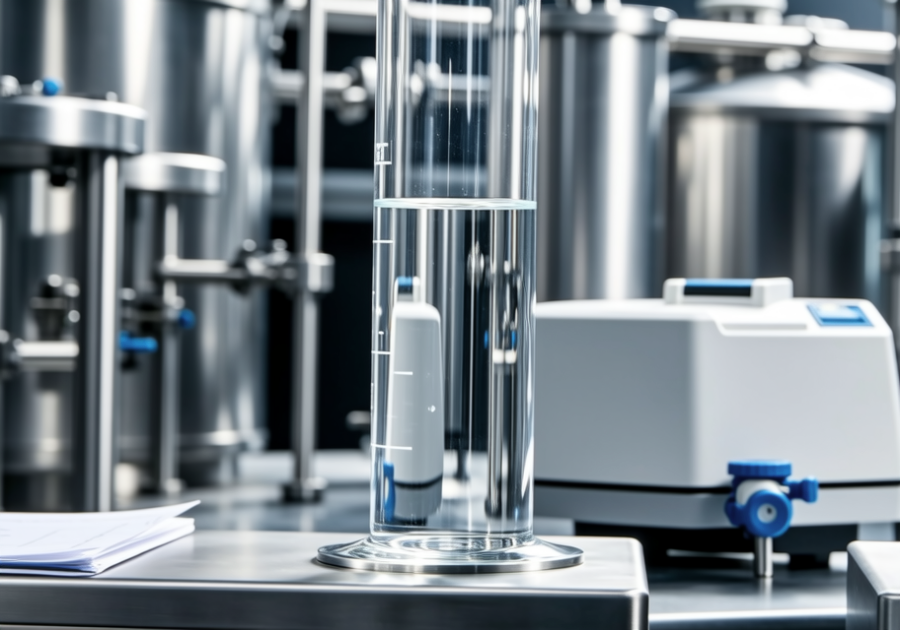
So, in a 100mL solution, 2 grams of glacial acetic acid are required as compared to 10 grams of 500mL aqueous solution. To mix the two solutions, make sure that you are using a beaker or a measuring cup to be exact with these quantities. Also, shake the two agents to have a solution with an even concentration.
The reaction between these two is an exothermic one and can irritate the skin so make sure your hands are covered during the mixing of these two agents. Moreover, it is also recommended to keep this solution in a container with a tight-fitting lid to avoid evaporation.
When dealing with glacial acetic acid, one should be careful and use proper PPE in a chemical lab as this is pure acetic acid. In low concentrations, it can just cause mild damage or irritation to your skin but in high concentrations like in glacial acetic acid can seriously harm you.
Wrapping Up:
To achieve the 2% acetic acid dilution, one needs to calculate the quantity of solvent and then mix accordingly. Diluted acetic acid solutions have great importance in the current industry and their dilution can be done both in a laboratory and at an industrial scale. The most common uses are their use in food ingredients (vinegar), in horticulture and agriculture as herbicides, for food preservation, and in medical research. Dealing with glacial acetic acid for dilution purposes should be handled with care.
Looking for chemical products? Let suppliers reach out to you!
You May Interested In


Glow70/KLOW80 99% China Peptides Warehouse Direct Delivery Lyophilized Powder in Stock
$169/UNIT FOB


2026-10-25
Trade Alert
Delivering the latest product trends and industry news straight to your inbox.
(We'll never share your email address with a third-party.)

Related News
Recommend Reading
-
![Business Society’s Market Outlook for MIBK on August 13, 2026: Volatile and Tending to Weaken]()
Business Society’s Market Outlook for MIBK on August 13, 2026: Volatile and Tending to Weaken
-
![Business Society September 29, 2026 Propylene Oxide Trend Analysis: Volatility]()
Business Society September 29, 2026 Propylene Oxide Trend Analysis: Volatility
-
![Business Society’s September 11, 2026, Petroleum Coke Trend Analysis: Volatile]()
Business Society’s September 11, 2026, Petroleum Coke Trend Analysis: Volatile
-
![Business Society’s Outlook on Caustic Soda Prices on August 13, 2026: Stability to Be the Dominant Trend]()
Business Society’s Outlook on Caustic Soda Prices on August 13, 2026: Stability to Be the Dominant Trend
-
![Business Society September 29, 2026 Phthalic Anhydride Trend Analysis: Strong Rebound with a Bullish Bias]()
Business Society September 29, 2026 Phthalic Anhydride Trend Analysis: Strong Rebound with a Bullish Bias