Amazing Monthly Sales Performance of Opdivo and Keytruda in China
It was revealed that by September 30, i.e., about one month after the marketing in China, the sales revenue of the two anti-PD-1 monoclonal antibody drugs: Opdivo and Keytruda separately reached RMB 190 million and RMB 150 million, showing amazing performance.
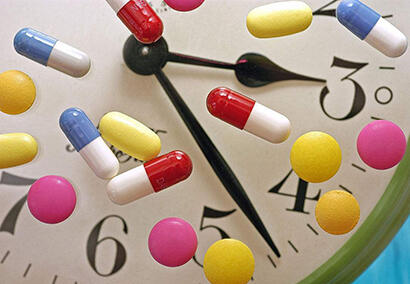
According to Pharmcube’s research on return on investment of new drugs marketed in China, it used to take averagely 10 years for new drugs to achieve RMB 100 million sales in China, however, this situation is changing as China’s drug regulation environment changes.
The marketing of the non-small cell lung cancer (NSCLC) new drug: osimertinib is an event worth mentioning: its sales exceeded RMB 500 million within 9 months of marketing in China; in the same year, sales of adalimumab that topped the global list of pharmaceutical product sales were only RMB 200 million in China. Seen from current situation, sales of Opdivo and Keytruda are likely to exceed those of osimertinib (in their first year of marketing), to become new benchmarks for innovative drug sales in China.
Global monoclonal antibody drug market worth USD 100 billion
Monoclonal antibody drugs have been widely applied in oncology and immunotherapy fields, etc. in recent years owing to unique advantages such as significant therapeutic effects and low side effects.
Global sales of monoclonal antibody drugs totaled USD 106.1 billion in 2017, growing by more than 20% than 2016, wherein, the top 7 monoclonal antibody drugs occupied 7 positions of the ranking list of global top 10 best-selling pharmaceutical products in 2017, and contributed total sales of USD 65.6 billion.
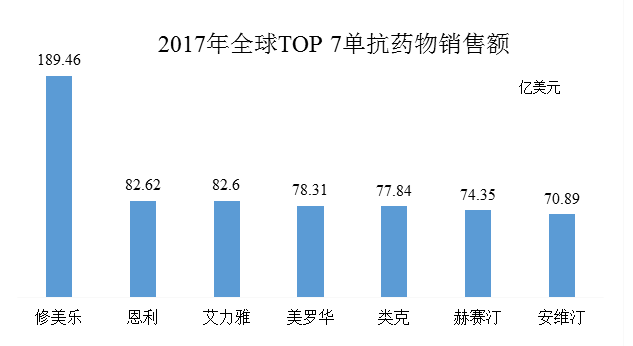
In 2017, Opdivo achieved global sales of USD 4.948 billion, while Keytruda contributed USD 3.809 billion sales revenue for MSD. Roughly speaking, sales performance of Opdivo and Keytruda in global market largely benefits from the innovative drug payment systems of European and American countries: with the developed commercial medical insurances of those countries, innovative drugs will soon be included in the corresponding drug lists of commercial medical insurance products once their efficacy is confirmed, and then will hopefully achieve rapid growth of sales.
Unlike that, most monoclonal antibody drugs in China should be paid by patients themselves, and clinical use of those drugs is very limited in China due to their expensive prices. The new edition of China’s medical insurance drug catalog included 2 monoclonal antibody drugs for the first time in 2017, with 7 monoclonal antibody drugs successfully included in the subsequent two negotiations. 9 monoclonal antibody drugs have so far been included in China’s medical insurance drug catalog, which is deemed as the fuse for the explosion of monoclonal antibody drugs in China by the industry, indicating that the market demand is expected to be rapidly released.

You May Interested In


2026-09-21
Trade Alert
Delivering the latest product trends and industry news straight to your inbox.
(We'll never share your email address with a third-party.)

Related News
-
China's National Narcotics Control Commission Issues Important Notice: Beware of These 8 Chemicals Being Diverted for Drug Production
-
European Diesel Crack Spread Hits Record $74.66 per Barrel as Global Refinery Outages Mount
-
Global Chemical Giants Accelerate Plant Closures and Layoffs as Industry Enters Structural Capacity Rationalization
-
Ukraine Strikes Russia’s Perm Refinery Again, Forcing Crude Unit Offline at 260,000-BPD Facility
-
Ukraine Strikes Russia’s Ryazan Refinery Again, Setting 17-Million-Tonne Facility Ablaze
-
Wanhua Chemical Raises Southeast Asia MDI and TDI Offers by $200 per Tonne
-
Rising Naphtha Prices in Japan Drive Up Costs for Diapers, Sanitary Products, and Cosmetics
-
Global Chemical Inventories Hit Critical Lows as Over 200 Chinese Companies Suspend Quotations
-
Hengli Sanctions Spill Over: One Barrel of Iranian Crude Pulls an Aromatics Chain Into Risk
-
Chemicals Are Going Wild: Sulfur Surges 512%, Titanium Dioxide, Polyols and Sulfuric Acid Lose Control
Recommend Reading
-
![A $25 Billion Bill Hits Global Companies as Chemical Costs Are Repriced]()
A $25 Billion Bill Hits Global Companies as Chemical Costs Are Repriced
-
![EU Puts Chemicals on Its China De-Risking Watchlist]()
EU Puts Chemicals on Its China De-Risking Watchlist
-
![China’s Chemical “Spring Surge”: 68.8% of Products Rising—Real Recovery or Just a Pre-Festival Mirage?]()
China’s Chemical “Spring Surge”: 68.8% of Products Rising—Real Recovery or Just a Pre-Festival Mirage?
-
![One Million Tonnes of U.S. Ethane Arrive as China Sets a New Import Record]()
One Million Tonnes of U.S. Ethane Arrive as China Sets a New Import Record
-
![IEA Warns Oil Inventories Are Draining Fast as Chemicals Enter Risk Pricing]()
IEA Warns Oil Inventories Are Draining Fast as Chemicals Enter Risk Pricing
-
![January China's bunker fuel market fluctuates]()
January China's bunker fuel market fluctuates
-
![Bottom-fishing and Replenishment Orders & Strong Raw Materials Drive Significant ABS Price Increase in January]()
Bottom-fishing and Replenishment Orders & Strong Raw Materials Drive Significant ABS Price Increase in January
-
![Costs Rise, January PP Follows Upstream Prices]()
Costs Rise, January PP Follows Upstream Prices
-
![Raw Material Strength and Weak Demand Lead to PC Fluctuations in January in China]()
Raw Material Strength and Weak Demand Lead to PC Fluctuations in January in China
-
![Supply Disruptions Repeatedly Resonate, Lithium Carbonate Experiences Sharp Fluctuations]()
Supply Disruptions Repeatedly Resonate, Lithium Carbonate Experiences Sharp Fluctuations