How is Polyester Fibre Made?| Detailed Explanation
Polyester fiber is a synthetic fiber with good durability and wrinkle resistance. It also has the characteristic of easy maintenance. These characteristics have enabled it to be widely used in textiles, clothing, home furnishings, and industry. Polyester fibers are mainly made from petrochemical products. It is processed through a series of chemical and physical processes. This article will discuss "how is polyester fiber made".
Raw Materials and Polymerization Reactions
Polyester fibers’ main raw materials are terephthalic acid (PTA) and ethylene glycol (EG). These two chemicals come from the petroleum refining process and react chemically to produce polyester. Both of them undergo esterification or ester exchange reaction under the action of a catalyst to form polyethylene terephthalate (PET).
Under the action of high temperatures and catalysts such as antimony compounds or titanium compounds, PTA and EG undergo esterification or transesterification reactions. Polyethylene terephthalate (PET) is then formed.
The reaction is divided into two stages. The first stage is the formation of oligomers. PTA and EG undergo an esterification reaction. Oligomers and water are produced. Next is the condensation reaction stage.
Oligomers further polymerize to form high molecular weight PET while releasing ethylene glycol. The final PET is a solid resin, and the length of its molecular chain determines the properties of the fiber.
Melt Spinning
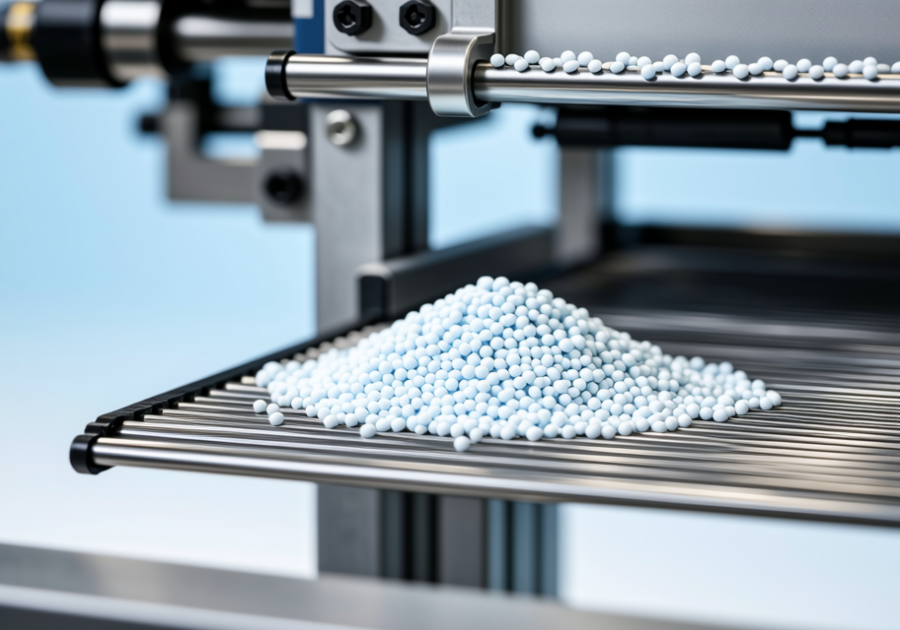
After obtaining PET resin, heat it to 260-280℃ to melt it. And then extrude the filaments through a spinning nozzle. The melt-spinning process includes several steps.
Firstly, there is melting. PET particles melt in a heating furnace. Then, there is filtering. The melted PET is filtered to remove impurities. That can ensure fiber quality. Next is spinning. Melted PET is extruded through a spinneret, and then slender filaments are formed. Finally, it is cooled and solidified. The filament is rapidly cooled by cold air or coolant. Primary fibers are then formed.
Drawing and Heat Setting
How is polyester fibre made? The next step is stretching and heat setting. The strength of the newly spun fibers after melt spinning is relatively low. They need to be drawn and heat-set to improve their mechanical properties.
Stretching elongates fibers, which can increase orientation and arrange molecular chains more orderly. It can enhance the strength and toughness of fibers. Subsequently, a heat setting is carried out to stabilize the fiber structure. This improves dimensional stability and heat resistance.
Surface Treatment And Fiber Modification
In order to adapt to different applications, polyester fibers can undergo various post-treatment processes. Dyeing treatment can improve dyeing performance, and can enhance color fastness.
Due to the difficulty of dyeing native polyester fibers, the dyeing performance can be improved by adding copolymer modifiers or surface treatment. Antistatic treatment is one of the post-treatment processes. Polyester fibers are prone to static electricity, so anti-static agents can be added.
Antibacterial and odor prevention treatment is necessary. When it is used for functional clothing, antibacterial agents may need to be added. Flame retardant treatment can improve safety. Therefore, in the industrial or safety protection field, it may be necessary to add flame retardants to improve safety.
Main Types And Applications
According to the spinning method and processing technology, polyester fibers are mainly divided into several types. Staple fiber is used for blending. It is also used to manufacture cotton fabrics and for blending with cotton to make T-shirts. Filament Yarn is used in high-strength fabrics such as sportswear, tents, etc. Hollow fiber is used for insulation materials, for example, down jacket fillers.
Environmental Protection and Sustainable Development
Recently people’s awareness of environmental protection is increasing, the polyester fiber industry is then developing towards sustainability. For example, recycling polyester (rPET) has become an important means of reducing plastic pollution. By recycling plastic bottles and reprocessing them into fibers, carbon emissions and energy consumption can be significantly reduced.
In addition, bio-based polyester is also a cutting-edge technology that uses renewable resources such as corn and sugarcane to replace petrochemical raw materials. The dependence on nonrenewable resources is thereby decreased.
Conclusion
How is polyester fibre made? You may have the idea now. The polyester fibers’ production process involves multiple steps from petrochemical raw materials to final fibers. Polymerization, melt spinning, stretching and heat setting, and surface treatment are included. The optimization and improvement have given polyester fibers a wide range of application prospects. It plays an important role in various fields such as textiles, industry, and medicine. Polyester fibers have good performance and low cost, these properties make it widely used in many fields, for example, clothing, home textiles, and industrial materials. With the advancement of technology, polyester fibers will develop towards environmental protection, functionalization, and high performance in the future, further meeting market demand.
Looking for chemical products? Let suppliers reach out to you!
You May Interested In


SS-31 Cosmetic peptides, discounted price improving cognitive impairment factory supply
$8E+1/UNIT FOB


2026-09-17
Trade Alert
Delivering the latest product trends and industry news straight to your inbox.
(We'll never share your email address with a third-party.)

Related News
-
Why You Should Never Mix Bleach and Vinegar
-
Benzoylecgonine: Detection and Testing Methods
-
What Color Should a Zinc-Copper Couple Be?
-
Acesulfame Potassium: Safety, Side Effects, and Food Uses
-
Zoledronic Acid: Uses, Mechanism, and Side Effects
-
Polysorbate 80: Food Additive, Medical Use, and Safety
-
Understanding the Arsenate Symbol and Its Uses
-
Sulfur Dioxide Properties & Uses: Industrial, Preservative & Safety Guide
-
Anastrozole Side Effects: What You Need to Know
Recommend Reading
-
![Business Society PVC Trend Analysis for September 11, 2026: Pullback Pressure]()
Business Society PVC Trend Analysis for September 11, 2026: Pullback Pressure
-
![Methylene Chloride Market Hits Bottom and Stabilizes, with Supply Contraction Driving a Moderate Recovery]()
Methylene Chloride Market Hits Bottom and Stabilizes, with Supply Contraction Driving a Moderate Recovery
-
![Business Society’s Market Outlook for Petroleum Coke on August 17, 2026: Volatile (Bullish)]()
Business Society’s Market Outlook for Petroleum Coke on August 17, 2026: Volatile (Bullish)
-
![Insufficient Support, Shandong Cyclohexanone Market in Decline]()
Insufficient Support, Shandong Cyclohexanone Market in Decline
-
![In April, the overall trend of maleic anhydride in China declined]()
In April, the overall trend of maleic anhydride in China declined