




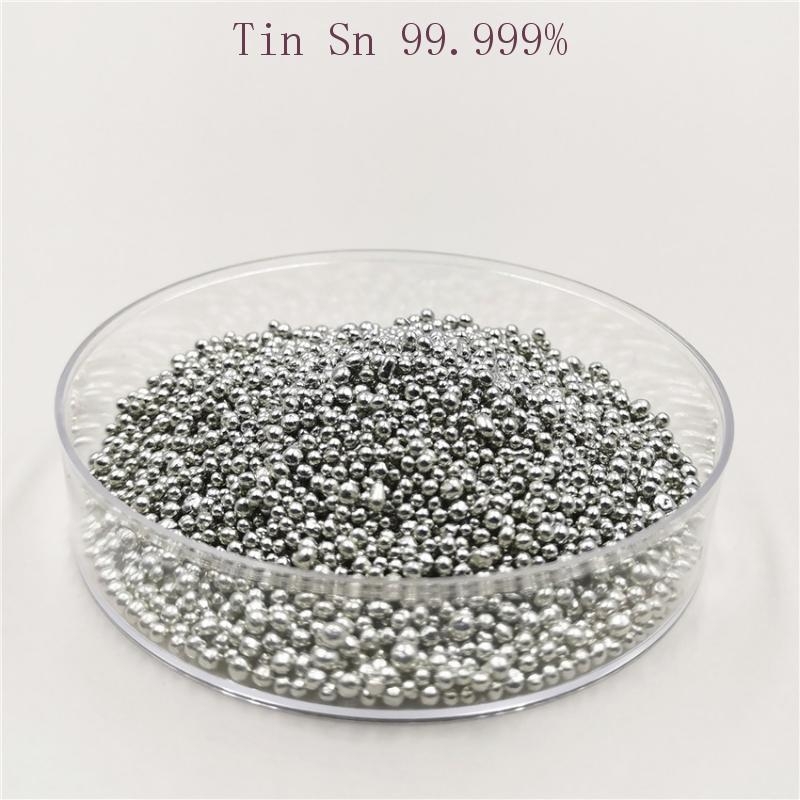


high pure Tin Sn 99.999% chemical basic material CAS#:7440-31-5 99.999% solid schpm
ISO 1 Inquiries
7440-31-5
Industrial Grade
99.999%
Shen Zhen
schpm
1kg/standard bag
Yes
2023-03-09
pure metal,inorganic chemicals,antimonide,high pure element,sulfide,telluride
-
Product Description
-
Seller Information
-
Inquiry History
-
DescriptionECHEMI Editorial ReferenceTin is a ductile, malleable, lustrous solid with a gray to almost silver-white color. Tin forms covalent bonds with carbon forming a variety of organometallic or organotin compounds, and the physical and chemical properties differ for various compounds such as Tin II (SnO) and Tin IV (SnO2), organotins, and inorganic tin compounds. Tin compounds are generally insoluble in water and have vapor pressures of approximately 0mmHg. Tin is not easily oxidized and resists corrosion; however, powdered t
White TIN is an almost silver-white, ductile, malleable, lustrous solid. mp 232° C, bp: 2507°C. Density: 7.3 g/cm3. Pure white tin becomes non-metallic powdery gray tin if held for a sustained period at temperatures less than 13°C.|DryPowder; DryPowder, OtherSolid; DryPowder, PelletsLargeCrystals, OtherSolid; OtherSolid; OtherSolid, Liquid|WHITE CRYSTALLINE POWDER.|Gray to almost silver-white, ductile, malleable, lustrous solid.|Appearance and odor vary depending upon the specific organotin compound.
White TIN is an almost silver-white, ductile, malleable, lustrous solid. mp 232° C, bp: 2507°C. Density: 7.3 g/cm3. Pure white tin becomes non-metallic powdery gray tin if held for a sustained period at temperatures less than 13°C.|Tin is a natural element in the earth's crust. It is a soft, white, silvery metal that does not dissolve in water. It is present in brass, bronze, pewter, and some soldering materials. Tin metal is used to line cans for food, beverages, and aerosols. Tin can combine with other chemicals to form compounds. Combinations with chemicals like chlorine, sulfur, or oxygen are called inorganic tin compounds (i.e., stannous chloride, stannous sulfide, stannic oxide). These are used in toothpaste, perfumes, soaps, food additives and dyes. Tin also can combine with carbon to form organotin compounds (i.e., dibutyltin, tributyltin, triphenyltin). These compounds are used to make plastics, food packages, plastic pipes, pesticides, paints, and pest repellents. Tin metal, and inorganic and organic tin compounds can be found in the air, water, and soil near places where they are naturally present in the rocks, or where they are mined, manufactured, or used.|Tin atom is a metal atom and a carbon group element atom. It has a role as a micronutrient.|Tin is a metallic element with atomic symbol Sn, atomic number 50, and atomic weight 118.71.|A trace element that is required in bone formation. It has the atomic symbol Sn, atomic number 50, and atomic weight 118.71.CertificatesBasic Info-
Product Name:
Tin
Other Name:Tin;C.I. 77860;C.I. Pigment Metal 5;Metallic tin;Silver Matt Powder;Tin Flake;Tin Powder;Wang;Tin element;Tin Paste 62-1177;Sn-S 200;SNE 06PB;TEGO 30;TEGO 60;AT-SN;Sn-HWQ;Sn-S-HWQ;PO 1;PO 2;W-Sn;G-Sn;FSn 2;AT-Sn600;Y-Sn100-Q2510;SNE 04PB;AH 302;Lecocel 501-059;ST-M 011-5;Sn99.90AA;Sn-HPN
CAS No.:7440-31-5
Molecular Formula:Sn
InChIKeys:InChIKey=ATJFFYVFTNAWJD-UHFFFAOYSA-N
Molecular Weight:118.71
Exact Mass:119.90200
EC Number:231-141-8
UNII:387GMG9FH5
ICSC Number:1535
UN Number:3089
DSSTox ID:DTXSID1049801
NCI Thesaurus Code:C76209
Color/Form:Cubic (gray); tetragonal (white); rhomboidal (tin brittle)|Almost silver-white, lustrous soft, very malleable & ductile metal; only slightly tenacious; easily powdered; when bent emits crackling "tin cry"; brittle @ 200 °C; brinell hardness 2.9; at -40 °C crumbles to gray amorphous powder (gray tin); slowly changes back above 20 °C to white tin
HScode:7106929000
Categories:
Characteristics-
PSA:
0
XLogP3:-0.91620
Appearance:White TIN is an almost silver-white, ductile, malleable, lustrous solid. mp 232° C, bp: 2507°C. Density: 7.3 g/cm3. Pure white tin becomes non-metallic powdery gray tin if held for a sustained period at temperatures less than 13°C.
Density:7.31 g/cm3
Melting Point:231.9 °C
Boiling Point:2507 °C
Flash Point:2270°C
Water Solubility:H2O: soluble
Vapor Pressure:0 mmHg (approx)
Flammability characteristics:Noncombustible Solid, but powdered form may ignite.
Odor:Odorless
Experimental Properties:NATURALLY OCCURRING ISOTOPES: 112 (0.95%); 114 (0.65%); 115 (0.34%); 116 (14.24%); 117 (7.57%); 118 (24.01%); 119 (8.59%); 120 (32.97%); 122 (4.71%); 124 (5.98%)|Tin has two allotropic forms at normal pressure; resists distilled, sea and soft tap water; oxygen in soln accelerates attack; when heated in air, tin oxide forms|Heat of fusion: 7.03 kJ/mol /white tin/|Specific Heat: 27.0 J/mol-K (white); 25.8 J/mol-K (grey) @ 25 °C|For more Other Experimental Properties (Complete) data for TIN (13 total), please visit the HSDB record page.
Air and Water Reactions:No rapid reaction with air No rapid reaction with water
Reactive Group:Metals, Less Reactive
Reactivity Profile:TIN is a reducing agent. Stable in massive form in air, but oxidizes (corrodes) in air as a powder, especially in the presence of water. Dissolve slowly in dilute strong acids in the cold. Dissolves in hot aqueous KOH and other strongly basic solutions. Incompatible with acids and base. Incompatible with chlorine and turpentine.
Autoignition Temperature:630 °C (cloud); 430 °C (layer)
Flammable Limits:Noncombustible Solid, but powdered form may ignite.
Heat of Vaporization:296.4 kJ/mol
Hazard IdentificationClassification of the substance or mixture
Not classified.
GHS label elements, including precautionary statements
Pictogram(s) No symbol. Signal word No signal word
Hazard statement(s) none
Precautionary statement(s) Prevention none
Response none
Storage none
Disposal none
Other hazards which do not result in classification
no data available
Handling and StoragePrecautions for safe handling
NO open flames. Handling in a well ventilated place. Wear suitable protective clothing. Avoid contact with skin and eyes. Avoid formation of dust and aerosols. Use non-sparking tools. Prevent fire caused by electrostatic discharge steam.
Conditions for safe storage, including any incompatibilities
Separated from strong oxidants.
-
-
Seller Information
-
Business Type:
Manufactory
-
Main Products:
pure metal,inorganic chemicals,antimonide,high pure element,sulfide,telluride
-
Location:
Mianyang, Sichuan Provice, China, Mianyang, Sichuan Provice, China
-
Payment Terms:
TT against copy of documents,L/C
-
Average lead Time:
7 days
-
Total Annual Revenue:
$1 million-$2.5 million
-
Total Employees:
11-50
-
Year of Establishment:
2018
Company Certificates-
 IOS9001
-
-
Inquiry History1 Inquiries
Country Product Purchase Quantity Date Posted  Germany
Tin ingot
1000 KG Jan 15, 2024 Post an enquiry for this product
More from this Seller
-
-

-
high pure Indium Telluride InTe 99.999% chemical compound material CAS#:1312-45-4 99.999% schpm
Industrial Grade / 99.999%
-
-
-

-
high pure Germanium Ge 99.999% chemical basic material CAS#:7440-56-4 99.999% schpm
Industrial Grade / 99.999%
-
-
-

-
high pure Indium In 99.999% chemical basic material CAS#:7440-74-6 99.999% schpm
Industrial Grade / 99.999%
-
-
-

-
high pure Gallium Telluride GaTe 99.999% chemical compound material CAS#:12024-14-5 99.999% schpm
Industrial Grade / 99.999%
-
-
-

-
high pure Tin Dioxide SnO2 99.99% chemical basic material CAS#:18282-10-5 99.99% schpm
Industrial Grade / 99.99%
-


