






4-tert-Amylphenol -a
80-46-6
25
2023-01-31

Chemical Pesticides,Food Additives,Agrochemicals,Active Pharm Ingredients,Flavors and Fragrances,Chemical Catalyst
-
Product Description
-
Seller Information
-
DescriptionECHEMI Editorial ReferencesolidBasic Info
-
Product Name:
4-tert-Pentylphenol
Other Name:Phenol,4-(1,1-dimethylpropyl)-;Phenol,p-tert-pentyl-;Phenol,p-(1,1-dimethylpropyl)-;4-(1,1-Dimethylpropyl)phenol;Amilfenol;p-tert-Amylphenol;4-tert-Amylphenol;p-(α,α-Dimethylpropyl)phenol;p-tert-Pentylphenol;4-tert-Pentylphenol;4-t-Amylphenol;p-(1,1-Dimethylpropyl)phenol;4-t-Pentylphenol;NSC 403672;NSC 4965;BirexSE;4-(2-Methylbutan-2-yl)phenol
CAS No.:80-46-6
Molecular Formula:C11H16O
InChIKeys:InChIKey=NRZWYNLTFLDQQX-UHFFFAOYSA-N
Molecular Weight:164.24
Exact Mass:164.24
EC Number:201-280-9
UNII:6NP9LYK846
NSC Number:403672|4965
UN Number:2430
DSSTox ID:DTXSID8021771
Color/Form:White crystals|Colorless needles
HScode:2907199090
Categories:
Characteristics-
PSA:
20.2
XLogP3:3.9
Appearance:P-tert-pentylphenol appears as colorless needles or beige solid. (NTP, 1992)
Density:0.962 g/cm3 @ Temp: 20 °C
Melting Point:94-95 °C
Boiling Point:262.5 °C
Flash Point:122.4±8.2 °C
Refractive Index:1.510
Water Solubility:37 mg/L (20 ºC)
Vapor Pressure:2.00X10⁻³ mm Hg at 25 deg C (ext)
Toxicity:LD50 orally in rats: 3.08 g/kg (Smyth)
Henrys Law Constant:Henry's Law constant = 2.03X10⁻⁶ atm-cu m/mole at 25 °C (est)
Dissociation Constants:pKa = 10.43
Experimental Properties:Incompatible with oxidizing materials|Liquid molar volume is 0.180266 cu m/kmo|Hydroxyl radical reaction rate constant = 4.2X10⁻¹¹ cu cm/molec-sec at 25 °C (est)
Air and Water Reactions:Insoluble in water.
Reactive Group:Phenols and Cresols
Reactivity Profile:Phenols, such as P-TERT-PENTYLPHENOL, do not behave as organic alcohols, as one might guess from the presence of a hydroxyl (-OH) group in their structure. Instead, they react as weak organic acids. Phenols and cresols are much weaker as acids than common carboxylic acids (phenol has pKa = 9.88). These materials are incompatible with strong reducing substances such as hydrides, nitrides, alkali metals, and sulfides. Flammable gas (H2) is often generated, and the heat of the reaction may ignite the gas. Heat is also generated by the acid-base reaction between phenols and bases. Such heating may initiate polymerization of the organic compound. Phenols are sulfonated very readily (for example, by concentrated sulfuric acid at room temperature). The reactions generate heat. Phenols are also nitrated very rapidly, even by dilute nitric acid. Nitrated phenols often explode when heated. Many of them form metal salts that tend toward detonation by rather mild shock. This material can react with oxidizing materials.
Heat of Vaporization:6.5751X10+7 J/kmol at melting point
Hazard IdentificationClassification of the substance or mixture
Skin corrosion, Sub-category 1B
Skin sensitization, Category 1
Serious eye damage, Category 1
Hazardous to the aquatic environment, long-term (Chronic) - Category Chronic 1
GHS label elements, including precautionary statements
Pictogram(s) 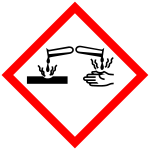

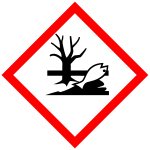
Signal word Danger
Hazard statement(s) H314 Causes severe skin burns and eye damage
H317 May cause an allergic skin reaction
H410 Very toxic to aquatic life with long lasting effects
Precautionary statement(s) Prevention P260 Do not breathe dust/fume/gas/mist/vapours/spray.
P264 Wash ... thoroughly after handling.
P280 Wear protective gloves/protective clothing/eye protection/face protection/hearing protection/...
P261 Avoid breathing dust/fume/gas/mist/vapours/spray.
P272 Contaminated work clothing should not be allowed out of the workplace.
P273 Avoid release to the environment.
Response P301+P330+P331 IF SWALLOWED: Rinse mouth. Do NOT induce vomiting.
P363 Wash contaminated clothing before reuse.
P304+P340 IF INHALED: Remove person to fresh air and keep comfortable for breathing.
P316 Get emergency medical help immediately.
P321 Specific treatment (see ... on this label).
P305+P351+P338 IF IN EYES: Rinse cautiously with water for several minutes. Remove contact lenses, if present and easy to do. Continue rinsing.
P302+P352 IF ON SKIN: Wash with plenty of water/...
P333+P317 If skin irritation or rash occurs: Get medical help.
P362+P364 Take off contaminated clothing and wash it before reuse.
P305+P354+P338 IF IN EYES: Immediately rinse with water for several minutes. Remove contact lenses, if present and easy to do. Continue rinsing.
P317 Get medical help.
P391 Collect spillage.
Storage P405 Store locked up.
Disposal P501 Dispose of contents/container to an appropriate treatment and disposal facility in accordance with applicable laws and regulations, and product characteristics at time of disposal.
Other hazards which do not result in classification
no data available
Handling and StoragePrecautions for safe handling
Handling in a well ventilated place. Wear suitable protective clothing. Avoid contact with skin and eyes. Avoid formation of dust and aerosols. Use non-sparking tools. Prevent fire caused by electrostatic discharge steam.
Conditions for safe storage, including any incompatibilities
Store the container tightly closed in a dry, cool and well-ventilated place. Store apart from foodstuff containers or incompatible materials.
-
-
Seller Information
-
Business Type:
Manufactory
-
Main Products:
Chemical Pesticides,Food Additives,Agrochemicals,Active Pharm Ingredients,Flavors and Fragrances,Chemical Catalyst
-
Location:
https://www.dideu.com/en/
-
Payment Terms:
TT against copy of documents,D/P,L/C,D/A,O/A,TT against B/L draft before shipment,100% TT in advance
-
Average lead Time:
7
-
Total Annual Revenue:
Above $100 million
-
Total Employees:
Above 1000
-
Year of Establishment:
2016
-
Certifications:
ISO Certificate,REACH
"> -
-
Country Product Purchase Quantity Date Posted Post an enquiry for this product