Selenic acid 7783-08-6
ISO
7783-08-6
Industrial Grade
99%
200KG/drum
Yes
2023-09-03
Flavors & Fragrances,Catalyst & Auxiliary,Intermediates,Dyes & Pigments,Inorganic Chemistry,petro chemicals
-
Product Description
-
Seller Information
-
DescriptionECHEMI Editorial Referencecolourless or white crystals
Selenic acid appears as a white crystalline solid. Very corrosive to skin, eyes and mucous membranes. Corrosive to metal. Toxic by skin absorption and by ingestion.
Selenic acid appears as a white crystalline solid. Very corrosive to skin, eyes and mucous membranes. Corrosive to metal. Toxic by skin absorption and by ingestion.|Selenic acid is a selenium oxoacid. It is a conjugate acid of a hydrogenselenate.|Selenic acid is an organic compound with the chemical formula H2SeO4. It may be found in over-the-counter daily dietary supplements as a source of [DB11135], an essential trace mineral for human health.|A strong dibasic acid with the molecular formula H2SeO4. Included under this heading is the acid form, and inorganic salts of dihydrogen selenium tetraoxide.CertificatesBasic Info-
Product Name:
Selenic acid
Other Name:Selenic acid;Selenium hydroxide oxide (Se(OH)2O2);63090-47-1;141676-86-0;1177580-12-9;2225846-52-4
CAS No.:7783-08-6
Molecular Formula:H2O4Se
InChIKeys:InChIKey=QYHFIVBSNOWOCQ-UHFFFAOYSA-N
Molecular Weight:144.97
Exact Mass:144.97
EC Number:231-979-4
UNII:HV0Y51NC4J
UN Number:1905
DSSTox ID:DTXSID2064818
Color/Form:White solid|Hexagonal colorless prisms
Categories:
Characteristics-
PSA:
74.60000
XLogP3:-1.6279
Appearance:Colorless Liquid
Density:1.407 g/mL at 25 °C
Melting Point:58 °C
Boiling Point:260 °C
Flash Point:>230 °F
Refractive Index:n20/D 1.5174(lit.)
Water Solubility:Miscible with sulfuric acid. Immiscible with ammonia.
Toxicity:Reference value: Oral-rat LD50: 1.6 mg/kg; Abdominal-rat LDL0: 8.973 mg/kg
Dissociation Constants:pKa1 = 1.7
Experimental Properties:Decomp in alcohol; reduced by hydrobromic acid, hydriodic acid, hydrogen sulfide, hydroxylamine hydrochloride, phenylhydrazine, formic acid, oxalic acid, malonic acid, pyruvic acid, acetyl chloride, and several metals; very deliquescent|Hygroscopic; reacts with ethanol|Standard molar enthalpy of formation: -530.1 kJ/mol|Strong oxidizing agent
Air and Water Reactions:Very hygroscopic. Soluble in water.
Reactive Group:Acids, Strong Oxidizing
Reactivity Alerts:Strong Oxidizing Agent
Reactivity Profile:SELENIC ACID, LIQUID reacts exothermically with chemical bases (for example: amines and inorganic hydroxides) to form salts. The reactions can generate dangerously large amounts of heat in small spaces. A good oxidizing agent. It may oxidize organic matter such as wood, cotton, fiberboard, etc. The solid reacts with active metals, including iron and aluminum, and also less active metals, to dissolve the metal and liberate hydrogen and/or toxic gases. Can initiate polymerization in certain classes of organic compounds. Reacts with cyanide salts and compounds to release gaseous hydrogen cyanide. Flammable and/or toxic gases are also often generated with dithiocarbamates, isocyanates, mercaptans, nitrides, nitriles, sulfides, and weak or strong reducing agents. Additional gas-generating reactions occur with sulfites, nitrites, thiosulfates (to give H2S and SO3), dithionites (SO2), and even carbonates: the carbon dioxide gas from the last is nontoxic but the heat and spattering from the reaction can be troublesome. May catalyze (increase the rate of) chemical reactions.
Hazard IdentificationClassification of the substance or mixture
Acute toxicity - Category 3, Oral
Skin irritation, Category 2
Serious eye damage, Category 1
Acute toxicity - Category 3, Inhalation
Specific target organ toxicity â repeated exposure, Category 2
Hazardous to the aquatic environment, short-term (Acute) - Category Acute 1
Hazardous to the aquatic environment, long-term (Chronic) - Category Chronic 1
GHS label elements, including precautionary statements
Pictogram(s) 
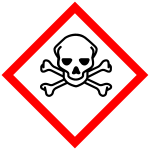

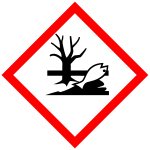
Signal word Danger
Hazard statement(s) H301+H331 Toxic if swallowed or if inhaled
H315 Causes skin irritation
H318 Causes serious eye damage
H373 May cause damage to organs through prolonged or repeated exposure
H410 Very toxic to aquatic life with long lasting effects
Precautionary statement(s) Prevention P264 Wash ... thoroughly after handling.
P270 Do not eat, drink or smoke when using this product.
P280 Wear protective gloves/protective clothing/eye protection/face protection/hearing protection/...
P261 Avoid breathing dust/fume/gas/mist/vapours/spray.
P271 Use only outdoors or in a well-ventilated area.
P260 Do not breathe dust/fume/gas/mist/vapours/spray.
P273 Avoid release to the environment.
Response P301+P316 IF SWALLOWED: Get emergency medical help immediately.
P321 Specific treatment (see ... on this label).
P330 Rinse mouth.
P302+P352 IF ON SKIN: Wash with plenty of water/...
P332+P317 If skin irritation occurs: Get medical help.
P362+P364 Take off contaminated clothing and wash it before reuse.
P305+P354+P338 IF IN EYES: Immediately rinse with water for several minutes. Remove contact lenses, if present and easy to do. Continue rinsing.
P317 Get medical help.
P304+P340 IF INHALED: Remove person to fresh air and keep comfortable for breathing.
P316 Get emergency medical help immediately.
P319 Get medical help if you feel unwell.
P391 Collect spillage.
Storage P405 Store locked up.
P403+P233 Store in a well-ventilated place. Keep container tightly closed.
Disposal P501 Dispose of contents/container to an appropriate treatment and disposal facility in accordance with applicable laws and regulations, and product characteristics at time of disposal.
Other hazards which do not result in classification
no data available
Handling and StoragePrecautions for safe handling
Handling in a well ventilated place. Wear suitable protective clothing. Avoid contact with skin and eyes. Avoid formation of dust and aerosols. Use non-sparking tools. Prevent fire caused by electrostatic discharge steam.
Conditions for safe storage, including any incompatibilities
Store the container tightly closed in a dry, cool and well-ventilated place. Store apart from foodstuff containers or incompatible materials.
-
-
Seller Information
-
Business Type:
Manufactory
-
Main Products:
Flavors & Fragrances,Catalyst & Auxiliary,Intermediates,Dyes & Pigments,Inorganic Chemistry,petro chemicals
-
Location:
17th Yuanlin Road ,Chongchuan area ,Nantong city ,Jiangsu province ,China
-
Payment Terms:
L/C,100% TT in advance
-
Average lead Time:
2 days
-
Total Annual Revenue:
Above $100 million
-
Total Employees:
201-300
-
Year of Establishment:
2008
Company Certificates-
 GB/T19001-2016 / Iso9001:2015
-
-
Country Product Purchase Quantity Date Posted Post an enquiry for this product

More from this Seller
-
-

-
CERESIN WAX
Industrial Grade / 99%
-
-
-

-
3-Nitrotoluene 99-08-1
Industrial Grade / 99%
-
-
-

-
Dodecane CAS NO. 112-40-3
Industrial Grade / 99%
-
-
-

-
2,4-Dichloronitrobenzene CAS611-06-3
Industrial Grade / 99%
-
-
-

-
Oleyl alcohol
Industrial Grade / 85%
-
-
-

-
Oxalyl Chloride CASNO.79-37-8 Chemical raw materials Barrel Liquid 99% High Quality
Industrial Grade / 99%
-