Chromyl chloride 14977-61-8
ISO
14977-61-8
Industrial Grade
99%
200KG/drum
Yes
2023-07-25

Flavors & Fragrances,Catalyst & Auxiliary,Intermediates,Dyes & Pigments,Inorganic Chemistry,petro chemicals
-
Product Description
-
Seller Information
-
Description
(T-4)-Dichlorodioxochromium (CAS No.: 14977-61-8) is supplied by NANTONG REFORM PETRO-CHEMICAL CO.,LTD, a Manufactory with 4 years on ECHEMI.
Key details: grade Industrial Grade, content 99%, packaging 200KG/drum.
Sample is available.
Contact the supplier on this page to request a quotation or the latest price.
ECHEMI Editorial ReferenceDeep-red liquid with a musty, burning, acrid odor. [Note: Fumes in moist air.]
Chromium oxychloride appears as a dark red fuming liquid with a pungent odor. Corrosive to tissue.|DARK RED FUMING LIQUID WITH PUNGENT ODOUR.|Deep-red liquid with a musty, burning, acrid odor. [Note: Fumes in moist air.]
Chromium oxychloride appears as a dark red fuming liquid with a pungent odor. Corrosive to tissue.CertificatesBasic Info-
Product Name:
(T-4)-Dichlorodioxochromium
Other Name:Chromium,dichlorodioxo-,(T-4)-;Chromium,dichlorodioxo-;Chromyl chloride;(T-4)-Dichlorodioxochromium;Chromium oxychloride (CrO2Cl2);Chromium chloride oxide (CrO2Cl2);Chromyl chloride (CrO2Cl2);Dichlorodioxochromium;Chromium dioxide dichloride;Chromium oxide chloride (CrO2Cl2);Chromium dichloride dioxide;Chromium chloride oxide (CrCl2O2);Chromium oxychloride (CrCl2O2);Chromyl dichloride;Chromyl chloride (CrCl2O2);Chromium(VI) dioxychloride;7791-14-2;34848-09-4
CAS No.:14977-61-8
Molecular Formula:Cl2CrO2
InChIKeys:InChIKey=AHXGRMIPHCAXFP-UHFFFAOYSA-L
Molecular Weight:154.9
Exact Mass:153.86800
EC Number:239-056-8
UNII:JQU316FZ5W
ICSC Number:0854
UN Number:1758
Color/Form:Deep red liquid; appears black under reflected light|Mobile, dark-red liquid|Blood red oily liquid
HScode:2914700090
Categories:
Characteristics-
PSA:
2
XLogP3:1.14140
Appearance:red liquid
Density:1.91 g/cm3 @ Temp: 25 °C
Melting Point:-96.5 °C
Boiling Point:117 °C
Flash Point:117°C
Water Solubility:soluble in carbon tetrachloride, carbon disulfide, benzene, nitrobenzene, chloroform, and POCL3. Insoluble in water(Reacts).
Storage Conditions:Protect from light and moisture.
Vapor Pressure:Vapour pressure, kPa at 20°C: 2.67
Vapor Density:Relative vapour density (air = 1): 5.3
Flammability characteristics:Reacts with water to form toxic hydrogen chloride and chlorine gas
Odor:Pungent odor|Musty, burning, acrid odor
Experimental Properties:Strong oxidizing agent; non-conductor of electricity|Decomposes in cold or hot water, and in alcohol|Vapor (Gas) Specific Gravity: 5.3|Ratio of Specific Heats of Vapor (Gas): 1.2832|For more Other Experimental Properties (Complete) data for CHROMYL CHLORIDE (12 total), please visit the HSDB record page.
Air and Water Reactions:Fumes in moist air. Hydrolyzes exothermically and vigorously on contact with water to generate chromic acid, hydrochloric acid and some chlorine [Merck, 11th ed., 1989]. Chromium oxychloride reacts with water to generate gaseous HCl. Based on a scenario where the chemical is spilled into an excess of water (at least 5 fold excess of water), half of the maximum theoretical yield of Hydrogen Chloride gas will be created in 10 minutes. Experimental details are in the following: "Development of the Table of Initial Isolation and Protective Distances for the 2008 Emergency Response Guidebook", ANL/DIS-09-2, D.F. Brown, H.M. Hartmann, W.A. Freeman, and W.D. Haney, Argonne National Laboratory, Argonne, Illinois, June 2009.
Reactive Group:Oxidizing Agents, Strong
Reactivity Alerts:Strong Oxidizing Agent
Reactivity Profile:CHROMIUM OXYCHLORIDE is a powerful and often violent oxidizing agent. Reacts readily with many inorganic and organic materials in the absence of a dilutent. Contact with hydrogen sulfide or phosphine can cause ignition. Contact with phosphorus tribromide, acetone, ethanol, ether, and turpentine causes ignition. Contact with moist phosphorus or with phosphorus trichloride leads to explosive reaction. Contact with ammonia causes incandescence. Reacts with sodium azide to form chromyl azide, which is explosive in the absence of a dilutent. Causes ignition of flowers of sulfur and of urea on contact. [Bretherick, 1979, p. 822-823].
Ionization Potential:12.60 eV
Flammable Limits:Noncombustible Liquid, but a powerful oxidizer.
Corrosivity:Will cause severe corrosion of common metals.
Heat of Vaporization:113 Btu/lb = 62.6 cal/g = 2.62X10+5 J/kg
Hazard IdentificationClassification of the substance or mixture
Oxidizing liquids, Category 1
Skin corrosion, Sub-category 1A
Skin sensitization, Category 1
Germ cell mutagenicity, Category 1B
Hazardous to the aquatic environment, short-term (Acute) - Category Acute 1
Hazardous to the aquatic environment, long-term (Chronic) - Category Chronic 1
Carcinogenicity, Category 1B
GHS label elements, including precautionary statements
Pictogram(s) 


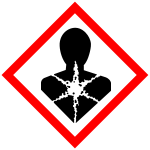
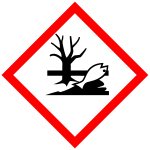
Signal word Danger
Hazard statement(s) H271 May cause fire or explosion; strong oxidizer
H314 Causes severe skin burns and eye damage
H317 May cause an allergic skin reaction
H340 May cause genetic defects
H410 Very toxic to aquatic life with long lasting effects
Precautionary statement(s) Prevention P210 Keep away from heat, hot surfaces, sparks, open flames and other ignition sources. No smoking.
P220 Keep away from clothing and other combustible materials.
P280 Wear protective gloves/protective clothing/eye protection/face protection/hearing protection/...
P283 Wear fire resistant or flame retardant clothing.
P260 Do not breathe dust/fume/gas/mist/vapours/spray.
P264 Wash ... thoroughly after handling.
P261 Avoid breathing dust/fume/gas/mist/vapours/spray.
P272 Contaminated work clothing should not be allowed out of the workplace.
P203 Obtain, read and follow all safety instructions before use.
P273 Avoid release to the environment.
Response P306+P360 IF ON CLOTHING: Rinse immediately contaminated clothing and skin with plenty of water before removing clothes.
P371+P380+P375 In case of major fire and large quantities: Evacuate area. Fight fire remotely due to the risk of explosion.
P370+P378 In case of fire: Use ... to extinguish.
P301+P330+P331 IF SWALLOWED: Rinse mouth. Do NOT induce vomiting.
P363 Wash contaminated clothing before reuse.
P304+P340 IF INHALED: Remove person to fresh air and keep comfortable for breathing.
P316 Get emergency medical help immediately.
P321 Specific treatment (see ... on this label).
P305+P351+P338 IF IN EYES: Rinse cautiously with water for several minutes. Remove contact lenses, if present and easy to do. Continue rinsing.
P302+P352 IF ON SKIN: Wash with plenty of water/...
P333+P317 If skin irritation or rash occurs: Get medical help.
P362+P364 Take off contaminated clothing and wash it before reuse.
P318 IF exposed or concerned, get medical advice.
P391 Collect spillage.
Storage P420 Store separately.
P405 Store locked up.
Disposal P501 Dispose of contents/container to an appropriate treatment and disposal facility in accordance with applicable laws and regulations, and product characteristics at time of disposal.
Other hazards which do not result in classification
no data available
Handling and StoragePrecautions for safe handling
NO contact with flammables. Handling in a well ventilated place. Wear suitable protective clothing. Avoid contact with skin and eyes. Avoid formation of dust and aerosols. Use non-sparking tools. Prevent fire caused by electrostatic discharge steam.
Conditions for safe storage, including any incompatibilities
Fireproof. Separated from combustible substances, reducing agents and food and feedstuffs. Dry. Keep in the dark. Keep in a well-ventilated room.
-
-
Seller Information
-
Business Type:
Manufactory
-
Main Products:
Flavors & Fragrances,Catalyst & Auxiliary,Intermediates,Dyes & Pigments,Inorganic Chemistry,petro chemicals
-
Location:
17th Yuanlin Road ,Chongchuan area ,Nantong city ,Jiangsu province ,China
-
Payment Terms:
L/C,100% TT in advance
-
Average lead Time:
2 days
-
Total Annual Revenue:
Above $100 million
-
Total Employees:
201-300
-
Year of Establishment:
2008
Company Certificates-
 GB/T19001-2016 / Iso9001:2015
-
-
Country Product Purchase Quantity Date Posted Post an enquiry for this product
More from this Seller
-
-

-
Adipic dihydrazide
Industrial Grade / 99%
-
-
-

-
1-Nitropropane 108-03-2
Industrial Grade / 99%
-
-
-
-Dibenzoyl-D-tartaric acid")
-
(+)-Dibenzoyl-D-tartaric acid
Industrial Grade / 99%
-
-
-

-
2-Aminobiphenyl
Industrial Grade / 99%
-