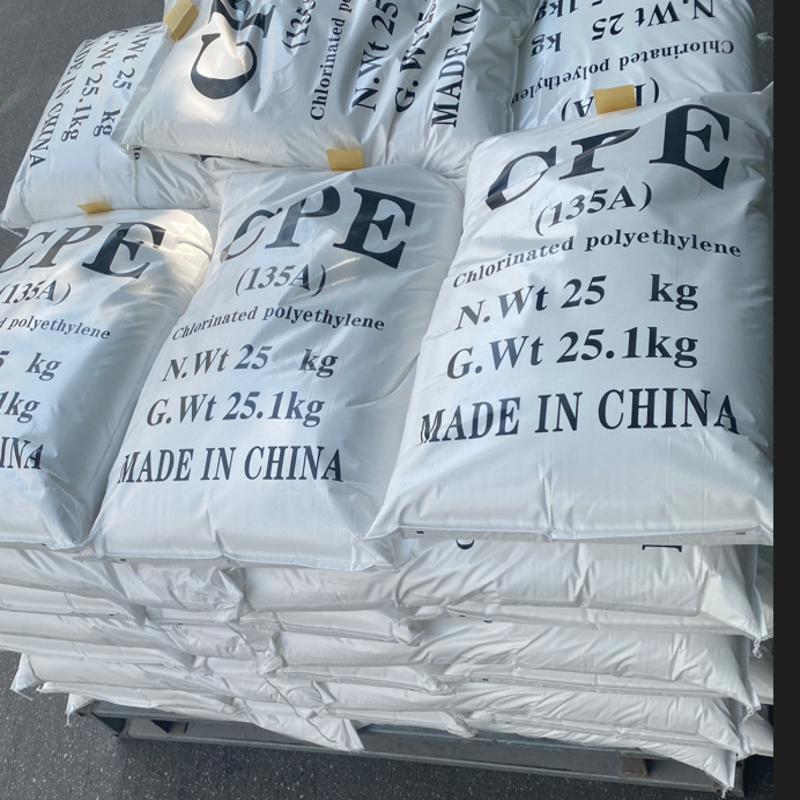
CPE is a polymer material prepared from high density polyethylene (HDPE) by chlorination substitution reaction. According to different structures and uses, chlorinated polyethylene can be divided into resin chlorinated polyethylene (CPE) and elastic chlorinated polyethylene (CM). In addition to being used alone, thermoplastic resin can also be blended with polyvinyl chloride (PVC), polyethylene (PE), polypropylene (PP), polystyrene (PS), ABS and even polyurethane (PU). In the rubber industry, CPE can be used as a special rubber with high performance and high quality, and can also be blended with ethylene propylene rubber (EPR), butyl rubber (IIR), nitrile rubber (NBR), chlorosulfonated polyethylene (CSM) and other rubber.
CPE has the dual properties of plastic and rubber and has good compatibility with other plastics and rubber. Therefore, except for a few used as main materials, CPE is mostly used together with rubber or plastic. When CPE and plastics are used together, it is mainly used as modifier. Its main purpose is to be used as impact modifier of UPVC products to improve the impact resistance and low temperature performance of UPVC When used with rubber, CPE mainly improves the flame retardancy, insulation and aging resistance of rubber. According to different applications, the main products include CPE135A, CPE135B and ACM impact modifier.
CPE135A is a model of chlorinated polyethylene. The first digit 1 represents that the residual crystallinity (TAC) is 0-10%, the second and third digits 35 represent that the chlorine content is 35%, and the last digit a represents the molecular weight of PE. As a PVC impact modifier, CPE135A has many advantages, such as low price, excellent performance and excellent aging resistance. However, there are some disadvantages in the use of CPE135A for products with high impact resistance, high hardness and low temperature resistance. Chlorinated polyethylene CPE135A is used for plastic modification. It is prepared by chlorination of special polyethylene under the action of chlorine atoms. It has excellent comprehensive physical properties, such as high toughness at low temperature; High tensile strength; It is quite close to the solubility parameters of PVC and has good affinity; Given the correct processing conditions, a network structure is formed inside the hard PVC products, so as to give the products excellent normal and low temperature toughness and impact strength.
CPE135B is prepared by chlorination of special polyethylene under the action of chlorine atoms. It is a saturated thermoplastic with random structure and almost no crystallization. It has low plasticizing temperature and Mooney viscosity and excellent processing performance. It can be mixed with natural rubber and synthetic rubber in any proportion, which gives the mouth excellent weather resistance and flame retardancy. It is mainly used for special synthetic rubber and can also be used as modifier and solubilizer of general synthetic rubber.
ACM Impact Modifier is a copolymer of slightly chlorinated HDPE and acrylate. It overcomes the weakness of high glass transition temperature and poor dispersion of CPE, and has obvious impact modification effect at low temperature. The use method of ACM is the same as that of CPE. During use, the extruder current and torque may decrease slightly. The amount of external lubricant must be reduced until the current and torque of ACM are the same or slightly higher than that of CPE. The low-temperature impact strength of ACM impact modifier is higher than that of traditional CPE, the elongation at break is also higher than CPE, and the Vicat softening point is lower than CPE. Therefore, PVC products modified with ACM impact modifier not only have good low-temperature impact strength, but also have excellent room temperature toughness, thermal stability and UV resistance.