If the victim is conscience, rinse the mouth, allow water to be drunk. Do not induce vomiting
4.2 Most important symptoms and effects, both acute and delayed
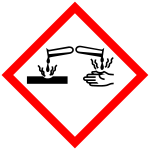
Causes burns.
Irritating to respiratory system.
4.3 Indication of any immediate medical attention and special treatment needed
If skin irritation or rash occurs, get medical advice/attention.
Section 5 Fire-Fighting measures
5.1 Extinguishing media:
Suitable extinguishing media:
Not applicable. Inorganic material. Not combustible, therefore define extinguishing
measures according to neighboring conditions.
Unsuitable extinguishing media:
Not available.
5.2 Special hazards arising from the
substance or mixture
No hazard product.
5.3 Special fire fighting methods and
special protective actions for
fire-fighters:
Firefighters must wear fire resistant protective equipment. Wear self contained
breathing apparatus and protective gloves.
Section 6 Accidental release measures
6.1 Personal precautions, protective equipment and emergency procedures:
6.1.1 For non-emergency personnel:
Avoid contact with skin and eyes, do not breath dust. See title 8.
Spillages can cause slippery situations.
Keep away from food, drink and animal feeding stuffs.
6.1.2 For emergency responders:
Wear an appropriate NIOSH/MSHA approved respirator if mist, vapor or dust is
generated.
6.2 Environmental Precautions:
Do not allow to enter drains or water courses. Prevent the spreading of the product
into the environment by diking with soil or other absorbent material. Contact the
authorities in case of large spillage
6.3 Methods for Containment and Cleaning up: Collect as much as possible in a (clean) container or by absorbent material.
Remove last traces by diluting with plenty of (warm) water
See also title 13
6.4 Reference to other sections:
See Section 7 for information on safe handling.
See section 8 for information on personal protection equipment.
See Section 13 for information on disposal.
6.5 Additional information:
Wet clean or vacuum up solids.
Don't use a brush or compressed air for cleaning surfaces or clothing.
Clear spills immediately.
Section 7 Handling and storage
7.1 Precautions for safe handling:
7.1.1 Protective measures:
Avoid the creation of dust, do not breathe dust.
Avoid contact with the concentrated product, see title 8.
Wash thoroughly after handling.
7.1.2 Advice on general occupational
hygiene:
Do not eat, drink and smoke in work areas. Wash hands after use. Remove
contaminated clothing and protective equipment before entering eating areas.
7.2 Conditions for safe storage, including
Keep packaging / storage vessel closed.Product name: sodium metasilicate pentahydrate
eSDS EU
Version #: 2.0
Revision date: 19-02-2020.
Issue date: 13-01-2016.
5 / 25
any incompatibilities:
Protect packaging from freezing, rain or direct sun.
Keep away from acids.
Compatible materials: (Stainless) steel.
Incompatible materials: Zinc, Tin, Aluminum, Cupper and their alloys.
See also title 10.
7.3 Specific end use(s):
Not applicable.
Section 8 Exposure Controls/Personal Protection
8.1 Control parameters:
8.1.1 Occupational exposure limits:
Not available
8.1.2 Additional exposure limits under the
conditions of use:
Not available
8.1.3 DNEL/DMEL and PNEC-Values:
DN(M)ELs for workers
Exposure
pattern
Route
Descriptor
DNEL / DMEL (Corre c t ed ) Dose descr ip t o r *) M
o s t s e n sitive en d p o i n t
Justification
Acute - systemic
effects
Dermal
Acute - systemic
effects
Inhalation
Acute - local
effects
Dermal
Acute - local
effects
Inhalation
Long-term -
systemic effects Dermal
DNEL
(Derived No
Effect Level)
1 . 4 9 m g/kg b w / da y
repeated dose
toxicity
7 (mouse) x 2.5 (interspecies) x 5
(intraspecies) x 2 (sub-chronic to
chronic)
Long-term -
systemic effects Inhalation
DNEL
(D e r iv e d N o E ff e c t L ev e l)
6.22 mg/m³
repeated dose
toxicity
2.5 (interspecies) x 5 (intraspecies) x
2 (sub-chronic to chronic)
Long-term -
local effects
Dermal
Long-term -
local effects
Inhalation
*) The (corrected) dose descriptor starting points have been automatically calculated by multiplying the values of the fields "D(N)MEL" and
"Assessment factor" provided in the Endpoint summary of IUCLID section 7. Toxicological information. It reflects the value after any
corrections, e.g. route-to-route extrapolation. See column "Justification" for the rationale behind such modifications and the use of
assessment factors.
DN(M)ELs for the general population
Exposure
pattern
Route
Descriptor DNEL / DMEL (Corrected) Dose descriptor *)
Most sensitive
endpoint
Justification
Acute - systemic
effects
DermalProduct name: sodium metasilicate pentahydrate
eSDS EU
Version #: 2.0
Revision date: 19-02-2020.
Issue date: 13-01-2016.
6 / 25
Acute - systemic
effects
Inhalation
Acute - systemic
effects
Oral
Acute - local
effects
Dermal
Acute - local
effects
Inhalation
Long-term -
systemic effects Dermal
DNEL
(Derived No
Effect Level)
0 . 7 4 m g/kg b w / da y
repeated dose
toxicity
7 (mouse) x 2.5
(interspecies) x 10
(intraspecies) x 2
(sub-chronic to chronic)
Long-term -
systemic effects Inhalation
DNEL
(D e r iv e d N o E ff e c t L ev e l)
1.55 mg/m³
repeated dose
toxicity
2.5 (interspecies) x 10
(intraspecies) x 2
(sub-chronic to chronic)
Long-term -
systemic effects Oral
DNEL
(Derived No
Effect Level)
0 . 7 4 m g/kg b w / da y
7 (mouse) x 2.5
(interspecies) x 10
(intraspecies) x 2
(sub-chronic to chronic)
Long-term -
local effects
Dermal
Long-term -
local effects
Inhalation
*) The (corrected) dose descriptor starting points have been automatically calculated by multiplying the values of the fields "D(N)MEL" and
"Assessment factor" provided in the Endpoint summary of IUCLID section 7. Toxicological information. It reflects the value after any
corrections, e.g. route-to-route extrapolation. See column "Justification" for the rationale behind such modifications and the use of
assessment factors.
8.2 Exposure controls
8.2.1Appropriate engineering controls:
Engineering measures / system design such as to prevent formation of or exposure to
dust.
8.2.2 Individual protection measures, such as personal protective equipment:
Eye/face protection:
Wear suitable tightly fitting goggles.
Hand protection:
Wear alkaline resistant gloves (natural latex), type EN 374, cat 3 Breakthrough time <
0.9 μg/cm²/min.
Body protection:
Wear suitable protective clothing.
Respiratory protection:
In the eventual risk of dust formation, prevent breathing of the dust (respirator with filter
P2).
Thermal hazards:
Wear suitable protective clothing to prevent heat.
8.2.3 Environmental exposure controls:
Avoid discharge into the environment. This material and its container must be disposed
of as hazardous waste.
According to local regulations, Federal and official regulations.
Section 9 Physical and chemical properties
9.1 Information on basic physical and chemical properties
Melting point/range (°C):
1089°C (The melting point of 1089°C refers to the anhydrous form of sodium
metasilicate. Hydrated forms (Na2SiO3xH2O) have a much lower melting point,Product name: sodium metasilicate pentahydrate
eSDS EU
Version #: 2.0
Revision date: 19-02-2020.
Issue date: 13-01-2016.
7 / 25
depending on the hydration level.)
Relative density:
2.61 g/cm3 (solutions)
Water solubility:
210 g/L at 20°C
Granulometry:
Powder: 0.005 - 2000 µm (Powder)
Granule: 200 -1250 µm (Granule)
Dissociation constant:
pKa 9.9, 11.8, 12 at 30 °C
9.2. Other information:
Boiling point:
Not available
Vapour pressure:
study scientifically unjustified
Surface tension:
Study scientifically unjustified
Partition coefficient noctanol/
water (log value):
study scientifically unjustified
Flash point:
study scientifically unjustified
Flammability:
Non flammable
Explosive properties :
Non explosive
Self-ignition temperature:
study scientifically unjustified
Oxidising properties:
Oxidising: no
Stability in organic solvents and identity of
relevant degradation products:
study scientifically unjustified
Viscosity:
study scientifically unjustified
Section 10 Stability and reactivity
10.1 Reactivity:
The substance is stable under normal storage and handling conditions.
10.2 Chemical stability:
Stable under recommended storage and handling conditions.
10.3 Possibility of hazardous reactions:
Under normal conditions, not hazardous reactions will occur.
10.4 Conditions to avoid:
Avoid prolonged contact with ambient air: hygroscopic behaviour may induce formation
of lumps. Avoid contact in concentrated form with acids.
10.5 Incompatible materials:
Avoid contact with Aluminum, Zinc, Tin, Cupper and their alloys.
10.6 Hazardous decomposition products:
Can form hydrogen if brought in contact with the above incompatible materials, causing
a risk for explosion. Exothermic reaction with acids.
Section 11 Toxicological information
11.1 Toxicokinetics, metabolism and distribution
11.1.1 Toxicokinetics
Basic toxicokinetics
The toxicokinetic studies on guinea pigs and cats showed that the excretion of silicon dioxide with the urine was markedly increased after
exposure to silicates. The excretion rate was independent of the doses applied indicating that the limiting factor is the rate of production of
soluble or absorbable silicon dioxide in the gastrointestinal tract.
11.2 Information on toxicological effects
Acute toxicity:
LD50(Oral, Rat):
1152 — 1349 mg/kg bw (male/female)
LD50(Dermal, Rabbit):
> 5000 mg/kg bw (male/female)
LC50(Inhalation, Rat):
> 2.06 mg/L air (analytical) (male/female)Product name: sodium metasilicate pentahydrate
eSDS EU
Version #: 2.0
Revision date: 19-02-2020.
Issue date: 13-01-2016.
8 / 25
Skin corrosion/Irritation:
Causes severe skin burns and eye damage.
Serious eye damage/irritation:
Causes serious eye damage
Respiratory or skin sensitization:
Not classified
Germ cell mutagenicity:
Not classified
Carcinogenicity:
Not classified
Reproductive toxicity:
Not classified
STOT- single exposure:
May cause respiratory irritation.
Affected Organs: respiratory organs
Route of exposure: Inhalation
STOT-repeated exposure:
Not classified
Aspiration hazard:
Not classified
Section 12 Ecological information
Toxicity:
Acute toxicity
Time
Species
Method
Remarks
LC50
210 mg/L
96h
Fish
OECD SIDS (2004)
2 (reliable with
restrictions)
key study
experimental result
EC50
1700 mg/L
48h
Daphnia
OECD SIDS (2004)
2 (reliable with
restrictions)
key study
experimental result
EC50
207 mg/L
72h
Algae
OECD SIDS (2004)
2 (reliable with
restrictions)
key study
experimental result
Persistence and degradability:
Not available
Bioaccumulative potential:
low potential for bioaccumulation
Mobility in soil:
Not available
Results of PBT&vPvB assessment:
Not PBT/vPvB.
Other adverse effects:
Not available
Section 13 Disposal considerations
13.1 Waste treatment methods:
Avoid discharge into the environment. This material and its container must be disposed
of as hazardous waste.
According to local regulations, Federal and official regulations.
13.2 Product / Packaging disposal:
Waste disposal according national or regional regulations, neutralisation prior to
disposal is advisory.
Dispose contaminated packaging according national or regional regulations,
preliminary cleaning with water is advisory









 Russia
 Ecuador
 Bangladesh
 India
India
 Kenya
Kenya
 Kuwait
 Extended Safety Data Sheet