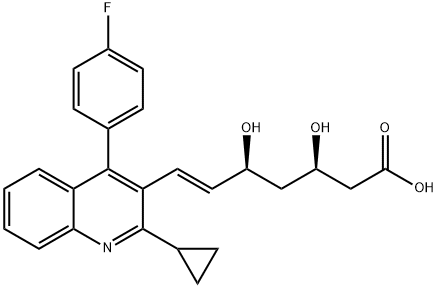
Pitavastatin 147511-69-1
3 Inquiries
147511-69-1
Shanghai
25kg/bag
2024-06-18
Agrochemicals,Daily Chemicals,Catalysts & Chemical Auxiliary Agents,Extract,Inorganic Chemicals,Organic Intermediate
-
Product Description
-
Seller Information
-
Inquiry History
-
DescriptionECHEMI Editorial ReferencePitavastatin (Brand Name: LIVALO) is an inhibitor of HMG-CoA reductase which catalyzes the first step of cholesterol synthesis. It appears as odorless and white to pale-yellow powder. It takes effects by reducing the level of certain fatty substances such as cholesterol in the body. Therefore, it is mainly indicated for the treatment of hypercholesterolaemia and for the prevention of cardiovascular diseases. It can not only lower the high cholesterol and triglyceride in certain patients, but al
Pitavastatin is a dihydroxy monocarboxylic acid that is (6E)-7-[2-cyclopropyl-4-(4-fluorophenyl)quinolin-3-yl]hept-6-enoic acid in which the two hydroxy groups are located at positions 3 and 5 (the 3R,5S-stereoisomer). Used as its calcium salt for treatment of hypercholesterolemia (elevated levels of cholesterol in the blood) on patients unable to sufficiently lower their cholesterol levels by diet and exercise. It has a role as an antioxidant. It is a member of quinolines, a dihydroxy monocarboxylic acid, a member of cyclopropanes, a statin (synthetic) and a member of monofluorobenzenes. It is a conjugate acid of a pitavastatin(1-).|Pitavastatin, also known as the brand name product Livalo, is a lipid-lowering drug belonging to the statin class of medications. By inhibiting the endogenous production of cholesterol within the liver, statins lower abnormal cholesterol and lipid levels and ultimately reduce the risk of cardiovascular disease. More specifically, statin medications competitively inhibit the enzyme hydroxymethylglutaryl-coenzyme A (HMG-CoA) Reductase, which catalyzes the conversion of HMG-CoA to mevalonic acid. This is the third step in a sequence of metabolic reactions involved in the production of several compounds involved in lipid metabolism and transport including cholesterol, low-density lipoprotein (LDL) (sometimes referred to as "bad cholesterol"), and very low-density lipoprotein (VLDL). Prescribing of statin medications is considered standard practice following any cardiovascular events and for people with a moderate to high risk of development of CVD, such as those with Type 2 Diabetes. The clear evidence of the benefit of statin use coupled with very minimal side effects or long term effects has resulted in this class becoming one of the most widely prescribed medications in North America. Pitavastatin and other drugs from the statin class of medications including [atorvastatin], [pravastatin], [rosuvastatin], [fluvastatin], and [lovastatin] are considered first-line options for the treatment of dyslipidemia. Increasing use of the statin class of drugs is largely due to the fact that cardiovascular disease (CVD), which includes heart attack, atherosclerosis, angina, peripheral artery disease, and stroke, has become a leading cause of death in high-income countries and a major cause of morbidity around the world. Elevated cholesterol levels, and in particular, elevated low-density lipoprotein (LDL) levels, are an important risk factor for the development of CVD. Use of statins to target and reduce LDL levels has been shown in a number of landmark studies to significantly reduce the risk of development of CVD and all-cause mortality. Statins are considered a cost-effective treatment option for CVD due to their evidence of reducing all-cause mortality including fatal and non-fatal CVD as well as the need for surgical revascularization or angioplasty following a heart attack. Evidence has shown that even for low-risk individuals (with <10% risk of a major vascular event occurring within 5 years) statins cause a 20%-22% relative reduction in major cardiovascular events (heart attack, stroke, coronary revascularization, and coronary death) for every 1 mmol/L reduction in LDL without any significant side effects or risks. While all statin medications are considered equally effective from a clinical standpoint, [rosuvastatin] is considered the most potent; doses of 10 to 40mg [rosuvastatin] per day were found in clinical studies to result in a 45.8% to 54.6% decrease in LDL cholesterol levels. Study data has confirmed that pitavastatin's potency in lowering LDL-C is comparable to that of other statins but also has increased efficacy in increasing HDL-C (also known as "good cholesterol"). Despite these differences in potency, several trials have demonstrated only minimal differences in terms of clinical outcomes between statins.|Pitavastatin is a HMG-CoA Reductase Inhibitor. The mechanism of action of pitavastatin is as a Hydroxymethylglutaryl-CoA Reductase Inhibitor.|Pitavastatin is a relatively newly developed cholesterol lowering agent (statin) that is associated with mild, asymptomatic and self-limited serum aminotransferase elevations during therapy, but has had limited use and has yet to be linked with clinically apparent acute liver injury.|Pitavastatin is a novel statin that induces plaque regression and elevates HDL-cholesterol levels.Basic Info-
Product Name:
Pitavastatin
Other Name:6-Heptenoic acid,7-[2-cyclopropyl-4-(4-fluorophenyl)-3-quinolinyl]-3,5-dihydroxy-,(3R,5S,6E)-;6-Heptenoic acid,7-[2-cyclopropyl-4-(4-fluorophenyl)-3-quinolinyl]-3,5-dihydroxy-,[S-[R*,S*-(E)]]-;(3R,5S,6E)-7-[2-Cyclopropyl-4-(4-fluorophenyl)-3-quinolinyl]-3,5-dihydroxy-6-heptenoic acid;Pitavastatin;NK 104;(+)-(3R,5S,6E)-7-[2-Cyclopropyl-4-(4-fluorophenyl)-3-quinolyl]-3,5-dihydroxy-6-heptenoic acid;(3R,5S,6E)-7-[2-Cyclopropyl-4-(4-fluorophenyl)quinolin-3-yl]-3,5-dihydroxyhept-6-enoic acid;1187885-60-4
CAS No.:147511-69-1
Molecular Formula:C25H24FNO4
InChIKeys:InChIKey=VGYFMXBACGZSIL-MCBHFWOFSA-N
Molecular Weight:421.46
Exact Mass:421.46
UNII:M5681Q5F9P
DSSTox ID:DTXSID4046448|DTXSID1048384|DTXSID50694059
NCI Thesaurus Code:C87751
ATC Code:C - Cardiovascular system
HScode:3004909090
Categories:
Characteristics-
PSA:
90.65000
XLogP3:3.45
Density:1.352±0.06 g/cm3(Predicted)
Boiling Point:692.0±55.0 °C(Predicted)
Flash Point:372.3±31.5 °C
Refractive Index:1.680
Water Solubility:Very slightly soluble
Storage Conditions:Store at room temperature between 15 °C and 30 °C (59 deg to 86 °F). Protect from light.
Vapor Pressure:2.32X10⁻¹⁷ mm Hg at 25 °C (est)
Henrys Law Constant:Henry's Law constant = 0.89X10⁻¹⁹ atm-cu m/mol at 25 °C (est)
Dissociation Constants:pKa = 4.3 (carboxy) (est)
Experimental Properties:MW: 493.45. MP: 138-139 °C. Specific optical rotation: +8.84 deg at 32 °C/D (c = 0.92 in chloroform). Soluble in acetonitrile /Pitavastatin lactone/|Hydroxyl radical reaction rate constant = 1.00X10⁻¹¹ cu cm/molecule-sec at 25 °C (cis); 1.08X10⁻¹¹ cu cm/molecule-sec at 25 °C (trans) (est)|Ozone reaction rate constant = 6.82X10⁻¹⁷ cu cm/molecule-sec at 25 °C (cis); 1.36X10⁻¹⁶ cu cm/molecule-sec at 25 °C (trans) (est)
Hazard IdentificationClassification of the substance or mixture
Reproductive toxicity, Category 2
Reproductive toxicity, Additional category for effects on or via lactation
GHS label elements, including precautionary statements
Pictogram(s)

Signal word Warning
Hazard statement(s) H361 Suspected of damaging fertility or the unborn child
H362 May cause harm to breast-fed children
Precautionary statement(s) Prevention P203 Obtain, read and follow all safety instructions before use.
P280 Wear protective gloves/protective clothing/eye protection/face protection/hearing protection/...
P260 Do not breathe dust/fume/gas/mist/vapours/spray.
P263 Avoid contact during pregnancy and while nursing.
P264 Wash ... thoroughly after handling.
P270 Do not eat, drink or smoke when using this product.
Response P318 IF exposed or concerned, get medical advice.
Storage P405 Store locked up.
Disposal P501 Dispose of contents/container to an appropriate treatment and disposal facility in accordance with applicable laws and regulations, and product characteristics at time of disposal.
Other hazards which do not result in classification
no data available
Handling and StoragePrecautions for safe handling
Handling in a well ventilated place. Wear suitable protective clothing. Avoid contact with skin and eyes. Avoid formation of dust and aerosols. Use non-sparking tools. Prevent fire caused by electrostatic discharge steam.
Conditions for safe storage, including any incompatibilities
Store the container tightly closed in a dry, cool and well-ventilated place. Store apart from foodstuff containers or incompatible materials.
-
-
Seller Information
-
Business Type:
Manufactory
-
Main Products:
Agrochemicals,Daily Chemicals,Catalysts & Chemical Auxiliary Agents,Extract,Inorganic Chemicals,Organic Intermediate
-
Location:
hisense intelligence valley,no 2116,of phoenix road
-
Payment Terms:
TT against copy of documents,D/P,L/C
-
Average lead Time:
7
-
Total Annual Revenue:
Less than $1 million
-
Total Employees:
11-50
-
Year of Establishment:
2017
-
-
Inquiry History3 Inquiries
Country Product Purchase Quantity Date Posted
United Arab Emirates
Pitavastatin
2 KG Jul 15, 2026
Saudi Arabia
Pitavastatin
10000 MG Jun 6, 2024
Saudi Arabia
pitavastatin
10 G Jun 6, 2024 Post an enquiry for this product