




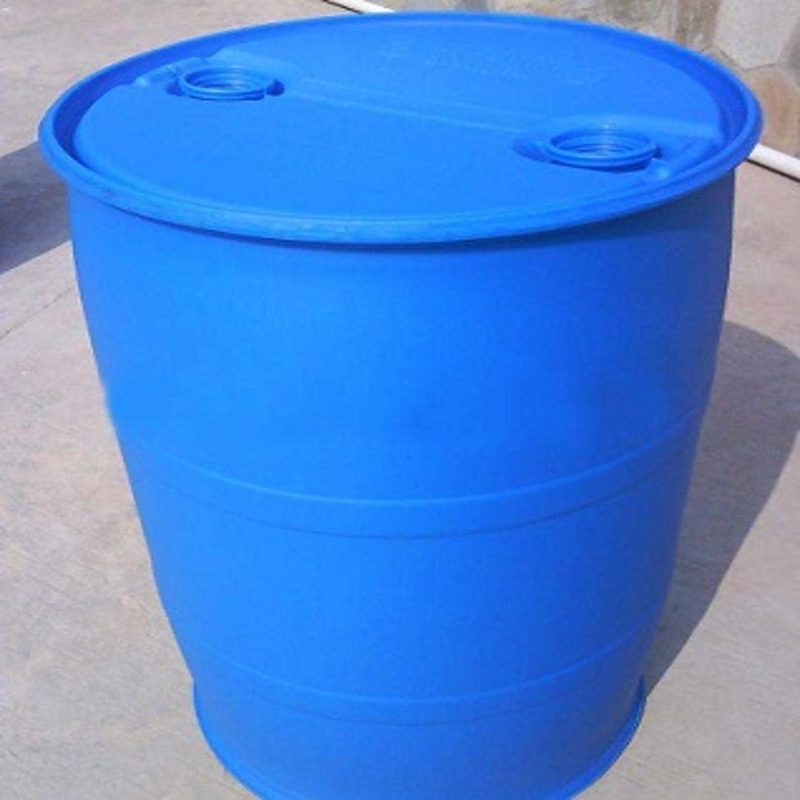
Nitrogen Tetroxide
2 Inquiries
10544-72-6
shanghai
25KG
2025-03-12

Chemical Pesticides,Food Additives,Agrochemicals,Active Pharm Ingredients,Flavors and Fragrances,Chemical Catalyst
-
Product Description
-
Seller Information
-
Inquiry History
-
DescriptionECHEMI Editorial ReferenceDinitrogen tetroxide (N₂O₄) is a colorless to pale yellow gas at room temperature that becomes a reddish-brown liquid below 21.2 °C. N₂O₄ has a molecular weight of 92.01 g/mol and is a diamagnetic compound due to its paired electrons. Dinitrogen tetroxide is a strong oxidizing agent and highly reactive with organic materials and reducing agents. It readily hydrolyzes in water to produce nitric acid (HNO₃) and nitrous acid (HNO₂). It is non-flammable but can support combustion and cause violent reactions when in contact with combustible substances.
Dinitrogen tetroxide (N₂O₄) is a colorless to pale yellow gas at room temperature that becomes a reddish-brown liquid below 21.2 °C. N₂O₄ has a molecular weight of 92.01 g/mol and is a diamagnetic compound due to its paired electrons. Dinitrogen tetroxide is a strong oxidizing agent and highly reactive with organic materials and reducing agents. It readily hydrolyzes in water to produce nitric acid (HNO₃) and nitrous acid (HNO₂). It is non-flammable but can support combustion and cause violent reactions when in contact with combustible substances.Basic Info-
Product Name:
Nitrogen oxide (N2O4)
Other Name:Nitrogen oxide (N2O4);Dinitrogen tetroxide;Nitrogen tetroxide;Dinitrogen tetraoxide;Nitrogen tetraoxide;1220110-47-3
CAS No.:10544-72-6
Molecular Formula:N2O4
InChIKeys:InChIKey=WFPZPJSADLPSON-UHFFFAOYSA-N
Molecular Weight:92.01
Exact Mass:92.01
EC Number:233-272-6
UNII:M9APC3P75A
UN Number:1067
Color/Form:Colorless gas|Yellow liquid below 22 °C|Colorless liquid; equilibrium with NO2|Brown liquid under pressure /Nitrogen dioxide/
HScode:28112900
Categories:
Characteristics-
PSA:
91.6
XLogP3:0.17
Appearance:Transparent gas
Density:1.45 g/cm3 @ Temp: 20 °C
Melting Point:-9.3 °C
Boiling Point:21.15 °C
Refractive Index:1.434
Water Solubility:reac H2O
Storage Conditions:Store in a cool, dry, well-ventilated location. Separate from oxidizable materials. Outside or detached storage is preferred. /Nitrogen oxides/
Vapor Pressure:14.33 psi ( 20 °C)
Vapor Density:1.58 (21 °C, vs air)
Toxicity:Inhalation-Rabbit LC50: 315 PPM/15 points
Flammability characteristics:Combustible in case of combustibles
Explosive limit:May react in an explosive manner with liquid hydrocarbons, nitrobenzene, carbon disulfide, and olefines.
Experimental Properties:GAS REACTS WITH WATER TO FORM MIXTURE OF NITROUS ACID & NITRIC ACID|0.532 ppm = 1 mg/cu m; 1 ppm = 1.88 mg/cu m at 25 °C and 760 mm Hg|Molar enthalpy of fusion: 14.65 kJ/mol at -9.3 °C|Dielectric constant 2.44 at 293.2 K|Critical volume: 167 cu cm/mol
Air and Water Reactions:Reacts with water to form nitric acid and nitric oxide.
Reactive Group:Oxidizing Agents, Strong
Reactivity Alerts:Strong Oxidizing Agent
Reactivity Profile:Liquid NITROGEN TETROXIDE is an oxidizing agent consisting of an equilibrium mixture of colorless dinitrogen tetraoxide (N2O4) and red-brown nitrogen dioxide (NO2). The exact composition of the mixture depends on the temperature with higher temperature favoring conversion to NO2. Vaporizes readily to give NO2, also an oxidizing agent. Noncombustible but can accelerate the burning of combustible materials. Reacts with reducing agents to generate heat and products that may be gaseous (causing pressurization of closed containers). The products may themselves be capable of further reactions (such as combustion in the air). Reacts with alkalis to form nitrates and nitrites [Merck 11th ed. 1989]. Corrodes steel if wet, but can be stored in steel cylinders if dry [Merck]. Reacts explosively with liquid ammonia even at very low temperatures (below its freezing point) [Mellor, 1940, Vol. 8, 54]. Reacts energetically with boron trichloride [Mellor, 1946, Vol. 5, 132]. Mixtures with metal carbonyls are hypergolic (enflame immediately). Mixtures with halocarbons, hydrazine derivatives, heterocyclic bases (pyridine), isopropyl nitrite/propyl nitrite, active metals (magnesium, calcium, etc.), nitroaromatics, nitrogen trichloride, phosphorus, triethylamine, unsaturated hydrocarbons may react explosively. Accidental mixing with hot cyclohexane caused an explosion [MCA Case History 128. 1962]. A mixture with acetonitrile and indium showed no evidence of change for a time and then detonated when shaken (ascribed to the catalyzed oxidation of acetonitrile) [Chem. & Ind., 1958, 1004]. Mixture with alcohols produced a violent explosion [Chem. Eng. News, 1955, 33, 2372]. Vapor reacts with barium oxide incandescently [Mellor, 1940, Vol. 8, 545]. A slow reaction between the vapor and formaldehyde became explosive near 180°C [Trans. Faraday Soc. 45:767-770. 1949]. Manganese and potassium both ignite in the vapor [Ann. Chem. et Phys.(2) 2:317]. The vapor and ozone react with the evolution of light and often explode when mixed [J. Chem. Phys. 18:366. 1920].
Autoignition Temperature:Not flammable (USCG, 1999)
Corrosivity:Corrosive liquid
Heat of Vaporization:Molar enthalpy of vaporization: 38.12 kJ/mol at 21.15 °C
Critical Temperature & Pressure:Critical temperature: 431 K; critical pressure: 10.1 MPa
Hazard IdentificationClassification of the substance or mixture
Gases under pressure: Liquefied gas
Oxidizing gases, Category 1
Skin corrosion, Sub-category 1B
Acute toxicity - Category 2, Inhalation
GHS label elements, including precautionary statements
Pictogram(s) 


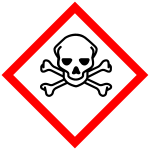
Signal word Danger
Hazard statement(s) H270 May cause or intensify fire; oxidizer
H314 Causes severe skin burns and eye damage
H330 Fatal if inhaled
Precautionary statement(s) Prevention P220 Keep away from clothing and other combustible materials.
P244 Keep valves and fittings free from oil and grease.
P260 Do not breathe dust/fume/gas/mist/vapours/spray.
P264 Wash ... thoroughly after handling.
P280 Wear protective gloves/protective clothing/eye protection/face protection/hearing protection/...
P271 Use only outdoors or in a well-ventilated area.
P284 [In case of inadequate ventilation] wear respiratory protection.
Response P370+P376 In case of fire: Stop leak if safe to do so.
P301+P330+P331 IF SWALLOWED: Rinse mouth. Do NOT induce vomiting.
P363 Wash contaminated clothing before reuse.
P304+P340 IF INHALED: Remove person to fresh air and keep comfortable for breathing.
P316 Get emergency medical help immediately.
P321 Specific treatment (see ... on this label).
P305+P351+P338 IF IN EYES: Rinse cautiously with water for several minutes. Remove contact lenses, if present and easy to do. Continue rinsing.
P320 Specific treatment is urgent (see ... on this label).
Storage P410+P403 Protect from sunlight. Store in a well-ventilated place.
P403 Store in a well-ventilated place.
P405 Store locked up.
P403+P233 Store in a well-ventilated place. Keep container tightly closed.
Disposal P501 Dispose of contents/container to an appropriate treatment and disposal facility in accordance with applicable laws and regulations, and product characteristics at time of disposal.
Other hazards which do not result in classification
no data available
Handling and StoragePrecautions for safe handling
Handling in a well ventilated place. Wear suitable protective clothing. Avoid contact with skin and eyes. Avoid formation of dust and aerosols. Use non-sparking tools. Prevent fire caused by electrostatic discharge steam.
Conditions for safe storage, including any incompatibilities
Ventilation along the floor. Separated from combustible substances and reducing agents.Store in tightly closed containers in a cool, well ventilated area away from oxidizable materials. Outside or detached storage is preferred. Do not put on wooden floors. Nitrogen oxides
-
-
Seller Information
-
Business Type:
Manufactory
-
Main Products:
Chemical Pesticides,Food Additives,Agrochemicals,Active Pharm Ingredients,Flavors and Fragrances,Chemical Catalyst
-
Location:
https://www.dideu.com/en/
-
Payment Terms:
TT against copy of documents,D/P,L/C,D/A,O/A,TT against B/L draft before shipment,100% TT in advance
-
Average lead Time:
7
-
Total Annual Revenue:
Above $100 million
-
Total Employees:
Above 1000
-
Year of Establishment:
2016
-
Certifications:
ISO Certificate,REACH
"> -
-
Inquiry History2 Inquiries
Country Product Purchase Quantity Date Posted  Germany
Nitrogen oxide (N2O4)
10 MT Sep 27, 2024  Pakistan
Dinitrogen tetraoxide
20 TON Feb 23, 2024 Post an enquiry for this product


