Nickel sulfate
1 Inquiries
7786-81-4
Industrial Grade
99%
ailike
25kg/Cardboard Drum
Yes
2026-06-01

api,Intermediates,Organic Chemistry,Inorganic Chemistry,Daily Chemicals,Cosmetic Raw Materals
-
Product Description
-
Seller Information
-
Inquiry History
-
DescriptionECHEMI Editorial ReferenceNickel sulfate (NiSO₄) is an inorganic salt that typically appears as green crystalline solids when hydrated (most commonly as hexahydrate, NiSO₄·6H₂O). It has a molecular weight of 154.75 g/mol (anhydrous form) and is soluble in water and slightly soluble in ethanol. Nickel sulfate is odorless and has a melting point of around 840 °C (anhydrous). When dissolved in water, it dissociates into nickel (Ni²⁺) and sulfate (SO₄²⁻) ions. It acts as a Lewis acid and is thermally stable under normal conditions, although it may release toxic fumes of nickel oxides and sulfur oxides upon decomposition.CertificatesBasic Info
-
Product Name:
Nickel sulfate (NiSO4)
Other Name:Sulfuric acid,nickel(2+) salt (1:1);Nickel sulfate (NiSO4);Nickel sulfate;Nickel(II) sulfate;Nickel sulfate (1:1);Nickelous sulfate;Nickel(2+) sulfate;Sulfuric acid nickel(2+) salt;Nickel(2+) sulfate (1:1);Nickel monosulfate;Fine Emerald;139939-67-6;1820866-61-2;2309326-19-8
CAS No.:7786-81-4
Molecular Formula:H2O4S.Ni
InChIKeys:InChIKey=HIRWGWMTAVZIPF-UHFFFAOYSA-N
Molecular Weight:156.77200
Exact Mass:155.90300
EC Number:232-104-9
UNII:4FLT4T3WUN
ICSC Number:0063
UN Number:3077
DSSTox ID:DTXSID6023787
NCI Thesaurus Code:C45869
Color/Form:Green-yellow crystals|Pale green
HScode:2833240000
Categories:
Characteristics-
PSA:
82.98000
XLogP3:0.42800
Appearance:Anhydrous nickel sulfate is a yellow-green crystalline solid. Nickel sulfate can also be obtained as a hexahydrate (NiSO4.6H2O (CAS: 10101-97-0) which is blue to emerald green, and as a heptahydrate (NiSO4.7H2O) (CAS: 10101-98-1) , which is green. Samples can contain variable quantities of water, depending on their previous exposure to moisture or conditions. All forms are mildly toxic and are carcinogenic. All are denser than water. The primary hazard is the threat to the environment. Immediate steps should be taken to limit its spread to the environment. Used to make other nickel compounds, in printing, and in dyeing of textiles.
Density:4.01 g/cm3
Melting Point:840 °C (decomp)
Boiling Point:330ºC at 760 mmHg
Water Solubility:H2O: 27.3-27.7 g/100 mL at 20 ºC
Storage Conditions:Storage site should be as close as practical to lab in which carcinogens are to be used, so that only small quantities required for expt need to be carried. Carcinogens should be kept in only one section of cupboard, an explosion-proof refrigerator or freezer (depending on chemicophysical properties ) that bears appropriate label. An inventory should be kept, showing quantity of carcinogen & date it was acquired Facilities for dispensing should be contiguous to storage area.
Flammability characteristics:Not flammable
Odor:Odorless
Experimental Properties:Somewhat efflorescent; loses 5 H20 @ about 100 °C /Hexahydrate/|Aqueous soln is acid; pH about 4.5 /Hexahydrate/|alpha-Form blue to blue-green tetragonal crystals; beta-form green transparent crystals; becomes blue and opaque at room temp; greenish-yellow anhydrous salt formed @ 280 °C /Hexahydrate/|Sweet astringent taste /Hexahydrate/|Green rhombic; Index of refraction: 1.467, 1.489, 1.492; density: 1.948; MP: 99 °C (loses H2O); BP: 103 °C (loses 6 H20); Solubility in water: 75.6 g/100 cc at 15.5 °C, 475.8 g/100 cc at 100 °C; sol in alc /Hepatahydrate/|Blue, tetragonal (alpha form); green monoclinic (beta form); Index of refraction: 1.581, 1.487; density: 2.07; MP: 53.3 °C (transition pt); BP: 103 °C (loses 6 H20); Solubility in water: 65.52 g/100 cc at 0 °C, 340.7 g/100 cc at 100 °C; solubility in methanol: 12.5 g/100 cc; very sol in alc, ammonium hydroxide /Hexahydrate/
Air and Water Reactions:Water soluble yielding acidic corrosive water solutions.
Reactive Group:Salts, Acidic
Reactivity Profile:Gives an acidic solution when dissolved in water. Emits highly toxic fumes of metallic nickel, oxides of sulfur, and oxides of nitrogen when heated to decomposition [Lewis, 3rd ed., 1993, p. 910].
Autoignition Temperature:Not flammable (USCG, 1999)
Flammable Limits:Not flammable
Hazard IdentificationClassification of the substance or mixture
Acute toxicity - Category 4, Oral
Skin irritation, Category 2
Skin sensitization, Category 1
Acute toxicity - Category 4, Inhalation
Respiratory sensitization, Category 1
Germ cell mutagenicity, Category 2
Specific target organ toxicity â repeated exposure, Category 1
Hazardous to the aquatic environment, short-term (Acute) - Category Acute 1
Hazardous to the aquatic environment, long-term (Chronic) - Category Chronic 1
Carcinogenicity, Category 1A
Reproductive toxicity, Category 1B
GHS label elements, including precautionary statements
Pictogram(s) 
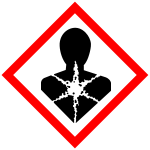
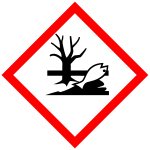
Signal word Danger
Hazard statement(s) H302 Harmful if swallowed
H315 Causes skin irritation
H317 May cause an allergic skin reaction
H332 Harmful if inhaled
H334 May cause allergy or asthma symptoms or breathing difficulties if inhaled
H341 Suspected of causing genetic defects
H372 Causes damage to organs through prolonged or repeated exposure
H410 Very toxic to aquatic life with long lasting effects
Precautionary statement(s) Prevention P264 Wash ... thoroughly after handling.
P270 Do not eat, drink or smoke when using this product.
P280 Wear protective gloves/protective clothing/eye protection/face protection/hearing protection/...
P261 Avoid breathing dust/fume/gas/mist/vapours/spray.
P272 Contaminated work clothing should not be allowed out of the workplace.
P271 Use only outdoors or in a well-ventilated area.
P284 [In case of inadequate ventilation] wear respiratory protection.
P203 Obtain, read and follow all safety instructions before use.
P260 Do not breathe dust/fume/gas/mist/vapours/spray.
P273 Avoid release to the environment.
Response P301+P317 IF SWALLOWED: Get medical help.
P330 Rinse mouth.
P302+P352 IF ON SKIN: Wash with plenty of water/...
P321 Specific treatment (see ... on this label).
P332+P317 If skin irritation occurs: Get medical help.
P362+P364 Take off contaminated clothing and wash it before reuse.
P333+P317 If skin irritation or rash occurs: Get medical help.
P304+P340 IF INHALED: Remove person to fresh air and keep comfortable for breathing.
P317 Get medical help.
P342+P316 If experiencing respiratory symptoms: Get emergency medical help immediately.
P318 IF exposed or concerned, get medical advice.
P319 Get medical help if you feel unwell.
P391 Collect spillage.
Storage P405 Store locked up.
Disposal P501 Dispose of contents/container to an appropriate treatment and disposal facility in accordance with applicable laws and regulations, and product characteristics at time of disposal.
Other hazards which do not result in classification
no data available
Handling and StoragePrecautions for safe handling
See Chemical Dangers. Handling in a well ventilated place. Wear suitable protective clothing. Avoid contact with skin and eyes. Avoid formation of dust and aerosols. Use non-sparking tools. Prevent fire caused by electrostatic discharge steam.
Conditions for safe storage, including any incompatibilities
PRECAUTIONS FOR "CARCINOGENS": Storage site should be as close as practical to lab in which carcinogens are to be used, so that only small quantities required for ... expt need to be carried. Carcinogens should be kept in only one section of cupboard, an explosion-proof refrigerator or freezer (depending on chemicophysical properties ...) that bears appropriate label. An inventory ... should be kept, showing quantity of carcinogen & date it was acquired ... Facilities for dispensing ... should be contiguous to storage area. Chemical Carcinogens
-
-
Seller Information
-
Business Type:
Trader
-
Main Products:
api,Intermediates,Organic Chemistry,Inorganic Chemistry,Daily Chemicals,Cosmetic Raw Materals
-
Location:
Huangdao District, Qingdao City, Shandong Province (formerly Room 606-2, Building 1, No. 10 Beijing Road, Jiaonan City)
-
Payment Terms:
TT against copy of documents,D/P,D/A,TT against B/L draft before shipment,100% TT in advance
-
Average lead Time:
15 days
-
Total Annual Revenue:
$5 million-$10 million
-
Total Employees:
51-100
-
Year of Establishment:
2023
Company Certificates-
 Credit rating certificate
-
 Hazardous Chemicals Business License
-
-
Inquiry History1 Inquiries
Country Product Purchase Quantity Date Posted  Turkey
niso4
21 MT Jun 16, 2026 Post an enquiry for this product

Hot Related Products
-
 soda ash Lisa shop
 -
 Caustic Soda-Batong
 -
 TUODA-Sodium carbonate
 -
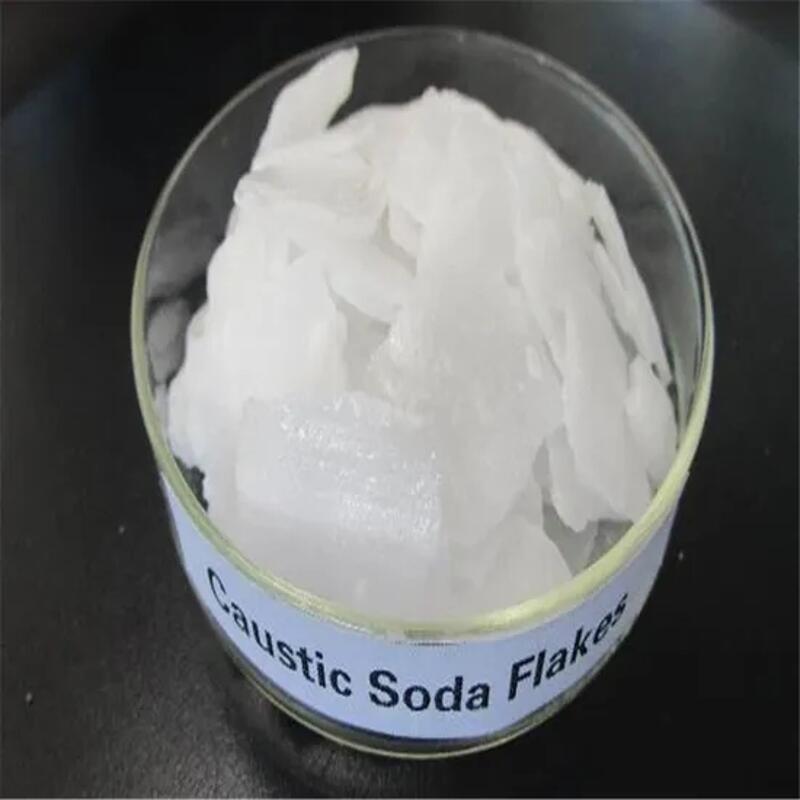
 Caustic Soda Flakes / Pearl Sodium Hydroxide Naoh High Purity 99% 98.5% 98% price
$450-550/MT FOB
-
 Industrial Grade 99% Caustic Soda in Flake Pearl and Solid Forms
 -
 Sodium carbonate99%
 -
 Caustic Soda Flakes White
 -
 Caustic soda and Sodium hydroxide
 -
 Sodium hydroxide White translucent crystalline solid
 -
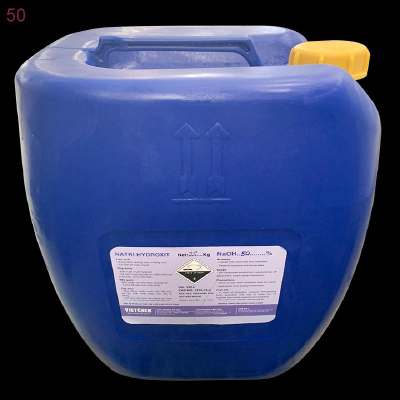
 Sodium Hydroxide 50% Liquid Vietchem Vietchem