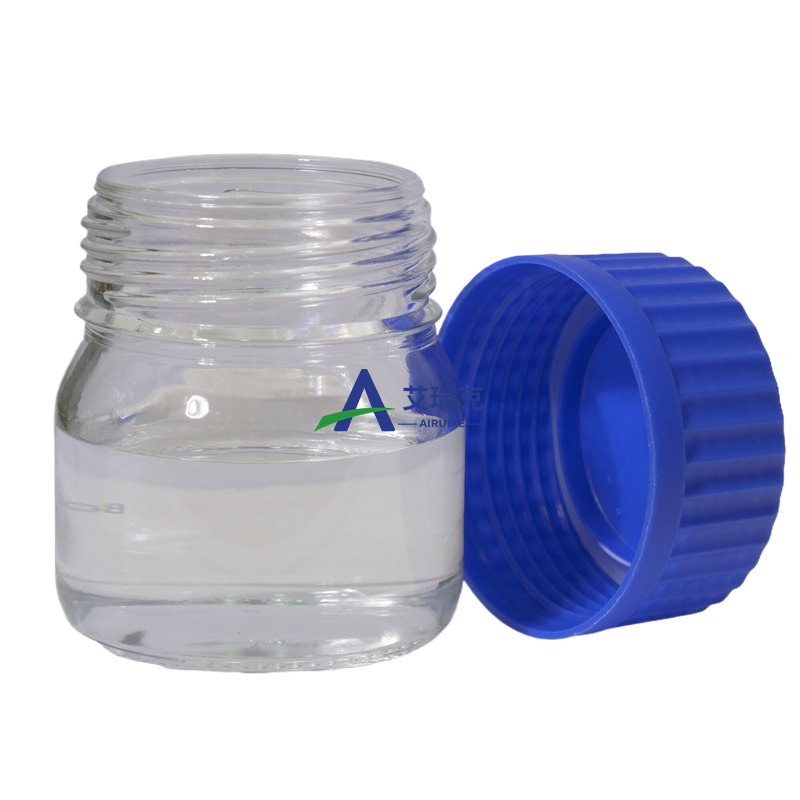
Decalin(91-17-8)
1 Inquiries
91-17-8
shanghai
200kg/drum
2025-11-27

Dichloromethane,Linocaine hydrochloride
-
Product Description
-
Seller Information
-
Inquiry History
-
DescriptionECHEMI Editorial Referencecolourless liquid
Decahydronaphthalene appears as a clear colorless liquid with an aromatic odor. Flash point 134°F. Less dense than water and insoluble in water. Vapors heavier than air.|Liquid|COLOURLESS LIQUID WITH CHARACTERISTIC ODOUR.
Decahydronaphthalene appears as a clear colorless liquid with an aromatic odor. Flash point 134°F. Less dense than water and insoluble in water. Vapors heavier than air.|Decalin is an ortho-fused bicyclic hydrocarbon that is the decahydro- derivative of naphthalene. It has a role as a solvent.Basic Info-
Product Name:
Decalin
Other Name:Naphthalene,decahydro-;Decahydronaphthalene;Bicyclo[4.4.0]decane;Dec;Naphthan;Perhydronaphthalene;Decalin;Dekalin;Decaline;NSC 406139
CAS No.:91-17-8
Molecular Formula:C10H18
InChIKeys:InChIKey=NNBZCPXTIHJBJL-UHFFFAOYSA-N
Molecular Weight:138.25
Exact Mass:138.25
BRN:878165
EC Number:202-046-9
UNII:88451Q4XYF
ICSC Number:1548
NSC Number:406139|77453|77452
UN Number:1147
DSSTox ID:DTXSID1024912
Color/Form:Clear colorless liquid|Water-white liquid
HScode:29021990
Categories:
Characteristics-
PSA:
0
XLogP3:4.6
Appearance:Clear Liquid
Density:0.8965 g/cm3 @ Temp: 22 °C
Melting Point:-43 °C
Boiling Point:155.5 °C
Flash Point:57 °C
Refractive Index:n20/D 1.474(lit.)
Water Solubility:H2O: 6 mg/L at 20 ºC
Storage Conditions:Store below +30°C.
Vapor Pressure:42 mm Hg ( 92 °C)
Vapor Density:4.76 (vs air)
Toxicity:Oral-Rat LD50: 4170 mg/kg
Flammability characteristics:Combustible in case of open flame, high temperature, strong oxidant; burning emits irritating smoke
Explosive limit:0.7-4.9%, 100°F
Odor:Slight odor resembling menthol; pure decalin does not smell of naphthalene
OH:2.01e-11 cm3/molecule*sec
Experimental Properties:MP: -42.9 °C; BP: 195.8 °C; density: 0.8999 @ 20 °C; index of refraction: 1.4695 @ 20 °C; insoluble in water; miscible in ethanol; very soluble in ethyl ether, acetone, benzene; chloroform /cis-Form/|MP: -30.3 °C; BP: 187.3 °C; density: 0.8965 @ 20 °C; index of refraction: 1.4810 @ 20 °C; insoluble in water; miscible in ethanol; very soluble in ethyl ether, acetone; miscible in benzene /trans-Form/|Air pollution factors: 1 mg/cu m = 0.17 ppm, 1 ppm = 5.75 mg/cu m|Conversion factors: 1 ppm= 5.65 mg/cu m|Volatile with steam|Heat of vaporization: 41.0 kJ/mol /Cis-isomer/|Heat of vaporization: 40.2 kJ/mol /Trans-isomer/|Enthalpy of formation: -52.45 kcal/mol; Gibbs energy of formation: 16.47 kcal/mol; Entropy: 63.34 kcal/mol; Heat capacity: 55.45 kcal/mol /Cis-isomer/|Enthalpy of formation: -55.14 kcal/mol; Gibbs energy of formation: 13.79 kcal/mol; Entropy: 63.32 kcal/mol ; Heat capacity: 54.61 kcal/mol /Trans-isomer/|Viscosity: 2.99 cP @ 25 °C /Cis-isomer/; 1.936 cP @ 25 °C /Trans-isomer/|For more Other Experimental Properties (Complete) data for DECAHYDRONAPHTHALENE (10 total), please visit the HSDB record page.
Air and Water Reactions:Flammable. Insoluble in water.
Reactive Group:Hydrocarbons, Aliphatic Saturated
Reactivity Alerts:Highly Flammable
Reactivity Profile:Saturated aliphatic hydrocarbons, such as DECAHYDRONAPHTHALENE, may be incompatible with strong oxidizing agents like nitric acid. Charring of the hydrocarbon may occur followed by ignition of unreacted hydrocarbon and other nearby combustibles. In other settings, aliphatic saturated hydrocarbons are mostly unreactive. They are not affected by aqueous solutions of acids, alkalis, most oxidizing agents, and most reducing agents. Oxidizes readily in air to form unstable peroxides that may explode spontaneously [Bretherick, 1979 p.151-154].
Peroxide Forming Chemical:Decahydronaphthalene (decalin)|B: Compounds that form peroxides on concentration (distillation/evaporation)|Kelly
Autoignition Temperature:482 °F (USCG, 1999)|482 °F; 250 °C (491 °F; 255 °C /Trans-isomer/)|255 °C
Heat of Combustion:-19,200 BTU/lb= -10,700 cal/g= -447x10+5 J/kg
Flammable Limits:LOWER 0.7% @ 100 °C; UPPER 4.9% @ 100 °C|LOWER 0.7%; UPPER 5.4% /TRANS-ISOMER/
Physical Dangers:As a result of flow, agitation, etc., electrostatic charges can be generated.
Heat of Vaporization:130 BTU/lb= 71 cal/g= 3.0x10+5 J/kg
Hazard IdentificationClassification of the substance or mixture
Flammable liquids, Category 3
Aspiration hazard, Category 1
Skin corrosion, Sub-category 1C
Acute toxicity - Category 3, Inhalation
Hazardous to the aquatic environment, short-term (Acute) - Category Acute 1
Hazardous to the aquatic environment, long-term (Chronic) - Category Chronic 1
GHS label elements, including precautionary statements
Pictogram(s) 
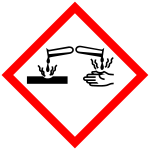
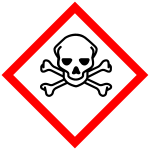
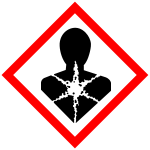

Signal word Danger
Hazard statement(s) H226 Flammable liquid and vapour
H304 May be fatal if swallowed and enters airways
H314 Causes severe skin burns and eye damage
H331 Toxic if inhaled
H410 Very toxic to aquatic life with long lasting effects
Precautionary statement(s) Prevention P210 Keep away from heat, hot surfaces, sparks, open flames and other ignition sources. No smoking.
P233 Keep container tightly closed.
P240 Ground and bond container and receiving equipment.
P241 Use explosion-proof [electrical/ventilating/lighting/...] equipment.
P242 Use non-sparking tools.
P243 Take action to prevent static discharges.
P280 Wear protective gloves/protective clothing/eye protection/face protection/hearing protection/...
P260 Do not breathe dust/fume/gas/mist/vapours/spray.
P264 Wash ... thoroughly after handling.
P261 Avoid breathing dust/fume/gas/mist/vapours/spray.
P271 Use only outdoors or in a well-ventilated area.
P273 Avoid release to the environment.
Response P303+P361+P353 IF ON SKIN (or hair): Take off immediately all contaminated clothing. Rinse affected areas with water [or shower].
P370+P378 In case of fire: Use ... to extinguish.
P301+P316 IF SWALLOWED: Get emergency medical help immediately.
P331 Do NOT induce vomiting.
P301+P330+P331 IF SWALLOWED: Rinse mouth. Do NOT induce vomiting.
P363 Wash contaminated clothing before reuse.
P304+P340 IF INHALED: Remove person to fresh air and keep comfortable for breathing.
P316 Get emergency medical help immediately.
P321 Specific treatment (see ... on this label).
P305+P351+P338 IF IN EYES: Rinse cautiously with water for several minutes. Remove contact lenses, if present and easy to do. Continue rinsing.
P391 Collect spillage.
Storage P403+P235 Store in a well-ventilated place. Keep cool.
P405 Store locked up.
P403+P233 Store in a well-ventilated place. Keep container tightly closed.
Disposal P501 Dispose of contents/container to an appropriate treatment and disposal facility in accordance with applicable laws and regulations, and product characteristics at time of disposal.
Other hazards which do not result in classification
no data available
Handling and StoragePrecautions for safe handling
NO open flames, NO sparks and NO smoking. Above 57°C use a closed system, ventilation and explosion-proof electrical equipment. Prevent build-up of electrostatic charges (e.g., by grounding). Handling in a well ventilated place. Wear suitable protective clothing. Avoid contact with skin and eyes. Avoid formation of dust and aerosols. Use non-sparking tools. Prevent fire caused by electrostatic discharge steam.
Conditions for safe storage, including any incompatibilities
Fireproof. Separated from oxidants. Cool. Keep in the dark. Well closed.Handle and store under Nitrogen. ...Potentially explosive peroxides can form on long time storage in contact with air. Light and heat accelerate peroxide /formation/.
-
-
Seller Information
-
Business Type:
Manufactory
-
Main Products:
Dichloromethane,Linocaine hydrochloride
-
Location:
BUILDING 1,HISENSE INTELLIGENCE VALLEY,NO.2116,OF PHOEIX ROAD, HIGH-TECH ZONE ,JINAN CITY ,SHANDONG PROVINCE,CHINA
-
Payment Terms:
D/P,L/C,D/A
-
Average lead Time:
15
-
Total Annual Revenue:
$10 million-$25 million
-
Total Employees:
11-50
-
Year of Establishment:
2016
-
-
Inquiry History1 Inquiries
Country Product Purchase Quantity Date Posted  Hungary
Decalin
1300 KG Oct 27, 2025 Post an enquiry for this product
Hot Related Products
-
 306-94-5
 -
 Top Notch Quality 99% High Purity Industrial Grade Cyclohexane Solvent from South Korea Origin
 -
 Perfluorodecalin
 -
&White Crystal(<22℃) Cyclohexanol CAS No.:108-93-0 from YI Hang") Hot Selling High Quality 99% Colorless Liquid(>25℃)&White Crystal(<22℃) Cyclohexanol CAS No.:108-93-0 from YI Hang
Hot Selling High Quality 99% Colorless Liquid(>25℃)&White Crystal(<22℃) Cyclohexanol CAS No.:108-93-0 from YI Hang -
 Best price of Cyclohexanol As Chemical intermediates Cas 108-93-0
 -
 Cyclohexanol cas108-93-0