Product
Supplier
Encyclopedia
Inquiry
o-Phenylenediamine CAS:95-54-5 buy - large image1
o-Phenylenediamine CAS:95-54-5 buy - image1
o-Phenylenediamine CAS:95-54-5 buy - image2
o-Phenylenediamine CAS:95-54-5 buy - image3
o-Phenylenediamine CAS:95-54-5 buy - image4
o-Phenylenediamine CAS:95-54-5 buy - image5
o-Phenylenediamine CAS:95-54-5 buy - image6

o-Phenylenediamine CAS:95-54-5

TDS 2 Inquiries

Unit Price: Get Latest Price
CAS No.:

95-54-5

Grade:

Industrail Grade

Content:

99%

Port:

shanghai

Brand:

Orient

Packaging:

25L, 200L, 1000L, customized

Price valid (until):

2025-12-26

Company Type:
Trader
Location:
China
Qualification:
Main Products:

pharmaceutical intermediates,peptides,electronic chemicals

  • Product Description

  • Seller Information

  • Inquiry History

  • Description
    o-Phenylenediamine Chemical Properties
    Melting point  100-102 °C
    Boiling point  256-258 °C
    bulk density 530kg/m3
    density  1,27 g/cm3
    vapor density  3.7 (vs air)
    vapor pressure  0.01 mm Hg ( 25 °C)
    refractive index  1.6339 (estimate)
    Fp  110°C
    storage temp.  2-8°C
    solubility  H2O: 1 tablet/10 mL, clear, colorless
    pka 4.46(at 25℃)
    form  tablet
    Colour Index  76010
    color  white to off-white
    PH 7-8 (50g/l, H2O, 20℃)
    PH Range Green Q uorescence (3.1) to nonQ uorescence (4.4)
    explosive limit 1.5%(V)
    Water Solubility  <0.1 g/100 mL at 20 ºC
    Sensitive  Air & Light Sensitive
    Merck  14,7284
    BRN  606074
    Exposure limits TLV-TWA 0.1 mg/m3; carcinogenicity: A2- Suspected Human Carcinogen (ACGIH 1989).
    Stability: Stable. Incompatible with strong oxidizing agents.
    Major Application bottom antireflective coatings, semiconductor devices, hair dyes, detecting antibody, substrate for horseantibody, glucose, streptomycin, penicillin, sulfonamide, neuroglobin, substrate for horseradish peroxidase
    LogP 0.12-0.17 at 20-25℃ and pH7-8
    CAS DataBase Reference 95-54-5(CAS DataBase Reference)
    NIST Chemistry Reference 1,2-Benzenediamine(95-54-5)
    IARC 2B (Vol. 123) 2020
    EPA Substance Registry System 1,2-Phenylenediamine (95-54-5)


    o-Phenylenediamine Usage And Synthesis
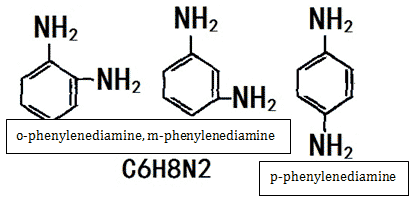
    Phenylenediamine Phenylenediamine is the simplest aromatic diamine. There are three isomers, namely o-phenylenediamine, m-phenylenediamine and p-phenylenediamine.
    p-Phenylenediamine appears as a colorless crystal, being quickly oxidized in the air into black. It has a boiling point of 267 °C. It is soluble in water, ethanol and ether. It can be used as raw materials or intermediates of dyes, vulcanization accelerators for rubber, developers for the photographic industry, fur dyes and hair dyes. People in frequent contact include usually dyeing hair workers, hairdressers and regular hair coloring patients. It can enter the body through the skin, being oxidized intermediates with different degrees of sensitization, being able to cause eczema-like or moss-like dermatitis, appearing mostly in the face, neck and forearm and other skin folds. For example, mouth, eye and nose and other parts are easy to be damaged. People inhalation of its dust can obtain bronchial asthma. The symptoms of oral poisoning are similar as aniline poisoning, being mainly subject to symptomatic treatment.
    O-phenylenediamine is also known as 1, 2-diaminobenzene, 1, 2-phenylenediamine. Substance precipitated from the water appears as white to pale yellow leaf-like crystals while product precipitated from chloroform appears as prism-like crystals. Its color is easy to change upon exposure to air, from white to yellow, brown, purple, and finally into black. It has a relative density of 1.2698, the melting point of 103 °C to 104 °C, the boiling point of 256~258 °C. It is slightly soluble in cold water (35 °C 4.15), being easily soluble in hot water (81 °C, 733), ethanol, ether, chloroform and benzene. Its reaction with inorganic acid can lead to the formation of water-soluble salts; its aqueous solution can react with carbon disulfide to generate 2-mercapto-benzimidazole; under pressure, it can react with carbon dioxide reaction to generate benzimidazolone. This product is toxic with inhalation causing visual disturbances. Its contact with the skin can cause inflammation with entering into the eyes being able to cause inflammation as well. Rat oral LD50: 1070mg/kg.
    M-phenylenediamine appears as a rhombic crystal, being quickly oxidized to brown color in the air. Its proportion is 1.139 with the melting point of 62.8 °C and the boiling point of 284 °C. It can be dissolved in water, alcohols, and ketones and so on. It can be used in the dye chemical industry, and as a curing agent for plastics. It can also enter into the human body via the respiratory tract, skin and gastrointestinal tract. Acute poisoning can cause methemoglobinemia, and liver damage and hemolytic anemia.
    Shop o-Phenylenediamine CAS:95-54-5-Detailed Image 1
    Figure 1 is the chemical structure of three isomers of phenylenediamine: o-phenylenediamine, m-phenylenediamine, p-phenylenediamine.
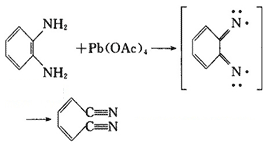
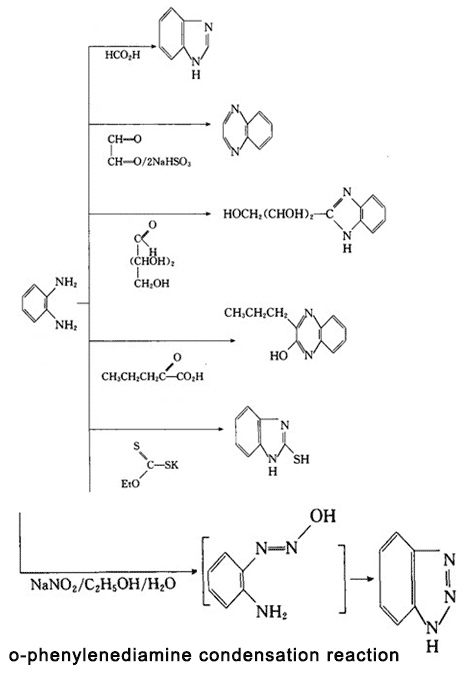
    Chemical properties O-phenylenediamine has active chemical properties, being able to have condensation reaction with acid, aldehydes, ketones and other compounds, generating heterocyclic compounds; it can also have oxidation, condensation, substitution and diazotization reaction.
    Shop o-Phenylenediamine CAS:95-54-5-Detailed Image 2
    Figure 2 is o-phenylenediamine oxidation.
    Shop o-Phenylenediamine CAS:95-54-5-Detailed Image 3
    Figure 3 is o-phenylenediamine condensation reaction.
    The main purpose and role of phenylenediamine Phenylenediamine is used as a fluorescent indicator and chromatographic analysis reagent. It is used for the identification of copper, gold, iron, magnesium, vanadium, ammonia, hydrogen sulfide, sulfur dioxide and chromic oxide, etc., and manufacturing azo dyes, fur dyeing and photographic materials. , Printing and dyeing industry.
    (1) o-phenylenediamine is mainly used in the manufacture of pesticides fungicides (carbendazim, benomyl, thiophanate-methyl, Thiabendazole), reducing dyes (reduction Yellow 6GD, reduction brilliant orange GR), cationic dye (Cationic brilliant yellow 10GFF), polymer stabilizer (2-mercaptobenzimidazole), heterocyclic compounds (benzimidazole and quinoxaline), photographic materials, surfactants, antifreeze, copper anticorrosive. It is one of the components of the hair dye formulation and is one of the organic reagents commonly used in analytical chemistry to identify 1, 2-diesters, carboxylic acids and aldehydes.
    (2) m-phenylenediamine is mainly used in the manufacture of dyes, such as direct fast black RN, and used as fur dyes, azo and diazine dye intermediates, the determination of nitrite, but also for ion exchange resins, block copolymer and photographic; for textile dyes, laboratory reagents, curing agents, corrosion inhibitors. Also used as a curing agent for epoxy resin and cement accelerator and so on.
    (3) p-phenylenediamine is mainly used in the manufacture of dyes, being also used for the synthesis of azo dyes disperse dyes, acid dyes, direct dyes, sulfur dyes, fur dyes (fur D). It can also be used for cosmetics Hair dye, also used in the preparation of rubber antioxidant ("anti-aging agent DNP", "anti-aging agent DOP", "anti-aging agent DBP") and the production of developing agents.
    Toxicity O-phenylenediamine has moderate toxicity, often due to inhalation of dust or skin absorption caused by poisoning (the latter phenomenon mostly). Inhalation of dust can cause rhinitis, bronchitis, frequent fever, causing unique asthma and vagal nervous tension caused by the tracheal inflammation, can cause severe acute eczema and eczema. M-phenylenediamine can cause methemoglobin changes, while the p-phenylenediamine can cause bronchial asthma, allergic dermatitis.
    The above information is edited and edited by Chemicalbook.
    Uses 1. It can be used as a cationic dye intermediates, being the main raw material of pesticides, carbendazim and other fungicides.
    2. It can be used as analytical reagent, fluorescent indicator, also used in organic and dye synthesis. It can be used as pesticides, pharmaceuticals and dyes intermediates
    3.  As a pesticide intermediates, dye intermediates
    phenylenediamine is the intermediate of fungicide carbendazim, methyl thiophanate, and thiabendazole, but also insecticides quinalphos intermediates. In addition, it can also used as an important intermediate of dye industry.
    4. The goods are intermediates of dyes, pesticides, additives and photographic materials. Itself is the dye fur yellow brown M. It can be used in the manufacture of polyamide, polyurethane, fungicides carbendazim and thiophanate, reduction scarlet GG, leveling agent, antioxidant MB, also used in the preparation of the developer, surfactant and so on.
    5.  It can be used as intermediates of chemical raw materials, pesticides and dyes.


    Shop Orthophosphorus acid 10294-56-1-Detailed Image 1

    Shop Trimellitic Anhydride  C9H4O5 552-30-7-Detailed Image 2

    Shop Trimellitic Anhydride  C9H4O5 552-30-7-Detailed Image 3


    Shop Trimellitic Anhydride  C9H4O5 552-30-7-Detailed Image 4

    Shop Trimellitic Anhydride  C9H4O5 552-30-7-Detailed Image 5

    Shop Trimellitic Anhydride  C9H4O5 552-30-7-Detailed Image 6


    Shop Trimellitic Anhydride  C9H4O5 552-30-7-Detailed Image 7


    Shop Trimellitic Anhydride  C9H4O5 552-30-7-Detailed Image 8

    Shop Trimellitic Anhydride  C9H4O5 552-30-7-Detailed Image 9

    Shop Trimellitic Anhydride  C9H4O5 552-30-7-Detailed Image 10

    Shop Trimellitic Anhydride  C9H4O5 552-30-7-Detailed Image 11

    Shop Trimellitic Anhydride  C9H4O5 552-30-7-Detailed Image 12

    ——  Q&A  ——

    Q1:Do you provide sample?

    A: Yes, we can provide free sample, you only need pay the shipping cost.

    Q2: What is the lead time?

    A: For stock goods, it usually take about 5-7 days by air, 15-30 days by sea,For customized products, the delivery time needs to be confirmed based on the actual situation.

    Q3: How can I buy? What is the payment method?

    A: You can contract us through Email or you can browse our website:orientchem.cc, we have bank transfer, 

    Q4:What if there are quality issues?

    A:We attach great importance to after-sales service of our products. If there are any quality issues, please contact us within 30 days of receiving the goods and we will handle returns and exchanges for you.


    Certificates

    Basic Info
    Product Name:

    o-Phenylenediamine

    Other Name:

    1,2-Benzenediamine;o-Phenylenediamine;C.I. 76010;C.I. Oxidation Base 16;o-Diaminobenzene;Orthamine;1,2-Diaminobenzene;1,2-Phenylenediamine;o-Benzenediamine;2-Aminoaniline;o-Aminoaniline;IK 3 (amine);o-Aminophenylamine;IK 3;NSC 5354;OPDA

    CAS No.:

    95-54-5

    Molecular Formula:

    C6H8N2

    InChIKeys:

    InChIKey=GEYOCULIXLDCMW-UHFFFAOYSA-N

    Molecular Weight:

    108.14100

    Exact Mass:

    108.14

    EC Number:

    202-430-6

    UNII:

    8B713N8Q0F

    ICSC Number:

    1441

    NSC Number:

    5354

    UN Number:

    1673

    DSSTox ID:

    DTXSID3025881

    Color/Form:

    Brownish-yellow leaflets from water; plates from chloroform|Tan crystals or leaflets from water|White crystalline solid when pure

    HScode:

    29215119

    Characteristics
    PSA:

    52.04000

    XLogP3:

    2.01340

    Appearance:

    1,2-phenylenediamine appears as colorless monoclinic crystals if pure; technical grade brownish-yellow crystals or a sandy brown solid. Used in manufacture of dyes, photography, organic synthesis.

    Density:

    1.27

    Melting Point:

    103-104 °C

    Boiling Point:

    256-258 °C

    Flash Point:

    110ºC

    Refractive Index:

    1.66

    Water Solubility:

    H2O: 1 tablet/10 mL, clear, colorless

    Storage Conditions:

    2-8ºC

    Vapor Pressure:

    0.01 mm Hg ( 25 °C)

    Vapor Density:

    3.7 (vs air)

    Toxicity:

    LD50 in rats (mg/kg): 1070 orally; 516 i.p., C. Burnett et al., J. Toxicol. Environ. Health 2, 657 (1977)

    Flammability characteristics:

    Lower flammable limit: 1.5%

    Explosive limit:

    vol% in air: 1.5

    Henrys Law Constant:

    Henry's Law constant = 7.20X10⁻⁹ atm-cu m/mol at 25 °C (est)

    Dissociation Constants:

    pKa1 = less than 2; pKa2 = 4.47 at 25 °C

    Collision Cross Section:

    129.1 Ų [M+H]+

    Experimental Properties:

    Hydroxyl radical reaction rate constant = 1.76X10⁻¹⁰ cu cm/molec-sec at 25 °C (est)

    Air and Water Reactions:

    Soluble in water [Hawley]. Melting point 219 F. Flash point 277 F. Toxic by skin absorption, inhalation or ingestion. Even as a solid will spot downwind area brown/purple (Roger Patrick, DuPont Engineer).

    Reactive Group:

    Amines, Aromatic

    Reactivity Profile:

    1,2-PHENYLENEDIAMINE a weak aromatic amine base neutralizes acids in exothermic reactions to form salts. May be incompatible with isocyanates, halogenated organics, peroxides, phenols (acidic), epoxides, anhydrides, and acid halides. Darkens on exposure to air (Roger Patrick, DuPont Engineer).

    Flammable Limits:

    Lower flammable limit: 1.5%

    Physical Dangers:

    Dust explosion possible if in powder or granular form, mixed with air.

    Hazard Identification

    Classification of the substance or mixture

    Acute toxicity - Category 3, Oral

    Acute toxicity - Category 4, Dermal

    Eye irritation, Category 2

    Skin sensitization, Category 1

    Acute toxicity - Category 4, Inhalation

    Germ cell mutagenicity, Category 2

    Carcinogenicity, Category 2

    Hazardous to the aquatic environment, short-term (Acute) - Category Acute 1

    Hazardous to the aquatic environment, long-term (Chronic) - Category Chronic 1

    GHS label elements, including precautionary statements

    Pictogram(s)
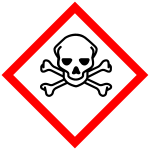
    Signal word

    Danger

    Hazard statement(s)

    H301 Toxic if swallowed

    H312 Harmful in contact with skin

    H319 Causes serious eye irritation

    H317 May cause an allergic skin reaction

    H332 Harmful if inhaled

    H341 Suspected of causing genetic defects

    H351 Suspected of causing cancer

    H410 Very toxic to aquatic life with long lasting effects

    Precautionary statement(s)
    Prevention

    P264 Wash ... thoroughly after handling.

    P270 Do not eat, drink or smoke when using this product.

    P280 Wear protective gloves/protective clothing/eye protection/face protection/hearing protection/...

    P261 Avoid breathing dust/fume/gas/mist/vapours/spray.

    P272 Contaminated work clothing should not be allowed out of the workplace.

    P271 Use only outdoors or in a well-ventilated area.

    P203 Obtain, read and follow all safety instructions before use.

    P273 Avoid release to the environment.

    Response

    P301+P316 IF SWALLOWED: Get emergency medical help immediately.

    P321 Specific treatment (see ... on this label).

    P330 Rinse mouth.

    P302+P352 IF ON SKIN: Wash with plenty of water/...

    P317 Get medical help.

    P362+P364 Take off contaminated clothing and wash it before reuse.

    P305+P351+P338 IF IN EYES: Rinse cautiously with water for several minutes. Remove contact lenses, if present and easy to do. Continue rinsing.

    P333+P317 If skin irritation or rash occurs: Get medical help.

    P304+P340 IF INHALED: Remove person to fresh air and keep comfortable for breathing.

    P318 IF exposed or concerned, get medical advice.

    P391 Collect spillage.

    Storage

    P405 Store locked up.

    Disposal

    P501 Dispose of contents/container to an appropriate treatment and disposal facility in accordance with applicable laws and regulations, and product characteristics at time of disposal.

    Other hazards which do not result in classification

    no data available

    Handling and Storage

    Precautions for safe handling

    NO open flames. Closed system, dust explosion-proof electrical equipment and lighting. Prevent deposition of dust. Handling in a well ventilated place. Wear suitable protective clothing. Avoid contact with skin and eyes. Avoid formation of dust and aerosols. Use non-sparking tools. Prevent fire caused by electrostatic discharge steam.

    Conditions for safe storage, including any incompatibilities

    Separated from food and feedstuffs. Well closed.Separated from food and feedstuffs. Well closed.

  • Seller Information
    Business Type:

    Trader

    Main Products:

    pharmaceutical intermediates,peptides,electronic chemicals

    Location:

    Room 102, 1st Floor, East Office Building, No. 45 Pengwan Road, Qianwan Bonded Port Area, Qingdao Zone, China (Shandong) Pilot Free Trade Zone

    Payment Terms:

    100% TT in advance

    Average lead Time:

    10

    Total Annual Revenue:

    $10 million-$25 million

    Total Employees:

    51-100

    Year of Establishment:

    2024

    A reliable supplier is like insurance.

    We are mainly specilized in supply of pharmaceutical intermediates, electronic chemicals,food additives, and other fine chemical products.
    Integrity is the foundation, quality is life. We would like to work together with you to build a greener and brighter future.

    Website: orientchem.cc
    Email: scarlett@orientchem.cc
    WhatsApp: +86 17753254221

  • Inquiry History
    2 Inquiries
    Country Product Purchase Quantity Date Posted
    India

    o-phenylene diamine

    4 MT Jan 8, 2024
    India

    o-Phenylenediamine

    20 MT Mar 19, 2025
    Post an enquiry for this product
pic ×

Scan the QR Code to Share

All products displayed on this website are only for non-medical purposes such as industrial applications or scientific research, and cannot be used for clinical diagnosis or treatment of humans or animals. They are not medicinal or edible.

According to relevant laws and regulations and the regulations of this website, units or individuals who purchase hazardous materials should obtain valid qualifications and qualification conditions.

The information shown above is provided by the enterprise itself, and the authenticity, accuracy and legitimacy of the content are the responsibility of the publishing company. ECHEMI does not bear any guarantee responsibility for this. Please be aware that risks in internet transactions objectively exist.

Feedback & Suggestions
Send Message

Thank you for your feedback. If you require further assistance, please contact us by email at info@echemi.com or call us at +86-532-55729510.