Aluminum chloride,CAS 7446-70-0
9 Inquiries
7446-70-0
Shang hai
25kg/drum
2025-11-27

Agrochemicals,Daily Chemicals,Catalysts & Chemical Auxiliary Agents,Extract,Inorganic Chemicals,Organic Intermediate
-
Product Description
-
Seller Information
-
Inquiry History
-
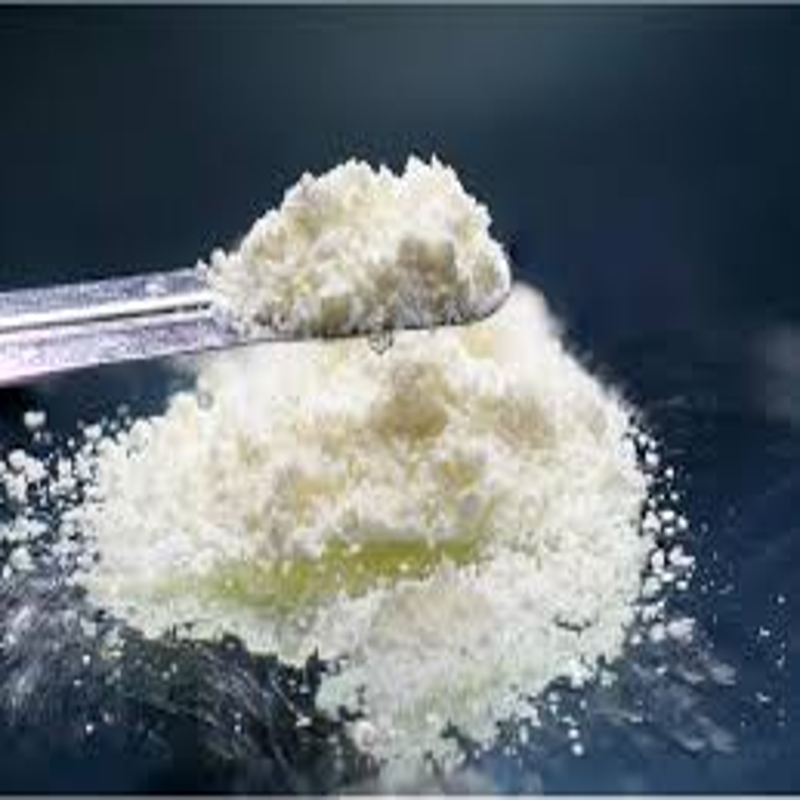
DescriptionECHEMI Editorial ReferenceAluminum chloride is a noncombustible but highly reactive whitish-gray, yellow, or green powder or liquid. Strong, acidic, irritating odor like hydrochloric acid.The vapor consists of double molecules Al2Cl6 . Soluble in water.
Aluminium chloride (AlCl3) is the main compound of aluminium and chlorine. It is white, but samples are often contaminated with iron trichloride, giving it a yellow colour. The solid has a low melting and boiling point. It is mainly produced and consumed in the production of aluminium metal, but large amounts are also used in other areas of chemical industry. The compound is often cited as a Lewis acid. It is an example of an inorganic compound that "cracks" at mild temperature, reversibly changing from a polymer to a monomer.
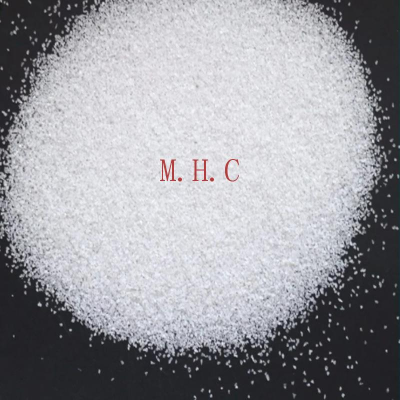
Aluminum chloride, anhydrous appears as a white to gray powder with a pungent odor. Corrosive to tissue and toxic by ingestion.|Aluminum chloride, solution appears as a straw-colored liquid. Denser than water. Contact may cause severe irritation to skin, eyes, and mucous membranes. May be toxic by ingestion.|DryPowder; Liquid; PelletsLargeCrystals; WetSolid
Aluminum chloride, anhydrous appears as a white to gray powder with a pungent odor. Corrosive to tissue and toxic by ingestion.|Aluminum chloride, solution appears as a straw-colored liquid. Denser than water. Contact may cause severe irritation to skin, eyes, and mucous membranes. May be toxic by ingestion.|Aluminium trichloride is an aluminium coordination entity. It has a role as a Lewis acid.|Aluminum chloride is a chemical compound with the chemical formula AlCl3. When contaminated with iron chloride, it often displays a yellow color compared to the white pure compound. It is used in various chemical applications as a Lewis base, with anhydrous aluminium trichloride being the most commonly used Lewis acid. It may also be found in over-the-counter as an antiperspirant or prescription products as an antihemorrhagic agent. In antiperspirant products, FDA approves the use of aluminum chloride as an active ingredient up to 15%, calculated on the hexahydrate form, in an aqueous solution nonaerosol dosage form.|A compound with the chemical formula AlCl3; the anhydrous salt is used as a catalyst in organic chemical synthesis, and hydrated salts are used topically as antiperspirants, and for the management of HYPERHYDROSIS.Basic Info-
Product Name:
Aluminum chloride
Other Name:Aluminum chloride (AlCl3);Aluminum chloride;Aluminum trichloride;Aluminium chloride;Aluminium trichloride;Trichloroaluminum;Aluminum(III) chloride;TK Flock;Lutan FN;NSC 143015;NSC 143016;Hemogin L;Takibine 100;Hemostop;41630-01-7;125690-94-0;195436-38-5;255839-01-1;1161430-81-4;1332483-60-9;1818401-35-2
CAS No.:7446-70-0
UN No.:UN 3264 8/PG 3
Molecular Formula:AlCl3
InChIKeys:InChIKey=VSCWAEJMTAWNJL-UHFFFAOYSA-K
Molecular Weight:133.34100
Exact Mass:131.88800
EC Number:231-208-1
NSC Number:143016|143015
UN Number:1726|2581
DSSTox ID:DTXSID6029674
Color/Form:White when pure; ordinarily gray or yellow to greenish|White, hexagonal crystals or powder|White or colorless hexagonal deliquescent or moisture sensitive plates
ATC Code:D - Dermatologicals
HScode:2827320000
Categories:
Characteristics-
PSA:
0 Ų
XLogP3:2.06850
Appearance:Yellow to gray powder
Density:2.48 g/cm3
Melting Point:192.6 °C
Boiling Point:182.7 °C @ Press: 752 Torr
Flash Point:88 °C
Water Solubility:H2O: soluble
Storage Conditions:2-8°C
Vapor Pressure:1 mm Hg ( 100 °C)
Toxicity:LD50 oral (rat) 3730 mg/kg LD50 skin (rabbit) >2 g/kg TLV-TWA (ACGIH) 2 mg(Al)/m3
Odor:STRONG ODOR OF HYDROGEN CHLORIDE
Experimental Properties:VAP: 1 Pa at 58.4 °C; 10 Pa at 76.5 °C; 100 Pa at 97.1 °C; 1 kPa at 120.7 °C; 10 kPa at 148.2 °C; 100 kPa at 180.5 °C (solid at each temp)|Fumes in air, strong odor of HCl; when heated in small quantities volatilizes without melting. Combines with water with explosive violence and liberation of much heat.|Hygroscopic|Enthalpy of fusion: 35.4 kJ/mol at MP|For more Other Experimental Properties (Complete) data for ALUMINUM CHLORIDE (7 total), please visit the HSDB record page.
Air and Water Reactions:Fumes in moist air (forms a large amount of hydrogen chloride gas). Reacts with active metals in the presence of moisture to produce hydrogen and HCl gases. Based on a scenario where the chemical is spilled into an excess of water (at least 5 fold excess of water), half of the maximum theoretical yield of Hydrogen Chloride gas will be created in 0.02 minutes. Experimental details are in the following: "Development of the Table of Initial Isolation and Protective Distances for the 2008 Emergency Response Guidebook", ANL/DIS-09-2, D.F. Brown, H.M. Hartmann, W.A. Freeman, and W.D. Haney, Argonne National Laboratory, Argonne, Illinois, June 2009.|Fumes in air.
Reactive Group:Acids, Strong Non-oxidizing
Reactivity Alerts:Known Catalytic Activity
Reactivity Profile:ALUMINUM CHLORIDE behaves as an acidic salt. Self-reactive. After long storage in closed containers, explosions often occur upon opening [Chem. Abst. 41:6723d 1947]. Can cause ethylene(also other alkenes) to polymerize violently [J. Inst. Pet. 33:254 1947]. Causes ethylene oxide to rearrange and polymerize, liberating heat [J. Soc. Chem. Ind. 68:179 1949]. Can catalyze violent polymerization of allyl chloride [Ventrone 1971]. Addition to nitrobenzene containing about 5% phenol caused a violent explosion [Chem. Eng. News 31:4915 1953]. Mixtures with nitromethane may explode when organic matter is present [Chem. Eng. News 26:2257 1948].|ALUMINUM CHLORIDE, SOLUTION is an aqueous solution of an acidic salt. Reacts exothermically with bases. May cause ethylene (also other alkenes) to polymerize violently [J. Inst. Pet. 33:254 1947].
Autoignition Temperature:Not flammable (USCG, 1999)
Critical Temperature & Pressure:Critical temperature: 620 K; critical pressure: 2.63 MPa
Hazard IdentificationClassification of the substance or mixture
Skin corrosion, Sub-category 1B
GHS label elements, including precautionary statements
Pictogram(s) 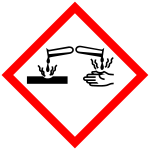
Signal word Danger
Hazard statement(s) H314 Causes severe skin burns and eye damage
Precautionary statement(s) Prevention P260 Do not breathe dust/fume/gas/mist/vapours/spray.
P264 Wash ... thoroughly after handling.
P280 Wear protective gloves/protective clothing/eye protection/face protection/hearing protection/...
Response P301+P330+P331 IF SWALLOWED: Rinse mouth. Do NOT induce vomiting.
P363 Wash contaminated clothing before reuse.
P304+P340 IF INHALED: Remove person to fresh air and keep comfortable for breathing.
P316 Get emergency medical help immediately.
P321 Specific treatment (see ... on this label).
P305+P351+P338 IF IN EYES: Rinse cautiously with water for several minutes. Remove contact lenses, if present and easy to do. Continue rinsing.
Storage P405 Store locked up.
Disposal P501 Dispose of contents/container to an appropriate treatment and disposal facility in accordance with applicable laws and regulations, and product characteristics at time of disposal.
Other hazards which do not result in classification
no data available
Handling and StoragePrecautions for safe handling
NO contact with water. Handling in a well ventilated place. Wear suitable protective clothing. Avoid contact with skin and eyes. Avoid formation of dust and aerosols. Use non-sparking tools. Prevent fire caused by electrostatic discharge steam.
Conditions for safe storage, including any incompatibilities
Separated from food and feedstuffs. Dry. Well closed. Store in an area without drain or sewer access.
-
-
Seller Information
-
Business Type:
Manufactory
-
Main Products:
Agrochemicals,Daily Chemicals,Catalysts & Chemical Auxiliary Agents,Extract,Inorganic Chemicals,Organic Intermediate
-
Location:
9F/TOWER B DANING MUSIC PLAZA NO.777, WANRONG ROAD JINGAN, DISTRICT, SHANGHAI, R.P. CHINA
-
Payment Terms:
TT against copy of documents,D/P,L/C,TT against B/L draft before shipment,100% TT in advance
-
Average lead Time:
14
-
Total Annual Revenue:
$2.5 million-$5 million
-
Total Employees:
5-10
-
Year of Establishment:
2022
-
-
Inquiry History9 Inquiries
Country Product Purchase Quantity Date Posted  Myanmar
Aluminium Trichoride ( anhydrous)
1.00 MT Nov 12, 2024  New Zealand
Aluminum chloride
25 KG May 29, 2026  India
India
Aluminum chloride granules
1 KG Apr 23, 2026  Saudi Arabia
Aluminium Chloride
1 20' Fcl Apr 1, 2026
India
Aluminum chloride
1000.00 KG Oct 15, 2024  Georgia
Aluminum chloride anhydrous
5 KG Apr 12, 2024  South Africa
aluminum Chloride (Alc3)
1.00 MT Aug 12, 2026
New Zealand
Aluminum chloride
25 KG May 30, 2026
India
ALUMINIUM CHLORIDE
1.00 MT Jun 3, 2024 Post an enquiry for this product