Product
Supplier
Encyclopedia
Inquiry
2-Butanol78-92-2 buy - large image1
2-Butanol78-92-2 buy - image1
2-Butanol78-92-2 buy - image2
2-Butanol78-92-2 buy - image3
2-Butanol78-92-2 buy - image4
2-Butanol78-92-2 buy - image5
2-Butanol78-92-2 buy - image6

2-Butanol78-92-2

Unit Price:

$33-34/MT FOB

Get Latest Price
CAS No.:

78-92-2

Grade:

Pharmaceutical Grade

Content:

99.5%

Port:

上海

Brand:

OORENT

Packaging:

Vial/Bottle/Bag/Carton

Price valid (until):

2026-07-16

Company Type:
Trader
Location:
China
Qualification:
Main Products:

pharmaceutical intermediates,peptides,electronic chemicals

  • Product Description

  • Seller Information

  • Description

    Product Detail  


    2-Butanol Chemical Properties
    Melting point  −115 °C(lit.)
    Boiling point  98 °C(lit.)
    density  0.808 g/mL at 25 °C(lit.)
    vapor density  2.6 (vs air)
    vapor pressure  12.5 mm Hg ( 20 °C)
    refractive index  n20/D 1.397(lit.)
    Fp  80 °F
    storage temp.  Store at +5°C to +30°C.
    solubility  125g/l
    pka >14 (Schwarzenbach et al., 1993)
    form  Liquid
    color  Colorless
    Relative polarity 0.506
    Odor Strong, pleasant.
    PH 7 (20°C)
    PH Range 7
    Odor Threshold 0.22ppm
    Odor Type fruity
    explosive limit 1.4-9.8%(V)
    Water Solubility  12.5 g/100 mL (20 ºc)
    Thermal Conductivity 0.134 W/(m·K) at 25 ℃
    Sensitive  Hygroscopic
    Merck  14,1541
    BRN  1718765
    Henry's Law Constant 1.19 (static headspace-GC, Merk and Riederer, 1997)
    Exposure limits ACGIH:TLV-TWA 100 ppm (303 mg/m3)
    OSHA:PEL-TWA 150 ppm (450 mg/m3)
    NIOSH:REL-TWA 100 ppm; REL-STEL 150 ppm
    Dielectric constant 15.8(25℃)
    Stability: Stable. Flammable. Substances to be avoided include acids, acid chlorides, acid anhydrides, oxidizing agents and halogens.
    Major Application cleaning products
    cosmetics
    environmental
    flavors and fragrances
    food and beverages
    personal care
    Cosmetics Ingredients Functions SOLVENT
    InChI 1S/C4H10O/c1-3-4(2)5/h4-5H,3H2,1-2H3
    InChIKey BTANRVKWQNVYAZ-UHFFFAOYSA-N
    SMILES CCC(C)O
    LogP 0.610
    Surface tension 23.56mN/m at 293.15K
    CAS DataBase Reference 78-92-2(CAS DataBase Reference)
    NIST Chemistry Reference 2-Butanol(78-92-2)
    EPA Substance Registry System 2-Butanol (78-92-2)
    ECETOC JACC REPORT 2-Butanol (78-92-2)

    Safety Information
    Hazard Codes  Xi
    Risk Statements  10-36/37-67
    Safety Statements  13-24/25-26-46-7/9
    RIDADR  UN 1120 3/PG 3
    OEB A
    OEL TWA: 100 ppm (305 mg/m3), STEL: 150 ppm (455 mg/m3)
    WGK Germany  1
    RTECS  EO1750000
    Autoignition Temperature 761 °F
    TSCA  TSCA listed
    HazardClass  3
    PackingGroup  II
    HS Code  29051490
    Storage Class 3 - Flammable liquids
    Hazard Classifications Eye Irrit. 2
    Flam. Liq. 3
    STOT SE 3
    Hazardous Substances Data 78-92-2(Hazardous Substances Data)
    Toxicity LD50 orally in Rabbit: 6480 mg/kg LD50 dermal Rat > 2000 mg/kg
    IDLH 2,000 ppm
    MSDS Information
    Provider Language
    sec-Butyl alcohol English
    SigmaAldrich English
    ACROS English
    ALFA English

    2-Butanol Usage And Synthesis
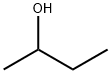
    Physical and Chemical Properties 2-butanol is also known as methyl ethyl alcohol, chemical formula is CH3CH2CHOHCH3. Molecular weight is 74.12. It is colorless liquid with a strong aroma of mint, flammable, volatile, with optical activity. The molecule has a chiral carbon atom, can be present in three forms of right-handed body, left-handed body and racemic body, dl-body: the relative density is 0.8063. Melting point is-114.7 ℃. Boiling point is 99.5 ℃, 45.5 ℃ (7.999 × 10³Pa). The flash point is 34 ℃. The refractive index is 1.3978. d-body: the relative density is 0.8080. Boiling point is 99.5 ℃. The flash point is 24 ℃. The refractive index is 1.3954. Specific rotation is + 13.9 °. l-body: the relative density is 0.8070. Boiling point is 99.5 ℃. The flash point is 28 ℃. The refractive index is 1.3955. Specific rotation is-13.51 ° (25 ℃). 2-butanol oxidation can generate methyl ethyl ketone and acetic acid. Slightly soluble in water (25 ℃ when 12.5ml/100ml), dissolved in acetone, benzene, miscible with ethanol and ether. This product interacts with water to form an azeotropic mixture, the product content is 68%, the total boiling point is 88.5 ℃. Rat oral is LD506480mg/kg. 2-butanol is the main raw material for producing methyl ethyl ketone, butyl acetate, sec-butyl acetate, and also used as a solvent and extraction agent, the raw materials of plasticizers, processing agents, herbicides, but also for synthesis of spices, flavors, coloring agents, wetting agent, cleaning agents and solvents of many natural resin, linseed oil and castor oil.
    Chemical Properties It is slightly sticky colorless flammable liquid, with a strong odor. Melting point is-114.7 ℃, the boiling point is 99.5 ℃, relative density (d204) is 0.808~0.809, the refractive index (nD25) is 1.3949, a flash point is 23.9 ℃. It is soluble in water, miscible in ethanol and ether.
    Uses 1. Used as extraction solvent, spices.
    2. 2-butanol is Used as a solvent, and chromatography reagents
    3. 2-butanol is Used for the production of intermediates of methyl ethyl ketone, for the preparation of butyl acetate, sec-butyl, used as plasticizers, processing agents, herbicides, solvents and so on.
    4. Used for the production of intermediates of methyl ethyl ketone, for the preparation of butyl acetate, sec-butyl.
    Butanol isomers Butanol is an important industrial raw material, also known as hydroxy butane, a monohydric alcohol, the lowest level alcohol for the same family which can have two or more isomers, butanol has four kinds of isomers, namely n-butanol, 2-butanol, tert-butanol and isobutanol. Relative molecular mass is 74.12. Butanol has the common property of alcohols, such as water-like, reacts with metal to produce alkoxide, reacts with halogen acid to produce halogenated hydrocarbons, dehydrates into alkenes, oxidation (or dehydrogenation) reaction to produce aldehydes and acids, and reacts with organic acids or oxygen-containing inorganic acid to generate ester and so on. In the four isomers, the toxicity of n-butanol is minimal, the toxicity of the other three is not large, but their irritation is great, with irritation to the skin and mucous membrane. Inhalation of large vapors can cause coma. The maximum allowable concentration at workplace is 100 × 10-6. Butanol can be directly used as a solvent, extraction agent, dehydrating agent, plasticizer, mineral processing agent, anti-aging agent, herbicide and so on.
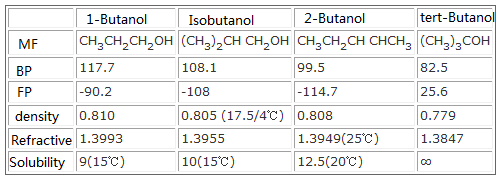
    Physical and chemical properties and toxicity of butanol are different due to isomers. The solubility in water depends on their structure, chemical properties depend on hydroxy location in alcohol: n-butanol and iso-butanol are primary alcohols, can be oxidized into the corresponding aldehyde or acid, sec-butyl alcohol is oxidized into the corresponding ketone, t-butanol is unsusceptible to oxidation.
    Shop 2-Butanol78-92-2-Detailed Image 2
    Physicochemical properties comparison chart of 4 isomers of butanol
    Under dehydrating catalyst, butanol can produce butene, n-butanol and 2-butene can give 1-butene, 2-butene, 2-butanol can generate 2-butene, isobutanol and tert-butanol generate isobutylene. Under the catalyst of copper and silver, the dehydrogenation generates carbonyl compounds, n-butanol generates butyraldehyde, butanol generates methyl ethyl ketone, isobutanol generate isobutyraldehyde. Under the catalyst, air oxidation can generate acid. Catalyzed by a mineral acid, it reacts with organic acid to generate ester. Reaction with benzene, can generate butyl benzene. Butanol reacts with chlorine to generate butyraldehyde chloride. Under the action of the aluminum catalyst at 300~350 ℃, reacts with ammonia, n-butanol, iso-butanol and 2-butanol react with ammonia to generate butylamine, dibutylamine, tributylamine, t-butanol does not have this character. N-butanol and tert-butanol at 180 ℃ react with hydrogen sulfide to generate butyl mercaptan.
    The above information were collated and edited by Xiaonan of Chemicalbook.
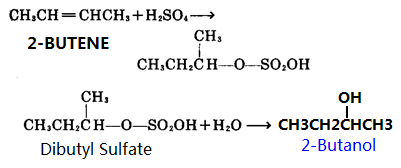
    Laboratory method for preparing 2-butanol 1, As raw materials 2-butene reacts with sulfuric acid in concentrated sulfuric acid to produce sulfuric acid butyl ester, sulfuric acid ester is then hydrolyzed to produce 2-butanol, and then distillation purification.
    Shop 2-Butanol78-92-2-Detailed Image 3
    2, 2-butanone is used as raw material, under the action of a Grignard reagent, to prepare 2-butanol.
    3, cis-2-butene is used as raw material, under the action of boron hydrides, to prepare d-or l-body.
    Production method After adsorption by butane of the cracking petroleum or natural gas in sulfuric acid, then hydrolyze with steam.
    Dangerous situations Prolonged inhalation is toxic, it irritates eye and skin. Flammable, flash point is 406 ℃, there is a greater risk of combustion. The allowable concentration in air of US is 100ppm (305mg/m3).
    Incompatibility Sec-butyl alcohol is incompatible with strong oxidizing agents.
    Storage It is Stored in metal drums, to prevent mechanical damage, best stored in a cool, dry and ventilated, non-flammable place, away from all possible sources of ignition, separated from strong oxidants.
    Transport requirements During transportation, "flammable liquid" shall be marked logo on the container. Others should be the same with "n-butanol".
    Extinguish measures When firing, dry powder fire extinguishing agent, fire-resistant foam or CO2 can be used. Water fighting is invalid, but spray with water in the fire container to keep it cool. If spills, and spills are not lighted, water mist can wash spray spills from the fire, and dilute to non-flammable mixtures. If necessary, water mist can be used to protect the operator to stop the leakage. Other items see the "n-butanol."
    Hazards & Safety Information Category: Flammable liquid
    Toxicity grading: Poisoning
    Acute toxicity
    Oral-rat LD50: 6480 mg/kg, Intravenous-Mouse LD50: 764 mg/kg
    Stimulus data
    Eyes-rabbit 100 mg/24 hours    moderate, Skin-rabbit 500 mg/24 hr  mild
    Hazardous characteristics
    It is explosive when mixed with air, self-oxidized to form explosive peroxides.
    Flammability hazard characteristics
    in case of fire, high temperature, oxidant, it is flammable, burning to generate irritation smoke, spontaneous combustion in contact with chromium trioxide.
    Storage characteristics
    Treasury ventilation low-temperature drying, and it is stored from oxidants.
    Extinguishing agent
    Dry powder, water spray, carbon dioxide, foam
    Professional standards
    TWA 100 PPM (310 mg/m3)
    Chemical Properties Colourless liquid
    Physical properties Clear, colorless, flammable liquid with a pleasant odor. Experimentally determined detection and recognition odor threshold concentrations were 400 μg/m3 (120 ppbv) and 1.2 mg/m3 (410 ppbv), respectively (Hellman and Small, 1974).
    Uses 2-Butanol is used in the production of methylethyl ketone and sec-butyl acetate, as asolvent in lacquers and alkyd enamels, in inhydraulic brake fluids, in cleaning compounds, and its xanthate derivatives in oreflotation. In addition, it is used to polish, clean materials, paint removers, fruit essences, perfumes, and dyestuffs.
    Definition ChEBI: A secondary alcohol that is butane substituted by a hydroxy group at position 2.
    Production Methods 2-Butanol is produced commercially by the indirect hydration of n-butenes.
    Production Methods There are two ways to produce 2-Butanol in industry. The first is the butene hydration method. After pretreatment, n-butene is hydrated with sulfuric acid to obtain 2-Butanol, which is purified to obtain 2-Butanol. The second is the ion exchange resin hydration method, which uses n-butene as raw material, acidic cation exchange resin as catalyst, carries out liquid-phase esterification reaction with organic acid, and then undergoes hydrolysis and rectification to obtain the product.
    General Description A clear colorless liquid with an alcohol odor. Flash point below 0 °F. Less dense than water. Vapors heavier than air. Soluble in water. Moderately irritates the eyes and skin. Prolonged and repeated contact may cause defatting and drying of the skin. Vapors may irritate the nose, throat and respiratory tract. May be harmful by ingestion.
    Air & Water Reactions Highly flammable. Soluble in water.
    Reactivity Profile Attacks plastics. [Handling Chemicals Safely 1980. p. 236]. Acetyl bromide reacts violently with alcohols or water (Merck 11th ed. 1989). Mixtures of alcohols with concentrated sulfuric acid and strong hydrogen peroxide can cause explosions. Example: An explosion will occur if dimethylbenzylcarbinol is added to 90% hydrogen peroxide then acidified with concentrated sulfuric acid. Mixtures of ethyl alcohol with concentrated hydrogen peroxide form powerful explosives. Mixtures of hydrogen peroxide and 1-phenyl-2-methyl propyl alcohol tend to explode if acidified with 70% sulfuric acid [Chem. Eng. News 45(43):73 1967; J, Org. Chem. 28:1893 1963]. Alkyl hypochlorites are violently explosive. They are readily obtained by reacting hypochlorous acid and alcohols either in aqueous solution or mixed aqueous-carbon tetrachloride solutions. Chlorine plus alcohols would similarly yield alkyl hypochlorites. They decompose in the cold and explode on exposure to sunlight or heat. Tertiary hypochlorites are less unstable than secondary or primary hypochlorites [NFPA 491 M 1991]. Base-catalysed reactions of isocyanates with alcohols should be carried out in inert solvents. Such reactions in the absence of solvents often occur with explosive violence [Wischmeyer 1969].
    Hazard Toxic, mutagenic, upper respiratory tract irritant, central nervous system impairment.
    Health Hazard Exposure to 2-butanol may cause irritationof the eyes and skin. The latter effect isproduced by its defatting action on skin. Thistoxic property is mild and similar to thatof other butanol isomers. High concentrationmay produce narcosis. The narcotic effect isstronger than that of n-butanol, probably dueto the higher vapor pressure of the secondaryalcohol.
    The toxicity is lower than that of itsprimary alcohol analogue.
    LD50 value, oral (rats): 6480 mg/kg.
    Flammability and Explosibility Flammable
    Chemical Reactivity Reactivity with Water No reaction; Reactivity with Common Materials: No reactions; Stability During Transport: Stable; Neutralizing Agents for Acids and Caustics: Not pertinent; Polymerization: Not pertinent; Inhibitor of Polymerization: Not pertinent.
    Safety Profile Poison by intravenous and intraperitoneal routes. Mildly toxic by ingestion. Experimental reproductive effects. A skin and eye irritant. See also nBUTYL ALCOHOL and ALCOHOLS. Dangerous fire hazard when exposed to heat or flame. Auto-oxidizes to an explosive peroxide. Ignites on contact with chromium trioxide. To fight fire, use water spray, alcohol foam, CO2, dry chemical. Incompatible with oxidizing materials. When heated to decomposition it emits acrid smoke and fumes.
    Potential Exposure Butyl alcohols are used as solvents for paints, lacquers, varnishes, natural and synthetic resins, gums, vegetable oils, dyes, camphor, and alkaloids. They are also used as an intermediate in the manufacture of pharmaceuticals and chemicals; in the manufacture of artificial leather, safety glass; rubber and plastic cements, shellac, raincoats, photographic films, perfumes; and in plastic fabrication.
    Environmental fate Biological. Bridié et al. (1979) reported BOD and COD values of 2.15 and 2.49 g/g using filtered effluent from a biological sanitary waste treatment plant. These values were determined using a standard dilution method at 20 °C for a period of 5 d. The ThOD for sec-butyl alcohol is 2.59 g/g. In activated sludge inoculum, following a 20-d adaptation period, 98.5% COD removal was achieved. The average rate of biodegradation was 55.0 mg COD/gh (Pitter, 1976).
    Photolytic. The estimated half-life of sec-butyl alcohol for the reaction of OH radicals in air ranges from 129 d to 23 yr (Anbar and Neta, 1967).
    Chemical/Physical. sec-Butyl alcohol will not hydrolyze in water because it does not contain a hydrolyzable group (Kollig, 1993).
    Shipping UN1120 Butanols, Hazard Class: 3; Labels: 3— Flammable liquid. UN1212 Isobutanol or Isobutyl alcohol, Hazard Class: 3; Labels: 3—Flammable liquid
    Purification Methods Purification methods are the same as for n-Butanol. These include drying with K2CO3 or CaSO4, followed by filtration and fractional distillation, refluxing with CaO, distillation, then refluxing with magnesium and redistillation, and refluxing with, then distilling from CaH2. Calcium carbide has also been used as a drying agent. The anhydrous alcohol is obtained by refluxing with sec-butyl phthalate or succinate. (For method see Ethanol.) Small amounts of alcohol can be purified via conversion to the alkyl hydrogen phthalate and recrystallisation [Hargreaves J Chem Soc 3679 1956]. For purification of optical isomers, see Timmermans and Martin [J Chem Phys 25 411 1928]. [Beilstein 2 III 1566.]
    Incompatibilities Butyl alcohols may form explosive mixture with air. In all cases they are Incompatible with oxidizers (chlorates, nitrates, peroxides, permanganates, perchlorates, chlorine, bromine, fluorine, etc.); contact may cause fires or explosions. Keep away from alkaline materials, strong bases, strong acids, oxoacids, epoxides. Attacks some plastics, rubber and coatings. n-Butanol is incompatible with strong acids; halogens, caustics, alkali metals; aliphatic amines; isocyanates. sec-Butanol forms an explosive peroxide in air. Ignites with chromium trioxide. Incompatible with strong oxidizers; strong acids; aliphatic amines; isocyanates, organic peroxides. tert-Butanol is incompatible with strong acids (including mineral acid), including mineral acids; strong oxidizers or caustics, aliphatic amines; isocyanates, alkali metals (i.e., lithium, sodium, potassium, rubidium, cesium, francium). isoButanol is incompatible with strong acids; strong oxidizers; caustics, aliphatic amines; isocyanates, alkali metals and alkali earth. May react with aluminum at high temperatur
    Toxics Screening Level The screening level for Sec-Butanol is 3000 μg/m3 based on 8 hour averaging.
    Waste Disposal Incineration, or bury absorbed waste in an approved land fill.
     

        Shop Hypophosphorous acid6303-21-5-Detailed Image 3 Shop Hypophosphorous acid6303-21-5-Detailed Image 4 Shop Hypophosphorous acid6303-21-5-Detailed Image 5 Shop Hypophosphorous acid6303-21-5-Detailed Image 6 Shop Hypophosphorous acid6303-21-5-Detailed Image 7 Shop Hypophosphorous acid6303-21-5-Detailed Image 8


    Basic Info
    Product Name:

    (±)-2-Butanol

    Other Name:

    2-Butanol;sec-Butyl alcohol;CCS 301;sec-Butanol;Ethylmethyl carbinol;2-Hydroxybutane;Methylethylcarbinol;3-Butanol;1-Methyl-1-propanol;1-Methylpropyl alcohol;s-Butanol;s-Butyl alcohol;dl-sec-Butanol;dl-Methylethylcarbinol;DL-Butan-2-ol;(±)-2-Butanol;Racemic-2-butanol;NSC 25499;15892-23-6

    CAS No.:

    78-92-2

    Molecular Formula:

    C4H10O

    InChIKeys:

    InChIKey=BTANRVKWQNVYAZ-UHFFFAOYSA-N

    Molecular Weight:

    74.12

    Exact Mass:

    74.12

    BRN:

    1718765

    EC Number:

    201-158-5

    ICSC Number:

    0112

    NSC Number:

    25499

    UN Number:

    1120

    DSSTox ID:

    DTXSID9021762

    Color/Form:

    Colorless liquid

    HScode:

    29051490

    Characteristics
    PSA:

    20.2

    XLogP3:

    0.6

    Appearance:

    Colorless Liquid

    Density:

    0.8063 g/cm3 @ Temp: 20 °C

    Melting Point:

    -114 °C

    Boiling Point:

    99.5 °C

    Flash Point:

    80 °F

    Refractive Index:

    1.393

    Water Solubility:

    H2O: 12.5 g/100 mL (20 ºc)

    Storage Conditions:

    Flammables area

    Vapor Pressure:

    12.5 mm Hg ( 20 °C)

    Vapor Density:

    2.6 (vs air)

    Toxicity:

    Oral-Rat  LD50: 6480 mg/kg; Intravenous-Mouse LD50: 764 mg/kg

    Flammability characteristics:

    It is flammable in case of open flame, high temperature, oxidant; burning produces irritating smoke; spontaneous combustion in contact with chromium trioxide

    Explosive limit:

    1.4-9.8%(V)

    Odor:

    HAS A STRONG VINOUS ODOR

    OH:

    9.60e-12 cm3/molecule*sec

    Henrys Law Constant:

    9.06e-06 atm-m3/mole|Henry's Law constant = 9.06X10⁻⁶ atm-cu m/mol @ 25 °C

    Dissociation Constants:

    pKa = 17.6

    Experimental Properties:

    IT EXISTS AS D, L, & DL ISOMERS|Saturated concn in air: 52 g/cu m @ 20 °C; 94 g/cu m @ 30 °C|Liquid heat capacity: 0.580 BTU/lb-F at 75 °F; Liquid thermal conductivity: 0.938 BTU-inch/hr-sq ft-F at 75 °F; Ideal gas heat capacity: 0.368 BTU/lb-F at 75 °F|Ionization potential= 10 eV|For more Other Experimental Properties (Complete) data for SEC-BUTYL ALCOHOL (13 total), please visit the HSDB record page.

    Air and Water Reactions:

    Highly flammable. Soluble in water.

    Reactive Group:

    Alcohols and Polyols

    Reactivity Alerts:

    Highly Flammable

    Reactivity Profile:

    Attacks plastics. [Handling Chemicals Safely 1980. p. 236]. Acetyl bromide reacts violently with alcohols or water (Merck 11th ed. 1989). Mixtures of alcohols with concentrated sulfuric acid and strong hydrogen peroxide can cause explosions. Example: An explosion will occur if dimethylbenzylcarbinol is added to 90% hydrogen peroxide then acidified with concentrated sulfuric acid. Mixtures of ethyl alcohol with concentrated hydrogen peroxide form powerful explosives. Mixtures of hydrogen peroxide and 1-phenyl-2-methyl propyl alcohol tend to explode if acidified with 70% sulfuric acid [Chem. Eng. News 45(43):73 1967; J, Org. Chem. 28:1893 1963]. Alkyl hypochlorites are violently explosive. They are readily obtained by reacting hypochlorous acid and alcohols either in aqueous solution or mixed aqueous-carbon tetrachloride solutions. Chlorine plus alcohols would similarly yield alkyl hypochlorites. They decompose in the cold and explode on exposure to sunlight or heat. Tertiary hypochlorites are less unstable than secondary or primary hypochlorites [NFPA 491 M 1991]. Base-catalysed reactions of isocyanates with alcohols should be carried out in inert solvents. Such reactions in the absence of solvents often occur with explosive violence [Wischmeyer 1969].

    Peroxide Forming Chemical:

    2-Butanol|B: Compounds that form peroxides on concentration (distillation/evaporation)|11 samples had 3 to > 1000 ppm, age > 1 yr|Kelly|An explosion occured during the distillation of a 10 yr old sample of the alcohol (the sample contained 12% peroxides). Another explosion of a 12 yr old sample occured during distillation. See Bretherick's.|Posdev, V. S. et al., Chem. Abs., 1977, 86, 194347

    Autoignition Temperature:

    763 °F (406 °C) (IN AIR); 711 °F (377 °C) (IN OXYGEN)|406 °C

    Heat of Combustion:

    -15,500 BTU/lb= -8600 cal/g= -360x10+5 J/kg

    Ionization Potential:

    10.10 eV

    Flammable Limits:

    Lower flammable limit: 1.7% by volume at 212 °F (100 °C); Upper flammable limit: 9.8% by volume at 212 °F (100 °C)|Class IC Flammable Liquid: Fl.P. at or above 73°F and below 100°F.

    Corrosivity:

    sec-Butyl alcohol will attack some forms of plastics, rubber, and coatings.

    Heat of Vaporization:

    49.72 kJ/mol @ 25 °C

    Critical Temperature & Pressure:

    Critical temperature: 536.2 K; critical pressure: 4.202 MPa

    Hazard Identification

    Classification of the substance or mixture

    Flammable liquids, Category 3

    Eye irritation, Category 2

    Specific target organ toxicity – single exposure, Category 3

    Specific target organ toxicity – single exposure, Category 3

    GHS label elements, including precautionary statements

    Pictogram(s)
    Signal word

    Warning

    Hazard statement(s)

    H226 Flammable liquid and vapour

    H319 Causes serious eye irritation

    H335 May cause respiratory irritation

    H336 May cause drowsiness or dizziness

    Precautionary statement(s)
    Prevention

    P210 Keep away from heat, hot surfaces, sparks, open flames and other ignition sources. No smoking.

    P233 Keep container tightly closed.

    P240 Ground and bond container and receiving equipment.

    P241 Use explosion-proof [electrical/ventilating/lighting/...] equipment.

    P242 Use non-sparking tools.

    P243 Take action to prevent static discharges.

    P280 Wear protective gloves/protective clothing/eye protection/face protection/hearing protection/...

    P264 Wash ... thoroughly after handling.

    P261 Avoid breathing dust/fume/gas/mist/vapours/spray.

    P271 Use only outdoors or in a well-ventilated area.

    Response

    P303+P361+P353 IF ON SKIN (or hair): Take off immediately all contaminated clothing. Rinse affected areas with water [or shower].

    P370+P378 In case of fire: Use ... to extinguish.

    P305+P351+P338 IF IN EYES: Rinse cautiously with water for several minutes. Remove contact lenses, if present and easy to do. Continue rinsing.

    P304+P340 IF INHALED: Remove person to fresh air and keep comfortable for breathing.

    P319 Get medical help if you feel unwell.

    Storage

    P403+P235 Store in a well-ventilated place. Keep cool.

    P403+P233 Store in a well-ventilated place. Keep container tightly closed.

    P405 Store locked up.

    Disposal

    P501 Dispose of contents/container to an appropriate treatment and disposal facility in accordance with applicable laws and regulations, and product characteristics at time of disposal.

    Other hazards which do not result in classification

    no data available

    Handling and Storage

    Precautions for safe handling

    NO open flames, NO sparks and NO smoking. Above 24°C use a closed system, ventilation and explosion-proof electrical equipment. Handling in a well ventilated place. Wear suitable protective clothing. Avoid contact with skin and eyes. Avoid formation of dust and aerosols. Use non-sparking tools. Prevent fire caused by electrostatic discharge steam.

    Conditions for safe storage, including any incompatibilities

    Fireproof. Separated from strong oxidants and aluminium.... STORE IN PLACES THAT ARE COOL ... PROVIDE ADEQUATE VENTILATION ... LOCATE ... STORAGE AREA WELL AWAY FROM AREAS OF FIRE HAZARD ... KEEP ... FROM POWERFUL OXIDIZING AGENTS ... EXPLOSIVES, OR MATERIALS WHICH REACT WITH AIR OR MOISTURE TO EVOLVE HEAT.

  • Seller Information
    Business Type:

    Trader

    Main Products:

    pharmaceutical intermediates,peptides,electronic chemicals

    Location:

    Room 102, 1st Floor, East Office Building, No. 45 Pengwan Road, Qianwan Bonded Port Area, Qingdao Zone, China (Shandong) Pilot Free Trade Zone

    Payment Terms:

    100% TT in advance

    Average lead Time:

    10

    Total Annual Revenue:

    $10 million-$25 million

    Total Employees:

    51-100

    Year of Establishment:

    2024

    A reliable supplier is like insurance.

    We are mainly specilized in supply of pharmaceutical intermediates, electronic chemicals,food additives, and other fine chemical products.
    Integrity is the foundation, quality is life. We would like to work together with you to build a greener and brighter future.

    Website: orientchem.cc
    Email: scarlett@orientchem.cc
    WhatsApp: +86 17753254221

  • Country Product Purchase Quantity Date Posted
    Post an enquiry for this product
pic ×

Scan the QR Code to Share

All products displayed on this website are only for non-medical purposes such as industrial applications or scientific research, and cannot be used for clinical diagnosis or treatment of humans or animals. They are not medicinal or edible.

According to relevant laws and regulations and the regulations of this website, units or individuals who purchase hazardous materials should obtain valid qualifications and qualification conditions.

The information shown above is provided by the enterprise itself, and the authenticity, accuracy and legitimacy of the content are the responsibility of the publishing company. ECHEMI does not bear any guarantee responsibility for this. Please be aware that risks in internet transactions objectively exist.

Feedback & Suggestions
Send Message

Thank you for your feedback. If you require further assistance, please contact us by email at info@echemi.com or call us at +86-532-55729510.